

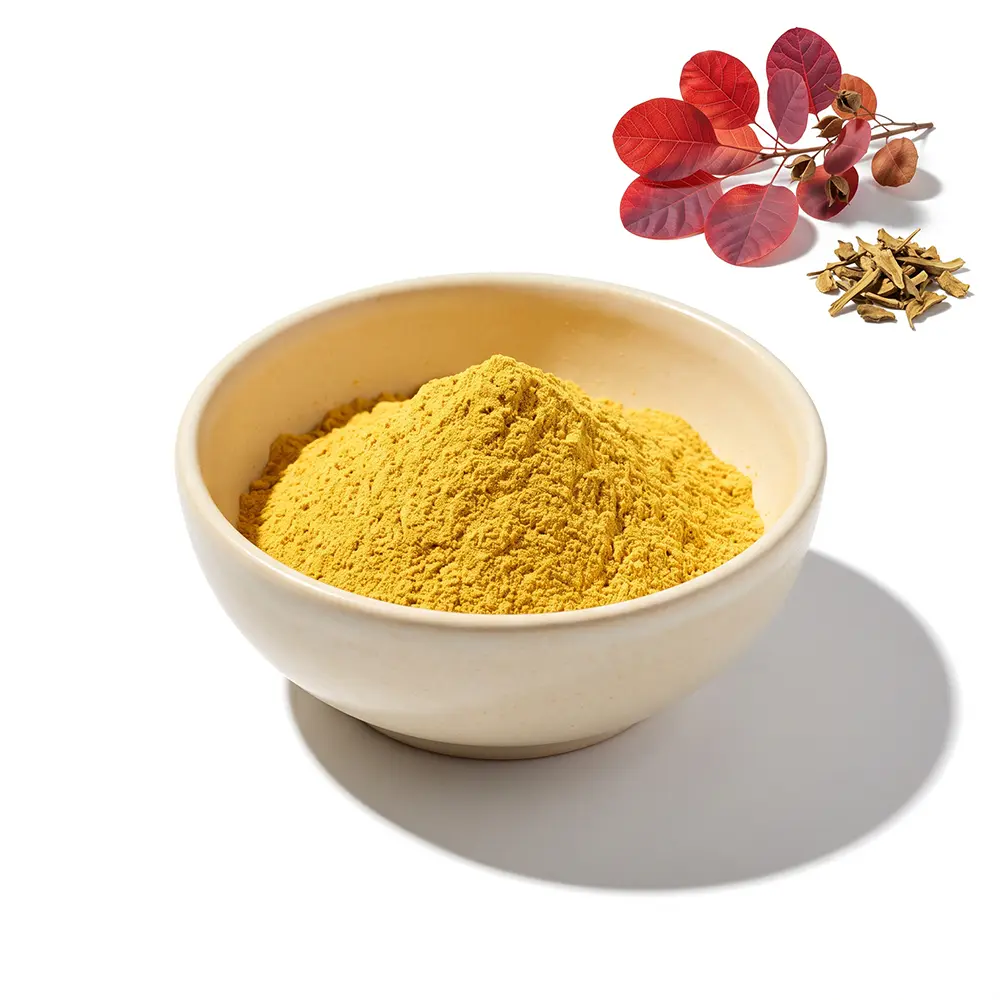
Bulk Fisetin (Smoke Tree Extract) Supplier — HPLC 50%, 85% & 98%, B2B Wholesale
Valeherb supplies fisetin bulk wholesale at 50%, 85%, and 98% purity by HPLC, extracted from the debarked stem bark of Cotinus coggygria Scop. (Smoke Tree, 黄栌), sourced from mountain forest regions of Shaanxi, Gansu, Hubei, and Sichuan at 1,200–2,600 m elevation. Fisetin (3,3′,4′,7-tetrahydroxyflavone) is a flavonoid most widely known in current research as the most potent senolytic compound identified in a landmark 2018 flavonoid screening study, alongside a well-established antioxidant research profile.[1]
On this page: product specifications, why bark and not leaf, stability and storage, research background, formulation applications, sourcing criteria, and regulatory guidance.
Product Specifications
| Parameter | Specification |
|---|---|
| CAS Number | 528-48-3 |
| Molecular Formula | C₁₅H₁₀O₆ |
| Molecular Weight | 286.24 g/mol |
| Purity | 50%, 85%, or 98% by HPLC |
| Appearance | Bright yellow needle-shaped crystalline powder, odourless |
| Particle Size | 80 mesh pass |
| Source | Cotinus coggygria Scop. debarked stem bark |
| Shelf Life | 24 months, sealed food-grade aluminium foil vacuum packaging |
Why Bark, Not Leaf
Fisetin concentration varies dramatically by plant part within Cotinus coggygria. Comparative phytochemical analysis found sulfuretin and fisetin present at meaningfully higher levels in bark extracts, while occurring only in trace amounts in leaf extracts — with these compounds not detected at all in flower extracts.[2] This is why commercial fisetin extraction sources debarked stem bark rather than leaf material, and why “smoke tree extract” and “smoke tree leaf extract” are not equivalent specifications for buyers targeting standardized fisetin content.
From Crude Extract to 98% Monomer: Why Three Grades Exist
Raw Cotinus coggygria bark contains fisetin only in low natural concentration, alongside related flavonoids (sulfuretin, fustin), polysaccharides, and resins. A first-stage ethanol/water extraction yields a crude concentrate where fisetin typically accounts for only a few percent of dry weight. Reaching the 50%, 85%, and 98% grades requires progressively more intensive downstream purification — degreasing, ethyl acetate partition to remove water-soluble impurities, and column chromatography to isolate the fisetin-specific fraction, followed by preparative chromatography and recrystallization for the highest-purity grades. Each grade therefore reflects a genuinely different level of processing investment, not simply a diluted version of the same material. For the full technical breakdown of this purification pathway, see How Fisetin Is Extracted and Purified from Smoke Tree Bark.
Stability and Storage
Fisetin’s stability profile is well characterised through accelerated and long-term testing on our own production batches. Understanding these sensitivities is essential for both storage and downstream formulation.
| Condition | Finding |
|---|---|
| Heat (sealed, 40°C) | Stable — 98.19% content retained after 10 days, minimal quality change |
| Heat (open, 60°C) | Sensitive — content dropped to 95.32% with visibly darkened colour after 10 days; open high-heat exposure accelerates oxidative degradation |
| Humidity (sealed, 75% RH) | Stable — no caking or discolouration after 10 days |
| Humidity (open, 90% RH) | Sensitive — noticeable moisture absorption in unsealed conditions |
| Light (4500 lux) | Sensitive — content dropped to 94.15% with visible darkening after 10 days of continuous exposure; light protection is essential |
| pH 3.0–5.0 (aqueous-alcoholic solution) | Stable — less than 1.2% content loss after 72 hours |
| pH 7.0 (neutral) | Mild degradation — approximately 3.7% content loss after 72 hours |
| pH ≥9.0 (alkaline) | Severe degradation — solution discoloured within 24 hours; more than 20% content loss by 72 hours |
Research Background
Provided as scientific context for formulators, not as claims for any Valeherb product.
Senolytic Research
Yousefzadeh et al. (2018) screened ten flavonoid polyphenols for senolytic activity in senescent murine and human fibroblasts, finding fisetin the most potent of those tested — notably more potent than quercetin, a structurally related flavonoid frequently discussed alongside it in the research literature. For a full compound-level comparison, see Fisetin vs Quercetin: A Senolytic Flavonoid Comparison. In progeroid and aged wild-type mice, fisetin reduced senescence markers across multiple tissues and was associated with improved health span and extended median lifespan in the treated animal model.[1] These are preclinical animal and cell-culture findings. Published human clinical trial data specific to senolytic outcomes remains extremely limited — reviews of the current human trial landscape note that dosing protocols and study designs vary considerably, and no peer-reviewed human trial has yet reported a confirmed senolytic endpoint.[3] This should be read as an active, early-stage area of research rather than an established human effect.
Joint and Musculoskeletal Research
Senescent cell accumulation in joint tissue has been studied as a contributing factor in osteoarthritis progression in animal models, and fisetin’s senolytic mechanism has motivated clinical trial research specifically in knee osteoarthritis, registered with clinical trial authorities and conducted at academic orthopedic research institutions.[4] This research uses clinical trial dosing protocols under medical supervision that are not equivalent to typical dietary supplement use, and results are not detailed here; formulators should not infer a specific effective dose from this research area.
Formulation Applications
- Anti-aging and antioxidant cosmetic serums: Positioned on published antioxidant and free-radical-scavenging research; typical use in weakly acidic (pH 4.0–5.5) leave-on formats. Pairs with vitamin C derivatives and niacinamide in brightening/antioxidant serum systems
- Soothing and sensitive-skin formulations: Anti-inflammatory-pathway research supports inclusion in calming and post-sun-exposure skin-care formats
- Natural colorant for color cosmetics: Fisetin’s bright yellow crystalline form provides a natural yellow-brown tone for lipstick, eyeshadow, and blush formulations as an alternative to synthetic dyes
- Antioxidant dietary supplement capsules: General antioxidant-positioned formulations; formulators should base specific dosing on their own regulatory and safety review rather than clinical trial dosing protocols, which are not equivalent to supplement use levels
- Sports and recovery formulations: Antioxidant and inflammatory-pathway research relevant to post-exercise recovery positioning
Sourcing Criteria
| Criterion | What to Require |
|---|---|
| Plant Part | Cotinus coggygria debarked stem bark confirmed on COA — not leaf material, which carries only trace fisetin content |
| Purity Verification | 85% or 98% fisetin content by HPLC per batch, benchmarked against a ≥99.8% reference standard |
| Packaging | Sealed, light-protected, food-grade aluminium foil vacuum packaging — given documented sensitivity to open-air heat, humidity, and light exposure |
| Stability Data | Request batch-specific accelerated (40°C/75% RH) and long-term (25°C/60% RH) stability data, plus pH stability range, particularly for buyers formulating aqueous or high-pH systems |
| Third-Party COA | Fisetin content (HPLC), total impurities, loss on drying, heavy metals, pesticide residues, microbial limits, moisture — per production batch from accredited laboratory |
Regulatory Guidance
- US (DSHEA): Antioxidant structure/function claims are supportable with published research — self-substantiation and FDA disclaimer required. “Senolytic,” anti-aging cellular-repair, and disease treatment/prevention claims (including for osteoarthritis or any other diagnosed condition) require drug-level approval and are not supported by current DSHEA positioning. FDA-registered facility (21 CFR Part 111)
- Cosmetics (EU/US): INCI name Cotinus Coggygria Bark Extract or Fisetin (as applicable). Confirm safety assessment under EU Cosmetics Regulation 1223/2009 for your specific formulation and concentration
- China (ChP): Cotinus coggygria bark has traditional and regulatory documentation in Chinese frameworks; export documentation available
- General: Given the active clinical trial research landscape around fisetin, Valeherb recommends conservative, research-grounded claim positioning and independent regulatory review before finalizing any finished-product marketing, particularly for joint-health or cellular-aging-related claims


