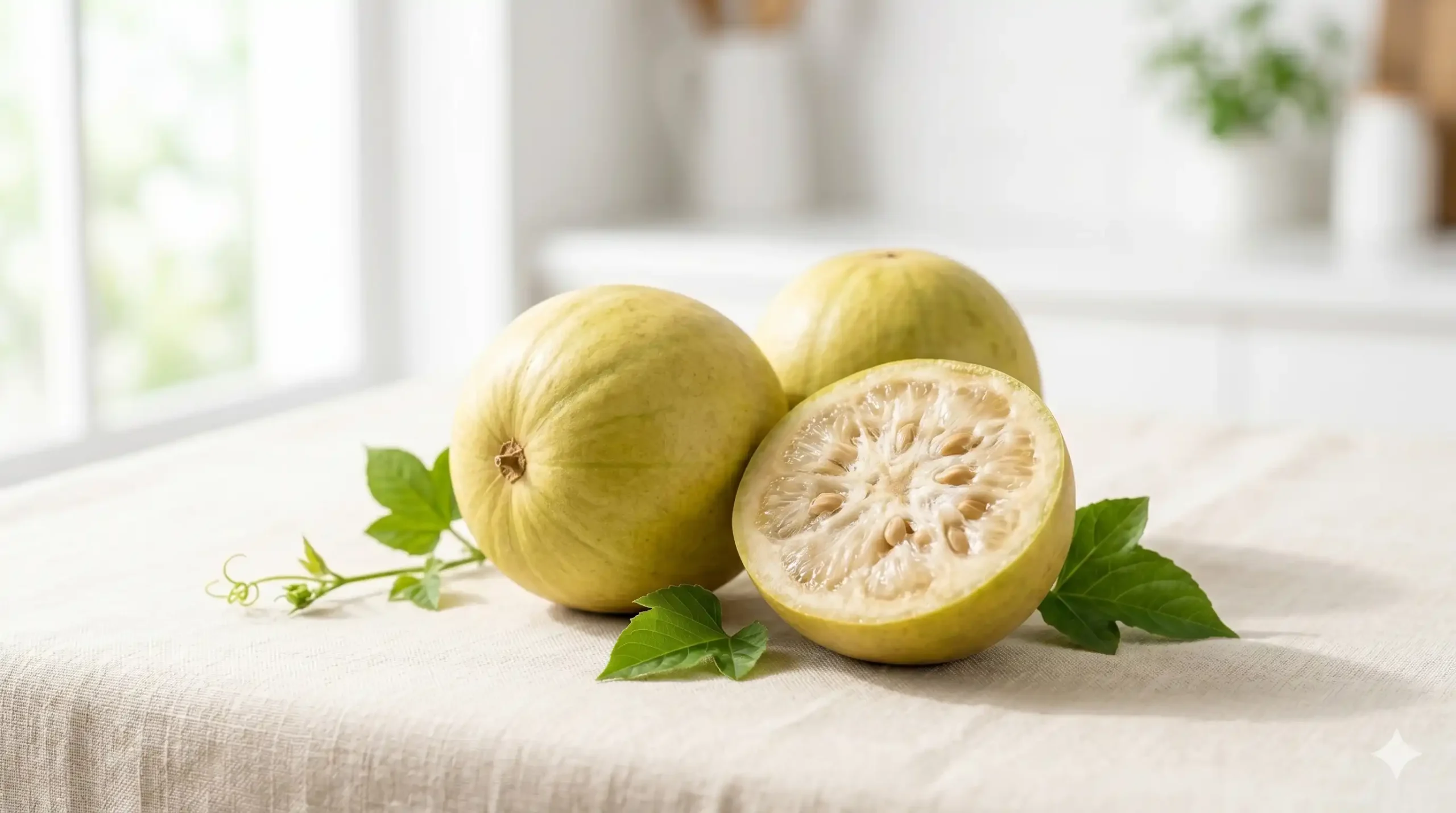

Quick Reference: Mogroside V Specifications
- Primary application grades: 25%, 40%, 50%, 60%, 80–85% Mogroside V by HPLC
- Sweetness potency (vs. 5% sucrose): 250–425× for high-purity grades (≥50%)
- Thermal stability: Stable to 150°C for 30 minutes; pH optimum 4–6; pH stable 2–9
- Regulatory status: FDA GRAS (GRN 000301); approved EU, Canada, China, ANZ
- Minimum COA requirements: Mogroside V % (HPLC), heavy metals (ICP-MS), pesticide residues, microbial limits
Inside every Siraitia grosvenorii fruit — the subtropical gourd cultivated for centuries in the mountains of Guangxi and Hunan — lies a family of triterpene glycosides responsible for one of the most technically compelling sweetening profiles in modern food science. The most commercially significant member of that family is mogroside V: the dominant bioactive compound that determines sweetness intensity, formulation suitability, and the commercial grade of every monk fruit extract sold globally. Understanding its chemistry, its industrial stability, and the sourcing decisions that flow from its purity designations is foundational knowledge for any formulator or procurement specialist working with this ingredient.
Mogroside V: Chemical Identity and Structure
Mogrosides are cucurbitane-type triterpene glycosides — complex molecules built from a 30-carbon cucurbitacin-derived aglycone core (mogrol) to which multiple glucose units are attached at specific hydroxyl positions. The nomenclature follows the number of glycoside units: mogroside II carries two glucose chains; mogroside III carries three; mogroside V carries five.[1]
That structural difference is not merely academic. Sweetness intensity scales non-linearly with glycoside number: mogroside V is approximately 250 to 425 times sweeter than a 5% sucrose solution, while mogroside II and III deliver substantially less sweetness and contribute bitter or herbaceous off-notes at elevated concentrations. This is why mogroside V percentage — not total mogroside content — is the specification that governs formulation utility and commercial grade.
| Property | Value |
|---|---|
| Molecular formula | C₆₀H₁₀₂O₂₉ |
| Molecular weight | 1,287.43 g/mol |
| Aglycone core | Mogrol (cucurbitane-type triterpenoid) |
| Glycoside units | 5 glucose residues |
| Water solubility | 100% water soluble at all commercial purity grades |
| Sweetness vs. 5% sucrose | 250–425× (grade-dependent) |
From Fruit to Powder: The Extraction and Purification Process
Commercial mogroside V production follows a well-defined aqueous extraction and chromatographic purification sequence. Fresh or properly dried Siraitia grosvenorii fruit is crushed and subjected to hot-water extraction, yielding an aqueous fraction containing total mogrosides alongside co-extractables including sugars, organic acids, and non-sweet glycoside fractions.[2]
The critical separation step is macroporous resin adsorption chromatography, in which the crude aqueous extract passes through a column packed with non-polar or weakly polar resin. The mogroside fraction is selectively retained and subsequently eluted with food-grade ethanol, while the majority of sugars and water-soluble impurities are washed through. Multiple adsorption-elution passes are required to reach purity grades above 40–50% mogroside V — this explains the non-linear cost increase as purity rises: each additional purification cycle adds processing time, solvent consumption, and yield loss.
| Commercial Grade | Mogroside V (%) | Sweetness vs. Sucrose | Typical Application |
|---|---|---|---|
| V25 (Standard) | ~25% | ~100–150× | Cost-sensitive beverage blends, bulk food fortification |
| V40 (Mid-Grade) | ~40% | ~150–200× | Nutrition bars, mainstream RTD beverages |
| V50–V55 (High-Purity) | 50–55% | ~200–300× | Premium supplements, precision food, pharma oral liquids |
| V80–V85 (Ultra-High) | 80–85% | ~300–425× | High-potency formats, analytical reference applications |
Flavor Chemistry: Why Purity Grade Determines Sensory Performance
A persistent concern among formulators new to monk fruit is aftertaste — the metallic finish of saccharin, the licorice note of stevia Reb A, or the cooling sensation of certain synthetic sweeteners. High-purity mogroside V does not reproduce these characteristics. Its glycoside structure activates T1R2/T1R3 sweet taste receptor heterodimers without engaging the bitter receptor pathways (TAS2R family) that generate metallic or chemical finishes at comparable concentrations.[1]
The practical flavor difference across grades is significant and technically grounded. Lower-purity extracts (V25–V40) retain co-extractable plant compounds — including mogroside II, mogroside III, and non-glycoside cucurbitacin-related fractions — that contribute earthy, grassy, or bitter background notes. As purification depth increases, these off-note contributors are progressively removed, and the sweetness signal becomes cleaner and more sucrose-like in its temporal profile.
- V25–V40 grades: Noticeable earthy or herbaceous background; higher use rates required for target sweetness; batch-to-batch flavor variation is more pronounced
- V50–V55 grades: Clean, rounded sweetness with rapid onset and minimal aftertaste; preferred sweet profile for citrus, tea, and transparent aqueous systems
- V80–V85 grades: Near-sucrose temporal profile; exceptional flavor neutrality; used where ingredient contribution must be imperceptible beyond sweetness
Sweetness Profile: Sensory Benchmarking vs Stevia and Sucrose
Knowing that mogroside V is “clean” is one thing — understanding exactly how it behaves on the palate compared to stevia and sucrose is what enables precise formulation decisions. Valeherb’s internal sensory profiling data, benchmarked across six flavor dimensions and three temporal parameters, documents where mogroside V excels and where formulators need to account for its unique characteristics.
Six-Dimension Flavor Profile
Sensory evaluation across six flavor dimensions confirms that mogroside V at 50% purity tracks most closely to sucrose, with one distinctive differentiator: a characteristic pleasant sweetness return that sets it apart from both stevia and sucrose.
| Flavor Dimension | Mogroside V (50%) | Stevia (Reb A) | Sucrose |
|---|---|---|---|
| Mildness | High — clean, non-intrusive onset | Moderate — mild menthol undertone | High |
| Freshness | High — bright, immediate | Moderate | Moderate |
| Astringency | Very low | Low–moderate at higher doses | None |
| Bitterness | Very low | Moderate — perceptible above 0.05% w/v | None |
| Sweetness return | Distinctive — pleasant lingering finish | Present, accompanied by licorice note | Short, clean finish |
| Herbal off-note | Minimal at recommended use rates | Detectable at standard use rates | None |
Sweetness Time Curve: Onset, Peak, and Duration
Temporal sweetness profiling — measuring perceived sweetness intensity over time after ingestion — reveals commercially significant differences between the three sweeteners at equivalent perceived sweetness levels:
- Sucrose: Rapid onset, peaks at ~3–5 seconds, fully decays by ~15 seconds. The benchmark clean temporal profile.
- Mogroside V: Similar onset to sucrose, peaks at ~5–8 seconds, with a characteristic pleasant sweetness return extending to ~28–32 seconds. This return reads as fullness rather than aftertaste — an asset in tea and fruit-forward RTD applications.
- Stevia (Reb A): Slightly slower onset, similar peak intensity, but persists up to ~38–42 seconds with a licorice-adjacent note that intensifies as sweetness decays. This extended tail is the primary sensory liability in stevia-forward formulations.
Industrial Stability: Thermal, pH, and Concentration Performance
For formulators, the value of any high-intensity sweetener is inseparable from its processing stability. Valeherb’s stability testing data for MV50 — conducted across a range of temperatures, pH conditions, and concentration levels — documents the precise operating boundaries relevant to commercial food and beverage production.[2]
1. Thermal Stability
Internal thermal stability testing of MV50 (V50% content measured by HPLC before and after 30-minute isothermal holds) confirms the following performance profile:
| Temperature (30 min hold) | Mogroside V retention | Formulation verdict |
|---|---|---|
| Baseline (pre-heating) | ~51% | Reference point |
| 120°C | ~51% — no measurable loss | ✅ Full stability — UHT, retort, hot-fill |
| 150°C | ~50% — minimal loss | ✅ Stable — baking, extrusion upper range |
| 180°C | ~42% — measurable degradation | ⚠️ Partial loss — compensate dosage by ~15–20% |
The effective upper processing limit with no meaningful sweetness loss is 150°C for 30 minutes — covering HTST pasteurization (72°C/15 s), UHT (135°C), hot-fill (85–92°C), and conventional baking (internal product temperatures of 90–100°C). At 180°C and above, a dosage compensation of approximately 15–20% is recommended to offset partial mogroside V degradation at exposed surfaces.

2. pH Stability and Sweetness Optimization
MV50’s sweetness potency follows a defined curve across pH, with a practical optimum that aligns well with commercial beverage production:
| pH Range | Sweetness behavior | Typical application |
|---|---|---|
| pH < 2 | Measurable sweetness decline | Evaluate case-by-case |
| pH 2–4 | ~190–210× sucrose; stable, slight upward trend | Carbonated soft drinks, acidic RTDs |
| pH 4–6 (optimum) | Peaks at ~230–240× at pH 4.5; best flavor quality | Citrus RTDs, functional drinks, tea beverages |
| pH 6–9 | ~190–200×; gradual decline, fully functional | Dairy analogs, protein drinks, neutral formats |
| pH > 9 | Sweetness decline accelerates | Alkaline applications — bench testing advised |
Peak sweetness occurs at pH 4.5 — precisely the acidity range of most commercial citrus and tea beverages. Across pH 2–9, sweetness variation stays within approximately ±20% of peak, meaning no reformulation is required when transitioning between typical beverage formats.

3. Concentration and Sweetness Potency
Sweetness potency declines as MV50 concentration increases — a characteristic of all high-intensity sweeteners with direct dosage implications:
| MV50 concentration | Sweetness potency (× sucrose) | Practical interpretation |
|---|---|---|
| 100–500 ppm (0.01–0.05% w/v) | ~180–200× | Optimal range — most beverage applications |
| 500–800 ppm | ~160–180× | Upper beverage range; sweetness return more perceptible |
| 800–1,200 ppm | ~120–160× | Confectionery and powder formats; efficiency declining |
| >1,500 ppm | ~50–100× | Significant potency drop; off-note risk increases |
MV50 delivers peak sweetness efficiency in the 100–500 ppm range. Working above 600 ppm returns diminishing sweetness per gram while increasing off-note risk — for applications requiring higher sweetness intensity, a co-sweetener system with erythritol or allulose is more cost-effective than increasing MV50 dosage alone.

For application-specific inclusion rates and co-ingredient blend ratios, see the companion guides: MV50 Inclusion Rate Guide and Monk Fruit Sweetener Blend formulation guide.
Bioactivity Beyond Sweetness: What Peer-Reviewed Research Documents
Mogroside V is not a functional-free sweetener. Published research has established a range of bioactive properties that create formulation positioning opportunities beyond calorie and sugar reduction.
Antioxidant Activity
In vitro studies consistently demonstrate DPPH and ABTS radical scavenging activity for mogroside V at concentrations relevant to food fortification levels. The glycoside’s antioxidant mechanism is linked to hydrogen atom transfer and electron donation capacity, with potency comparable to established polyphenol antioxidants in cell-free assay models.[3]
Anti-Inflammatory Potential: NF-κB and AMPK Pathways
Preclinical research has confirmed mogroside V’s capacity to attenuate inflammatory signaling through two mechanistically distinct pathways. First, mogrosides inhibit NF-κB pathway activation, reducing downstream pro-inflammatory cytokine production (TNF-α, IL-1β, IL-6) in macrophage and hepatocyte cell models. Second, AMPK activation by mogroside V contributes to both metabolic and anti-inflammatory effects — a pathway of particular relevance for functional food positioning targeting metabolic syndrome and insulin sensitivity.[4]
Gut Microbiota and Glycemic Modulation
A 2025 study published in Food & Function (Huang et al.) demonstrated that mogroside V supplementation in a murine model of type 2 diabetes improved gut microbiota diversity, increased SCFA-producing bacterial populations, and ameliorated glucose homeostasis markers including fasting blood glucose and insulin resistance indices.[5] These findings suggest prebiotic-adjacent activity as a secondary mechanism supporting metabolic health product positioning.
The zero glycemic index of mogroside V is its most commercially deployable metabolic property. Mogrosides are not metabolized through conventional carbohydrate pathways — no insulin response, no blood glucose elevation, and no caloric contribution.
Regulatory Status and Safety Profile
The U.S. FDA granted monk fruit extract GRAS status under notification GRN 000301 in 2010, based on acute, subchronic, and chronic toxicology data in multiple animal models, genotoxicity studies, and metabolic characterization. No adverse effects were identified at doses far exceeding dietary exposure. Subsequent GRAS notifications (GRN 359, 522, 556, 627) have expanded approved uses without any revision to the safety conclusion.
Regulatory acceptance extends to the EU (Novel Food approval), Canada (approved as sweetener and flavor enhancer), China (historical-use status), and Australia/New Zealand (FSANZ-approved). Unlike polyol sweeteners, mogroside V is employed at concentrations — typically 0.005–0.05% w/v in beverages — where gastrointestinal tolerance concerns are not clinically meaningful.
Sourcing Specifications: What B2B Buyers Must Verify
- Mogroside V % by HPLC (per batch): The analytical method (HPLC with UV detection at 203 nm or ELSD) must be disclosed alongside the result — total mogroside content measured by colorimetric methods significantly overstates mogroside V content and is not an acceptable substitute
- Heavy metal panel (ICP-MS): Lead, arsenic, cadmium, and mercury per batch, meeting USP <231> or EU maximum levels
- Pesticide residue screening: Multi-residue panel per batch for EU and US market compliance
- Microbial limits: Total aerobic plate count, yeast and mold, E. coli, Salmonella per batch
- Non-GMO and organic certification: Certification scope should specify the raw material, not only the manufacturing facility
Valeherb supplies these specifications with full per-batch documentation across every grade — see the Valeherb monk fruit extract product page for available grades and COA samples.
Frequently Asked Questions
What is mogroside V and how does it differ from other mogrosides?
Does mogroside V have side effects?
What mogroside V grade is appropriate for beverage formulations?
Is mogroside V stable in acidic beverages?
What is the difference between HPLC-verified mogroside V and total mogroside content?
How do I select the right co-ingredient blend when using MV50 in formulation?
References
[1] Pawar RS, Krynitsky AJ, Rader JI. Sweeteners from plants — with emphasis on Stevia rebaudiana (Bertoni) and Siraitia grosvenorii (Swingle). Analytical and Bioanalytical Chemistry, 405(13), 4397–4407 (2013). doi:10.1007/s00216-012-6693-0
[2] Guo Y, Chen X, Gong P, Long H, Wang J, Yang W, Yao W. Siraitia grosvenorii as a Homologue of Food and Medicine: A Review of Biological Activity, Mechanisms of Action, Synthetic Biology, and Applications in Future Food. Journal of Agricultural and Food Chemistry, 72(13), 6850–6870 (2024). doi:10.1021/acs.jafc.4c00018
[3] Suzuki YA, Murata Y, Inui H, Sugiura M, Nakano Y. Triterpene glycosides of Siraitia grosvenori inhibit rat intestinal maltase and suppress the rise in blood glucose level after a single oral administration of maltose in rats. Journal of Agricultural and Food Chemistry, 53(8), 2941–2946 (2005). doi:10.1021/jf0478105
[4] Li L, Zheng W, Wang C, Qi J, Li H. Mogroside V Protects against Hepatic Steatosis in Mice on a High-Fat Diet and LO2 Cells Treated with Free Fatty Acids via AMPK Activation. Evidence-Based Complementary and Alternative Medicine, 2020, 7826874 (2020). doi:10.1155/2020/7826874
[5] Huang H, Tian Y, Xue J, et al. Mogroside V improves gut microbiota composition and ameliorates type 2 diabetes in mice. Food & Function (2025). doi:10.1039/d4fo04446k