
Written by Jonathan · November 2026
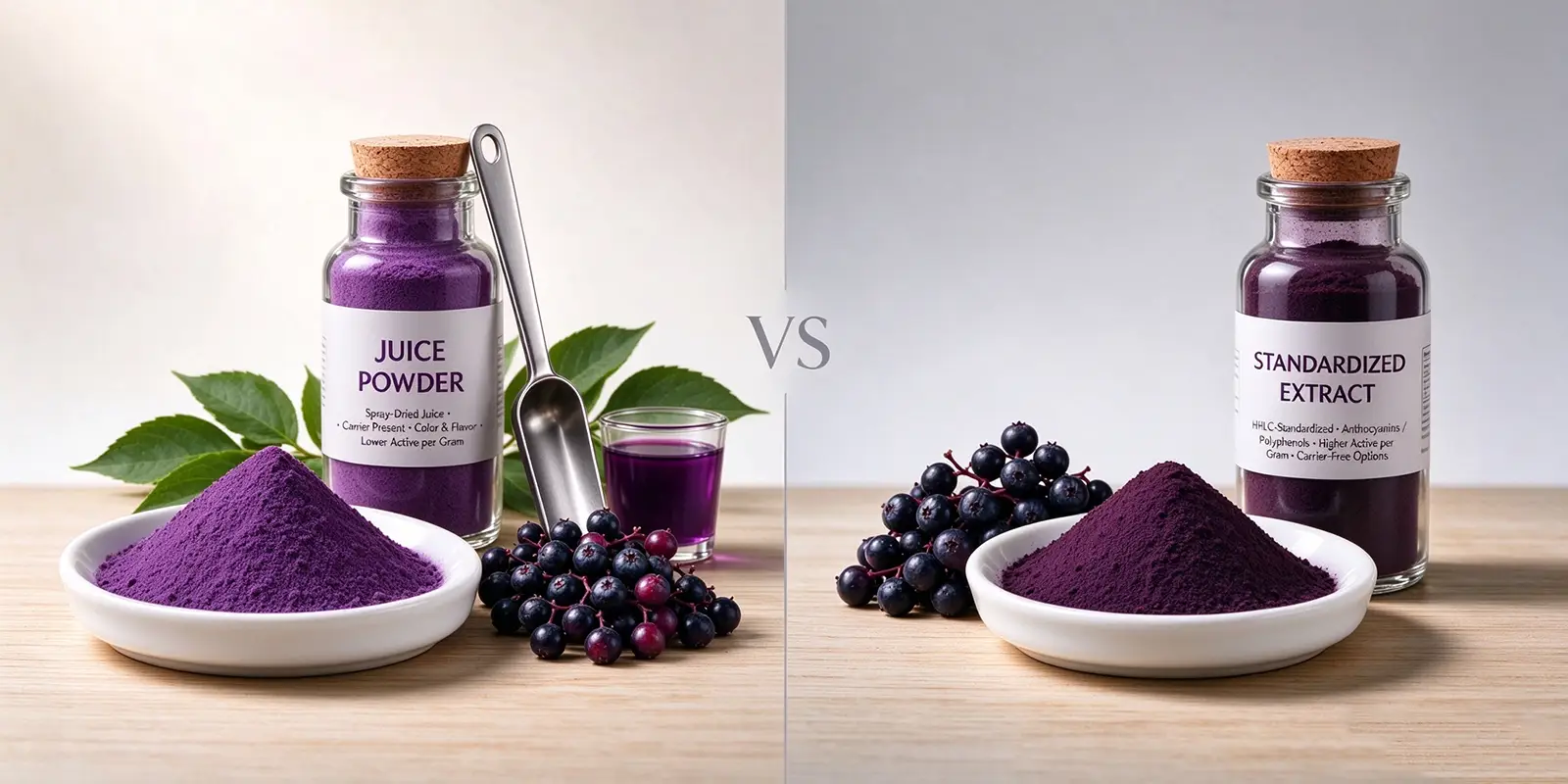
Elderberry powder is the fruit itself, or its juice, dried into a powder; elderberry extract is a concentrated ingredient standardized to a stated anthocyanin level. That is the core of the elderberry powder vs extract decision. A whole-fruit powder carries the berry’s fibre, sugars, acids and naturally occurring anthocyanins at fruit-level concentrations, while an extract trades the fruit matrix for a higher, specified pigment content. Which one fits depends on the label you need, the dose your format can carry and whether a number on a certificate of analysis (COA) is part of your claim.
In the elderberry powder vs extract choice, pick powder for a fruit ingredient with a simple label and natural colour; pick a standardized extract only when your format needs a guaranteed anthocyanin percentage in a small dose, and compare extracts only on the same test method.
Four Forms of Elderberry Ingredient Compared
Elderberry is sold in four powdered forms, and supplier listings often use the names interchangeably. The starting material and whether anything is concentrated or added are what separate them.
| Form | What it is | Carrier | Anthocyanin level | Typical declaration |
|---|---|---|---|---|
| Whole-fruit powder (freeze-dried or air-dried) | Ripe berries dried and milled | None | Natural fruit level | Elderberry |
| Elderberry juice powder | Pressed juice spray-dried onto a carrier | Maltodextrin or similar | Below whole fruit per gram, diluted by carrier | Elderberry juice, maltodextrin |
| Elderberry concentrate powder | Juice concentrated before drying | Usually | Higher than juice powder, not standardized | Elderberry juice concentrate, carrier |
| Elderberry extract powder | Solvent-extracted and often resin-purified fraction | Sometimes | Standardized to a stated percentage | Elderberry extract |
Elderflower powder and extract come from the flowers of the same plant, not the berries, and are a separate ingredient. Valeherb supplies black elderberry (Sambucus nigra) in the first two forms, freeze-dried whole-fruit powder and spray-dried juice powder; we do not offer standardized elderberry extracts or concentrates.
What Elderberry Contains and Why It Matters for Processing
The deep purple of elderberry comes from cyanidin-based anthocyanins. In European elderberry the two main pigments are cyanidin-3-sambubioside and cyanidin-3-glucoside, and across cultivars grown in the same trial, total anthocyanins ranged from 106 to 444 mg per 100 g of fresh berries[1]. Fresh elderberries are about 79.8% water and carry 7.0 g of dietary fibre per 100 g[2], so fibre accounts for roughly a third of the fruit’s dry matter.
Two practical consequences follow. First, a whole-fruit powder carries fruit-level pigment: dividing the reported species means (173 and 306 mg per 100 g fresh) by the fruit’s dry matter gives roughly 0.9–1.5% anthocyanins on a dry basis, measured by pH differential. This is our calculation from the cultivar data, not a specification. Second, anthocyanins are sensitive to heat, light and pH, so the drying method and storage decide how much of that natural level survives into the finished powder.
Elderberry Powder vs Extract: Side-by-Side Comparison
The forms differ less in what they contain than in how much of each component they deliver per gram. The comparison below is qualitative because extract and concentrate specifications vary widely between suppliers.
| Parameter | Whole-fruit powder | Juice powder | Standardized extract |
|---|---|---|---|
| Anthocyanins | Natural fruit level | Diluted by carrier | Specified, higher |
| Dietary fibre | Retained | Largely removed with pulp | Removed |
| Solubility | Disperses; fibre settles | Dissolves clear | Dissolves; depends on carrier |
| Flavour | Full tart, earthy berry | Milder berry | Varies by grade and carrier |
| Dose needed for colour or fruit content | Highest | High | Lowest |
| Label | Single ingredient | Carrier declared | “Extract” declared |
| Best fit | Fruit-forward foods, clean-label blends | Drink mixes and syrups | Small-dose capsules and tablets |
When comparing juice powder quotes, cost the elderberry solids, not the kilogram of powder: subtract moisture and the carrier percentage from 100%, then divide the price per kilogram by that fraction. A juice powder with a large carrier share can look inexpensive per kilogram while costing more per unit of fruit.
Spray-dried vs freeze-dried elderberry powder
Freeze dried elderberry powder is made from the whole berry without a carrier and keeps the most colour; spray-dried elderberry powder is made from juice and needs a carrier because the juice is too rich in sugars and acids to dry on its own. Freeze-drying generally retains more of the fruit’s polyphenols, and spray-dried results depend heavily on which carrier is used, which is why the carrier should be named on any spray-dried specification. The grade-by-grade detail for our two powders is on the elderberry fruit powder specification page.
Why Elderberry Anthocyanin Numbers Don’t Match Between Suppliers
This is where most elderberry powder vs extract comparisons go wrong. Two COAs reporting anthocyanin content for elderberry can disagree even on the same material, because the result depends on the test method and on which compound the result is expressed as. Comparing percentages without both details is not a like-for-like comparison.
| Method | What it measures | Effect on the number |
|---|---|---|
| Single-pH UV/visible absorbance | All material absorbing near 520–535 nm at low pH | Includes polymeric and degraded pigment, so tends to read high |
| pH differential (AOAC 2005.02) | Monomeric anthocyanins only, from the absorbance difference between pH 1.0 and 4.5 | Excludes polymeric pigment; expressed as a chosen reference compound |
| HPLC | Individual anthocyanins separated and summed | Depends on which peaks are counted and which standard is used |
The pH differential method excludes polymerized pigments because they absorb at both pH 1.0 and 4.5[3]; a method that reads absorbance at a single low pH has no such correction. The reference compound matters as well. The AOAC calculation expresses results as cyanidin-3-glucoside using a molecular weight of 449.2 g/mol. Expressing the same absorbance as cyanidin chloride (322.70 g/mol) changes the molecular-weight term by a factor of about 1.39, before any difference in absorptivity is considered. The method paper itself requires the wavelength, molecular weight and absorptivity to be stated whenever another reference pigment is used.
Ask for the method
UV single-pH, pH differential or HPLC, with the method reference.
Ask for the reference compound
Cyanidin-3-glucoside, cyanidin-3-sambubioside or cyanidin chloride, with the molecular weight used.
Confirm the basis
As-is or dry basis, and whether a carrier is included in the weight.
Retest on one method
Send samples from each supplier to the same laboratory before treating any two figures as comparable.
Is Elderberry Powder Safe? Cyanogenic Glycosides and Processing
Elderberry’s food-safety question is cyanogenic glycosides, compounds that can release hydrogen cyanide, and the risk sits mainly in stems, leaves and unripe fruit rather than in ripe, processed berries. In American elderberry, stems showed the highest total cyanogenic potential (37.4 μg CN⁻ equivalents per g), whole green berries the second highest (25.6 μg/g) and ripe berries the lowest, while a commercially processed elderberry juice had no quantifiable cyanogenic glycosides or cyanide[4]. That study measured the American subspecies, so it shows where the compounds concentrate rather than giving values for European fruit.
Heat treatment reduces what remains. A review of S. nigra processing reported reductions of 44% in juice, 80% in tea and up to 96% in liqueur and spread at 100–105 °C, citing earlier studies[5]. The best-documented incident illustrates the failure mode: in 1983, eight people in Monterey County, California, were flown to hospital after drinking juice pressed from wild elderberries crushed together with leaves and branches; all recovered, and the leaves and stems were considered the likely cause[6].
European vs American Elderberry: Colour Stability
European black elderberry (Sambucus nigra) and American elderberry (S. canadensis, also treated as S. nigra subsp. canadensis) differ most in pigment structure, which affects colour stability more than colour shade. In a side-by-side cultivar study, every American sample had more than 60% acylated anthocyanins, led by cyanidin 3-(E)-p-coumaroyl-sambubioside-5-glucoside, while the European cultivars had none; the authors noted that acylated pigments are more colour-stable in processing.
For buyers, that means sambucus elderberry powder from European fruit performs best as a colour in acidic, cool, low-light products such as drink mixes and gummies, and fades faster in near-neutral or heat-intensive applications. Valeherb supplies black elderberry powder from S. nigra only.
Choosing an Elderberry Form by Application
In practice, the elderberry powder vs extract question is settled by format more than any other factor: how much powder the format can carry, whether it must dissolve clear, and whether the label must read as a single fruit ingredient.
| Application | Suggested form | Mesh | Formulation note |
|---|---|---|---|
| Gummies | Juice powder | Fine | Dissolves into the syrup phase; low pH helps hold the purple |
| Capsules and sachets | Whole-fruit powder, or extract for small doses | 80–120 | Whole fruit keeps a single-ingredient label; extract fits more anthocyanin per capsule |
| Drink mixes and shots | Juice powder | Fine | Clear dispersion without sediment |
| Elderberry syrup from powder | Juice powder or whole-fruit powder | 40–60 | Whole fruit adds body but settles; include a heat step in the process |
| Elderberry powder tea blends | Coarse whole-fruit powder | Coarse | Coarse particles stay in the bag; juice powder suits instant tea |
| Natural colour | Whole-fruit or juice powder | 40–60 | Best in acidic, cool, low-light products |
| Bars, granola, bakery | Coarse whole-fruit powder | Coarse | Visible fruit pieces; alkaline batters shift the colour |
Elderberry powder vs syrup is a format question, not a quality one: syrup is a finished liquid with added sugar and water, while powder is the ingredient a syrup or drink mix can be made from. Where a formula needs a standardized anthocyanin grade and elderberry fruit powder cannot reach the target dose, a purified berry extract is the usual route; our aronia, blueberry and elderberry comparison sets out how the three berries differ, and aronia berry extract is the standardized anthocyanin option in our range.
Specify the form, the drying method, the carrier share and the anthocyanin test method together; any one of them alone does not define an elderberry ingredient.
Frequently Asked Questions
Is elderberry powder the same as elderberry extract?
No. Elderberry powder is the dried fruit or dried juice, with anthocyanins at the level the fruit naturally contains. Elderberry extract is a concentrated fraction, usually standardized to a stated anthocyanin percentage, so a much smaller dose delivers the same pigment. Powder keeps the fruit’s fibre, sugars and acids and can be labelled simply as elderberry, while an extract is declared as an extract.
Is elderberry powder safe?
From a food-safety standpoint, the concern with elderberry is cyanogenic glycosides, which concentrate in stems, leaves and unripe berries. Food-grade elderberry powder should be made from ripe, destemmed and processed fruit; studies have found no quantifiable cyanogenic glycosides in commercially processed elderberry juice, and heat treatment reduces them further. Buyers should ask suppliers how ripeness, destemming and heat treatment are controlled and whether cyanogenic testing is available.
How much elderberry powder equals 1 lb of dried elderberries?
For whole-fruit powder, the conversion is close to one to one by dry matter, adjusted for moisture: multiply the weight of dried berries by (1 − berry moisture) ÷ (1 − powder moisture). For example, if dried berries are at 10% moisture and the powder at 5%, 1 lb of dried berries corresponds to about 0.95 lb of powder. Juice powders and extracts have no fixed equivalence because the fibre is removed and a carrier or concentration step is added.
How is elderberry powder made?
Industrially, ripe elderberries are harvested, destemmed and sorted, then processed in one of two ways. For whole-fruit powder they are dried, by freeze-drying for the highest colour retention, and milled to the required mesh. For juice powder the berries are pressed, the juice is mixed with a carrier such as maltodextrin and spray-dried. About 4.7 kg of fresh berries yields 1 kg of freeze-dried whole-fruit powder.
Should I choose spray-dried or freeze-dried elderberry powder?
Choose freeze-dried elderberry powder when you need the deepest colour, full fruit flavour, a single-ingredient label or an organic option. Choose spray-dried elderberry juice powder when the product must dissolve clear, as in drink mixes and gummies, and a declared carrier is acceptable. Compare the two on cost per unit of fruit solids rather than price per kilogram, because the carrier dilutes the juice powder.
Both grades are available as black elderberry from S. nigra, with organic certification on the freeze-dried grade and standard or custom mesh. Send your format and target specification through the elderberry fruit powder page for a matched grade and lot documentation.
References
[1] Lee J, Finn CE. Anthocyanins and other polyphenolics in American elderberry (Sambucus canadensis) and European elderberry (S. nigra) cultivars. J Sci Food Agric. 2007;87:2665–2675. doi:10.1002/jsfa.3029
[2] U.S. Department of Agriculture, Agricultural Research Service. Elderberries, raw (SR Legacy, FDC ID 171727). FoodData Central. https://fdc.nal.usda.gov/food-details/171727/nutrients (government food composition database, not peer-reviewed literature)
[3] Lee J, Durst RW, Wrolstad RE. Determination of total monomeric anthocyanin pigment content of fruit juices, beverages, natural colorants, and wines by the pH differential method: collaborative study. J AOAC Int. 2005;88(5):1269–1278. doi:10.1093/jaoac/88.5.1269
[4] Appenteng MK, Krueger R, Johnson MC, Ingold H, Bell R, Thomas AL, Greenlief CM. Cyanogenic glycoside analysis in American elderberry. Molecules. 2021;26(5):1384. doi:10.3390/molecules26051384
[5] Avena A, Ozola L, Ķeķe A. Sambucus nigra fruits and their processing solutions: a review. Research for Rural Development. 2024;39:67–72. doi:10.22616/RRD.30.2024.011 (conference proceedings review; reduction figures cited from earlier primary studies)
[6] Centers for Disease Control. Poisoning from elderberry juice — California. MMWR Morb Mortal Wkly Rep. 1984;33(13):173–174. https://www.cdc.gov/mmwr/preview/mmwrhtml/00000311.htm (government surveillance report, not peer-reviewed; read in original)
Jonathan
Content Editor, Valeherb. Specializing in botanical ingredient science communication for B2B nutraceutical and functional food markets.
This content is provided for informational and B2B sourcing purposes only and has not been evaluated by the FDA. It is not intended to diagnose, treat, cure, or prevent any disease. © 2026 Valeherb. All rights reserved.