

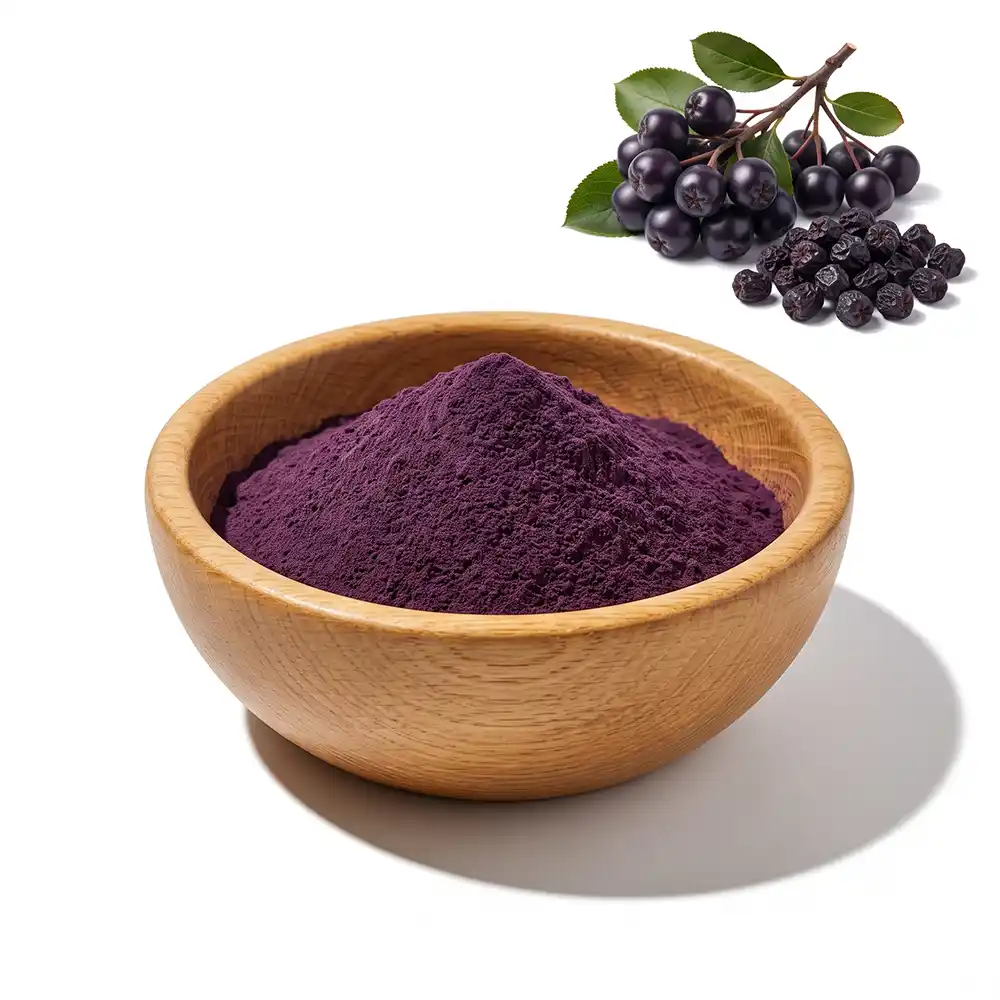
Bulk Aronia Berry Extract Supplier — Black Chokeberry, Anthocyanins 5% & 25%, 4:1 / 10:1 / 30:1 Ratio Extracts, B2B Wholesale
Valeherb supplies Aronia berry extract bulk wholesale — also known as black chokeberry extract — in two product lines: anthocyanin-standardized extracts (5% and 25% by HPLC) and concentration-ratio extracts (4:1, 10:1, and 30:1). Derived from the fruit of Aronia melanocarpa (Michx.) Elliott (Rosaceae), Aronia berry has one of the highest recorded oxygen radical absorbance capacity (ORAC) values among fruits tested to date, driven by its dual-compound polyphenol profile — anthocyanins (predominantly cyanidin glycosides) and proanthocyanidins, both present at exceptionally high concentrations in the fruit.[2]
On this page: available grades, active compound profile, research background, formulation applications, sourcing criteria, and regulatory guidance.
Available Grades and Specifications
Anthocyanin-Standardized Extracts
| Grade | Anthocyanin Content | Typical Application |
|---|---|---|
| Standard | 5% anthocyanins (HPLC) | Functional food and beverage fortification; entry-level antioxidant supplement blends |
| High-Potency | 25% anthocyanins (HPLC) | Premium antioxidant capsules; natural colorant applications; concentrated supplement formulations |
Ratio Extracts — 4:1 / 10:1 / 30:1
Full-spectrum whole-fruit extracts retaining anthocyanins alongside the proanthocyanidin fraction — Aronia’s proanthocyanidin content is notably higher than its anthocyanin content, and the two compound classes act through complementary mechanisms.[3] Anthocyanin content is reported as-tested per batch.
| Grade (Ratio) | Concentration Profile | Typical Application |
|---|---|---|
| 4:1 | Full-spectrum — anthocyanins + proanthocyanidins + phenolic acids | Traditional antioxidant tonic supplements, functional food blends |
| 10:1 | Concentrated full-spectrum profile | Mainstream antioxidant capsules, natural colorant blends |
| 30:1 | High-concentration full-spectrum | Premium antioxidant stacks; compact dosing formats |
Custom standardization levels and dual-compound (anthocyanin + proanthocyanidin) specifications available on request. MOQ, lead time, and current pricing available on inquiry.
Active Compound Profile
| Compound | Class | Notes |
|---|---|---|
| Cyanidin-3-galactoside | Anthocyanin — dominant marker | Principal anthocyanin in Aronia; strongest radical-scavenging activity among the identified anthocyanins in published comparative research[3] |
| Cyanidin-3-arabinoside, -glucoside, -xyloside | Anthocyanins | Secondary anthocyanin fraction; four major anthocyanins account for the total anthocyanin content typically quantified by HPLC[2] |
| Proanthocyanidins (procyanidins B2, B5, C1) | Condensed tannins | Present at higher total concentration than anthocyanins in raw fruit; potent enzyme-inhibitory and radical-scavenging activity studied in published in vitro research[3] |
| Chlorogenic and neochlorogenic acid | Phenolic acids | Secondary antioxidant compounds; contribute to overall polyphenol profile alongside flavonols |
Research Background
Provided as scientific context for formulators, not as claims for any Valeherb product.
Antioxidant Mechanism and Enzyme Inhibition
Bräunlich et al. (2013, published in vitro research) investigated extracts, isolated anthocyanins, and isolated procyanidins from Aronia melanocarpa berries and bark across four bioassays: DPPH radical scavenging, 15-lipoxygenase (15-LO) inhibition, xanthine oxidase (XO) inhibition, and α-glucosidase inhibition. Cyanidin-3-arabinoside showed the strongest radical-scavenging and enzyme-inhibitory activity among the tested anthocyanins, while procyanidin-enriched subfractions were identified as particularly potent α-glucosidase inhibitors with strong 15-LO inhibitory activity.[3] These are in vitro findings described here as research context.
Comprehensive Bioactivity Review
Ren et al. (2022, Molecules) reviewed the molecular targets and lead compounds identified from Aronia berries, highlighting cyanidin-3-O-galactoside, chlorogenic acid, and quercetin as the primary bioactive compounds under active research investigation, and summarising the published preclinical evidence across antioxidant and metabolic research domains.[1]
Cardiometabolic Research — A Balanced View
Published clinical research on Aronia supplementation and cardiometabolic markers shows mixed results. Some smaller trials have reported reductions in blood pressure, cholesterol, and inflammatory markers following Aronia extract or juice supplementation. However, a 2022 systematic review by Christiansen et al. (Review of Diabetic Studies), which evaluated 17 studies including both randomized controlled trials and quasi-experimental designs, found that Aronia supplementation did not significantly affect body weight, triglycerides, total cholesterol, HDL cholesterol, or blood pressure across the pooled evidence, and concluded that more long-term, high-quality randomized controlled studies are needed.[4] This is presented as a balanced view of the current published evidence, not as a claim for any Valeherb product.
Formulation Applications
- Antioxidant supplement capsules: 25% anthocyanin extract or 10:1/30:1 ratio extract at 300–500 mg per serving. Pairs with grape seed extract, elderberry, and vitamin C in multi-berry antioxidant formulas
- Functional food and beverage fortification: 5% anthocyanin or 4:1 ratio extract for antioxidant fortification and natural deep-purple coloring in juices, smoothie powders, and functional beverages
- Natural colorant applications: 25% anthocyanin extract as a natural food colorant alternative to synthetic dyes, leveraging Aronia’s exceptionally high anthocyanin density per gram of extract
- Sports and recovery formulations: Antioxidant positioning in post-exercise recovery blends, based on the polyphenol fraction’s documented radical-scavenging activity in published in vitro research
Sourcing Criteria
| Criterion | What to Require |
|---|---|
| Species Confirmation | Aronia melanocarpa (Michx.) Elliott confirmed on COA. Distinguish from Aronia arbutifolia (red chokeberry) and Aronia prunifolia — different anthocyanin/proanthocyanidin ratios |
| Anthocyanin Content | HPLC-verified anthocyanin percentage per batch for standardized grades (5%/25%). For ratio extracts, anthocyanin content reported as-tested |
| Proanthocyanidin Data | For full-spectrum ratio extracts, request total proanthocyanidin content alongside anthocyanins — this fraction is present at higher concentration than anthocyanins in raw Aronia and contributes independently to antioxidant activity |
| Third-Party COA | Anthocyanin content (HPLC), heavy metals (USP <232>), pesticide residues, microbial limits (USP <2021>), moisture — per production batch from accredited laboratory |
Regulatory Guidance
- US (DSHEA): Antioxidant structure/function claims are supportable with published research — self-substantiation and FDA disclaimer required. Disease treatment or cardiometabolic claims require drug approval and are not supported by the current mixed clinical evidence base
- EU: Not currently on the EU authorized health claims register. Aronia berry extract is used as a natural colorant and functional food ingredient in some member states — confirm specific claim permissions with regulatory counsel
- China: Aronia melanocarpa extract is used in functional food and beverage applications; confirm current approved use categories under GB standards for your specific application


