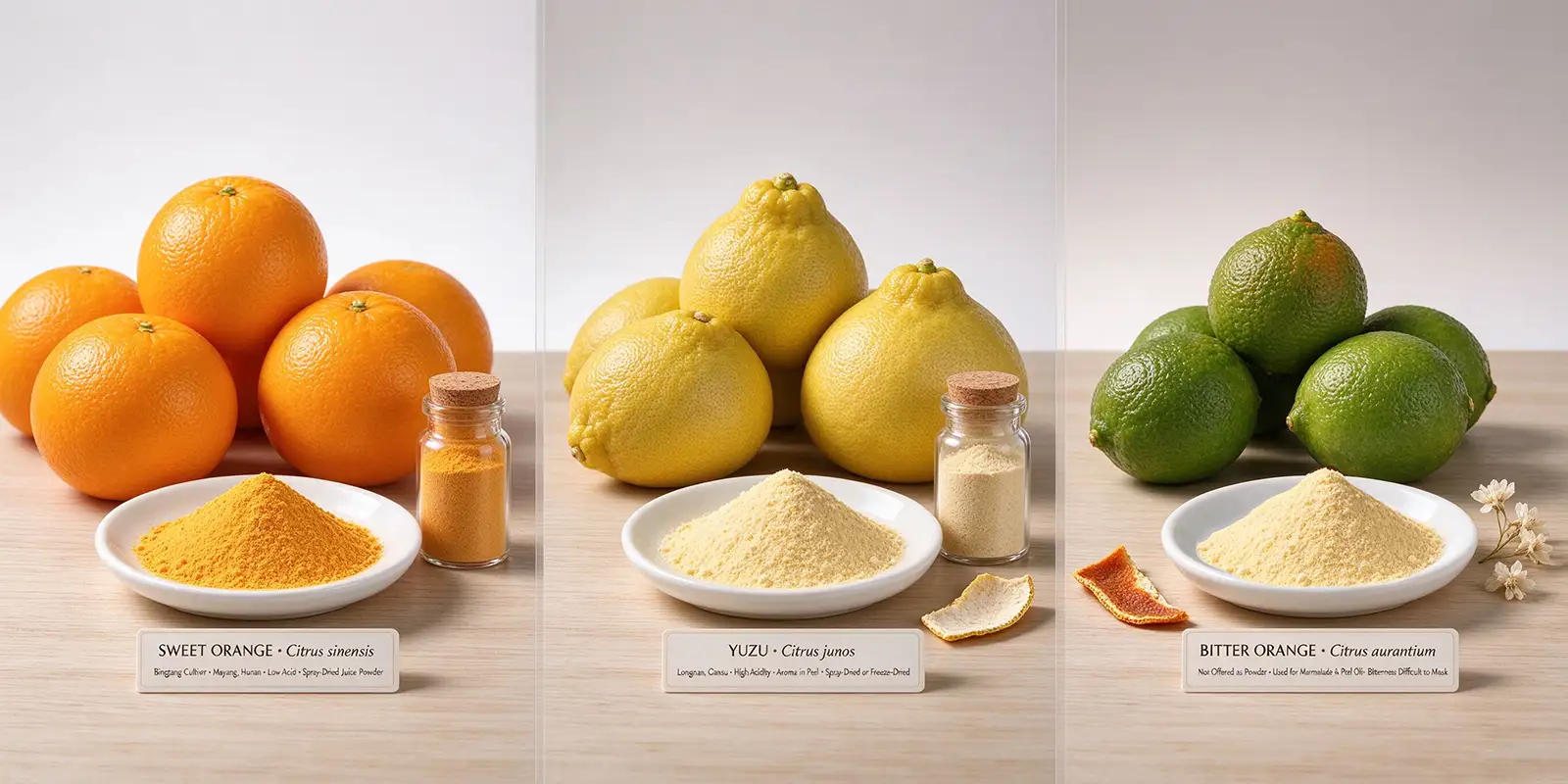

“Orange powder” sounds like a single ingredient, but the citrus behind it can be a sweet table orange, an aromatic acid citrus such as yuzu, or a bitter orange grown mainly for marmalade and peel oil. These are different species with different sugar, acid and aroma profiles, and the differences carry straight through drying into the finished powder. This guide compares the three, starting with the yuzu vs orange question most buyers ask, so that formulators can choose the citrus first and the format second.
Choose sweet orange powder for a rounded, juicy orange taste with little added sugar needed; choose yuzu powder for a sharp, fragrant citrus note with far higher acidity; bitter orange is too bitter for most drink and food powders and is better suited to marmalade and peel-oil uses.
Are Yuzu and Orange the Same Fruit?
No. In the yuzu vs orange question, the key fact is that they are separate citrus species. Yuzu is Citrus junos, a small, rough-skinned, very seedy acid citrus valued for its fragrant rind[1]. Sweet orange is Citrus sinensis, the species behind table oranges and orange juice; within it, cultivars range from normal-acid types to low-acid ones such as Bingtang orange[2]. Bitter orange, also called sour or Seville orange, is Citrus aurantium, a seedy, bitter and acidic fruit traditionally used for marmalade[3].
All three are sometimes sold under “orange” names, which is why buyers can receive a powder that tastes nothing like what they expected. Naming the species on the specification avoids that problem.
Yuzu vs Orange vs Bitter Orange at a Glance
| Property | Sweet orange (Bingtang) | Yuzu | Bitter orange |
|---|---|---|---|
| Species | Citrus sinensis | Citrus junos | Citrus aurantium |
| Valeherb source | Mayang, Hunan | Longnan, Gansu | Not offered as powder |
| Dominant taste | Sweet, low acid, juicy | Very sour, intensely aromatic | Bitter and sour |
| Acidity | 0.55–0.95% titratable acid in published samples | About 4.5% citric acid in the juice | Acidic (no comparable figure in our sources) |
| Where the value sits | Juice sugars and sugar–acid balance | Peel aroma oils | Peel oil, flowers, marmalade |
| Best powder fit | Drinks, dairy, confectionery, children’s products | Premium drinks, bakery, seasonings, sauces | Rarely used as a fruit powder |

Acidity figures come from different studies and methods, so they indicate scale rather than an exact ratio: Bingtang data are from a 2025 flavor study of Hunan and Yunnan fruit[4], and the yuzu figure is from the UC Riverside Citrus Variety Collection[1]. Even allowing for that, yuzu juice carries roughly five to eight times the acid of Bingtang juice.
Sweet Orange (Bingtang): Sugar–Acid Balance Drives the Flavor
For sweet orange, the most useful single number is the sugar–acid ratio, calculated as total soluble solids divided by titratable acid (TSS/TA). A higher ratio reads as sweeter and softer; a lower one reads as brighter and more tart. Bingtang orange is classified as a low-acid sweet orange, in contrast to normal-acid cultivars such as Newhall navel[2].
A 2025 study in Acta Horticulturae Sinica measured Bingtang fruit from Hongjiang in Hunan and Xinping in Yunnan. Across four sample groups, soluble solids ranged from 12.6% to 15.6%, titratable acid from 0.55% to 0.95%, and the TSS/TA ratio from about 14 to 28[4]. The study also found that origin shapes the profile: Hunan fruit carried more organic acids and a fuller, more robust taste, while Yunnan fruit had higher levels of peel volatiles such as D-limonene and valencene. Malic acid, citric acid, octanal and (E)-2-hexenal were the compounds most closely linked to consumer preference.
Valeherb’s sweet orange powder is made from Bingtang orange grown in Mayang, part of the same Huaihua area of western Hunan as the Hongjiang samples. For a formulator, that profile means a powder that tastes like ripe orange juice with little need for added sweetener, and enough acid to keep it from tasting flat. The trade-off is moisture sensitivity: sugar-rich juice powders absorb water readily, so packaging and storage matter more than they do for low-sugar citrus.
Yuzu: Aroma From the Peel, Acidity From the Juice
Yuzu works almost the opposite way. A fresh yuzu yields only about 18% of its weight as juice, carries around 28 seeds, and has highly acidic juice that is used much like lemon[1]. Its commercial value lies in the rind. In cold-pressed peel oils from six Japanese cultivars, limonene made up 63.1–68.1% of the volatiles, followed by γ-terpinene and β-phellandrene, and the study identified 17 compounds with a distinctly yuzu-like odor, several present only in traces[5].
Both sweet orange and yuzu peels are limonene-dominated[4][5], so the difference people notice is not the main compound but the minor ones layered on top of it. That is why yuzu reads as floral and sharp where orange reads as sweet and rounded, even though their peel oils share the same backbone.
Yuzu is also unusually cold-hardy for a citrus. The UC Riverside record notes that plant explorer Frank N. Meyer considered it the hardiest of the true citrus species and reported yuzu growing wild in Gansu Province in 1914[1]. Valeherb’s yuzu comes from Longnan in southern Gansu, which lets us offer yuzu alongside sweet orange from a single supplier rather than as a separate Japanese import.
Bitter Orange: Why We Do Not Make It Into Powder
Bitter orange is available to us from western Hubei, but Valeherb does not offer it as a fruit powder. The reason is flavor rather than supply. Seville-type sour orange is described as seedy, bitter and acidic, and its traditional value lies in marmalade, peel oil and, from the flowers, neroli oil for perfumery[3]. Those uses depend on cooking with sugar or on extracting oils, not on drying the fruit into a ready-to-use powder.
In a powdered drink or a snack seasoning, that bitterness is difficult to mask and narrows the range of products the ingredient can serve. For formulators who want a bittersweet citrus note, grapefruit powder is a more practical option, because it pairs bitterness with juiciness and sweetness that a dried bitter orange lacks.
How Each Citrus Behaves as a Powder
The species sets the flavor; the drying format decides how much of it survives. Sweet orange and yuzu are both available as spray-dried juice powder and as freeze-dried whole-fruit powder, and the choice matters more for yuzu than for sweet orange. In other words, the yuzu vs orange gap widens or narrows depending on whether the peel goes into the dryer.
Most of the flavor sits in the juice sugars and acids, so spray-dried juice powder already delivers a convincing orange taste with high solubility. Freeze-dried whole-fruit powder adds peel aroma, color and a more natural mouthfeel.
Most of the character sits in the peel, so a juice-only powder gives acidity but loses much of the signature aroma. Freeze-dried whole-fruit powder is the format that tastes most recognizably of yuzu.
Low-temperature drying also protects aroma in citrus generally. In a 2023 comparison on a Chinese red tangerine, freeze-dried powder retained 19 volatile compounds versus 14 in spray-dried powder, together with more D-limonene and more vitamin C[6]. Our guide to freeze-dried fruit powder covers the process in more detail.
Matching Citrus Powder to Your Application
| Application | Better choice | Why |
|---|---|---|
| Orange-flavored powdered drinks | Sweet orange, spray-dried | Familiar orange taste, high solubility, contributes sweetness |
| Premium or craft citrus drinks | Yuzu, spray-dried or freeze-dried | Distinctive aroma and sharp acidity that stand out from standard orange |
| Children’s and family products | Sweet orange | Low acidity and a rounded, recognizable flavor |
| Bakery, cookies and fillings | Yuzu or sweet orange, freeze-dried | Whole-fruit powder keeps peel aroma and visible fruit particles |
| Seasonings, dressings and dry sauces | Yuzu, freeze-dried | Fragrant acid top note that pairs with salt and umami |
| Yogurt, ice cream and confectionery | Sweet orange or yuzu, freeze-dried | Natural color and a real-fruit flavor impression |
| Bittersweet citrus profiles | Grapefruit rather than bitter orange | Bitterness balanced by juiciness and sweetness |
Many formulas also use the two together: sweet orange powder as the base for body and sweetness, with a smaller share of yuzu powder to lift the aroma and sharpen the finish. Specifications for both, including drying format and carrier content, are on our sweet orange and yuzu powder page.
Pick the citrus for the flavor you want, then pick the format for how much of that flavor you need to keep: sweet orange lives in the juice, yuzu lives in the peel.
Frequently Asked Questions
Is yuzu a type of orange?
No. Yuzu is a separate citrus species, Citrus junos, while sweet orange is Citrus sinensis. Yuzu is much more acidic, has little juice and many seeds, and is valued mainly for its fragrant peel rather than for sweetness.
Which is sweeter, yuzu or orange?
Sweet orange is far sweeter. Low-acid cultivars such as Bingtang orange combine high soluble solids with low titratable acid, while yuzu juice contains roughly five to eight times more acid, so yuzu tastes sharply sour.
Can yuzu powder replace orange powder in a recipe?
Not one for one. Yuzu powder is more acidic and more aromatic, so it is usually used at a lower rate and needs more sweetener. Many formulators combine the two, using sweet orange powder as the base and yuzu powder to lift the aroma.
What is Bingtang orange?
Bingtang orange is a low-acid sweet orange (Citrus sinensis) cultivar grown in Hunan and Yunnan in China. Its high sugar–acid ratio gives a sweet, mild flavor, which makes it well suited to orange powders that need little added sweetener.
Why is bitter orange rarely sold as a fruit powder?
Bitter orange is seedy, bitter and acidic, and its traditional value lies in marmalade, peel oil and neroli oil from the flowers. Dried into a powder, its bitterness is hard to mask in drinks and foods, so grapefruit powder is usually a more practical bittersweet option.
References
[1] Citrus Variety Collection, University of California, Riverside. Citrus junos Sieb. ex Tanaka (yuzu), accession record CRC 1216. University germplasm database, not peer-reviewed literature. https://citrusvariety.ucr.edu/crc1216
[2] Huang D, Zhao Y, Cao M, Qiao L, Zheng ZL. Integrated systems biology analysis of transcriptomes reveals candidate genes for acidity control in developing fruits of sweet orange (Citrus sinensis L. Osbeck). Frontiers in Plant Science. 2016;7:486. https://doi.org/10.3389/fpls.2016.00486
[3] Citrus Variety Collection, University of California, Riverside. Seville sour orange (Citrus aurantium L.), accession record CRC 3856. University germplasm database, not peer-reviewed literature. https://citrusvariety.ucr.edu/crc3856
[4] Kong J, Fu C, Wu Y, Liu Y, Hu Z, Xu J, Huang H, Zhao Z, Chen L, Chen J. Flavoromics analysis and flavor quality difference analysis in Bingtang oranges. Acta Horticulturae Sinica. 2025;52(4):984–996. In Chinese with English abstract. https://doi.org/10.16420/j.issn.0513-353x.2024-0191
[5] Lan-Phi NT, Shimamura T, Ukeda H, Sawamura M. Chemical and aroma profiles of yuzu (Citrus junos) peel oils of different cultivars. Food Chemistry. 2009;115(3):1042–1047. https://doi.org/10.1016/j.foodchem.2008.12.024
[6] Li S, Mao X, Guo L, Zhou Z. Comparative analysis of the impact of three drying methods on the properties of Citrus reticulata Blanco cv. Dahongpao powder and solid drinks. Foods. 2023;12(13):2514. https://doi.org/10.3390/foods12132514