

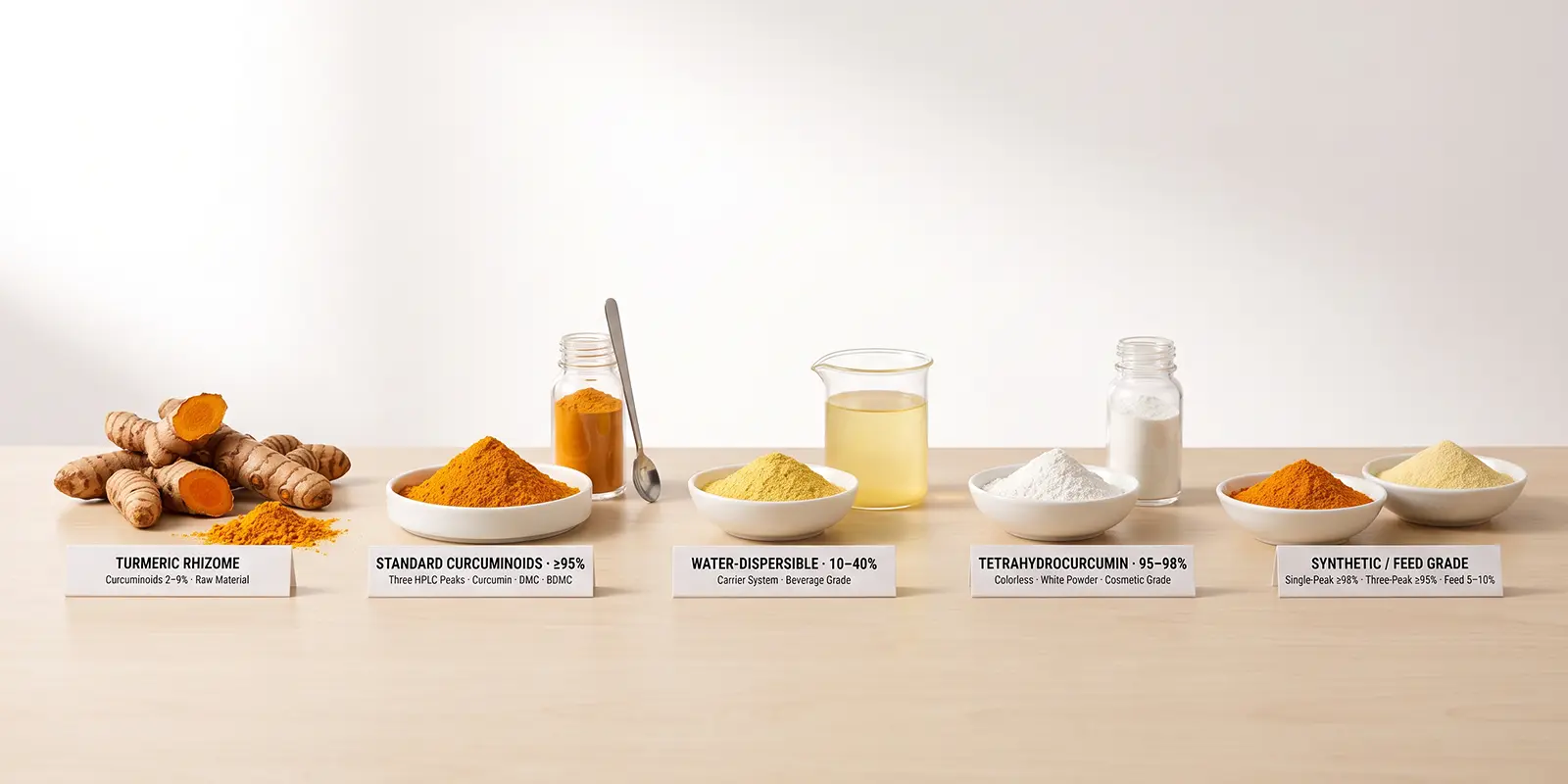

A purchase order that says only “curcumin 95%” leaves at least four questions open: is the material extracted from turmeric or synthesized, does the assay count one compound or three, has the molecule been chemically modified, and is it made for human or animal use. The types of curcumin extract traded today fall into seven grades, and each one is defined by its process route rather than by its percentage alone. This guide sorts them by how they are made, what the chromatogram should look like, and where each grade fits in a formulation.
Most supplement work calls for natural 95% curcuminoids (three HPLC peaks). Water-based drinks need a water-dispersible grade at a lower assay, color-sensitive cosmetics use tetrahydrocurcumin, single-compound research work uses ≥98% curcumin (natural or synthetic, which must be declared), and feed applications use feed-grade extract or turmeric residue.
Types of Curcumin Extract at a Glance
The table below compares the seven grades on the points that decide a specification. Assay ranges marked as industry practice are common trade specifications, not regulatory limits; the regulatory figures are cited in the sections that follow.
| Grade | Typical assay | HPLC profile | Color | Process route | Main use | Human / feed |
|---|---|---|---|---|---|---|
| Standard curcuminoids | ≥95% total curcuminoids | Three peaks (curcumin, DMC, BDMC) | Orange-yellow | Solvent extraction, crystallization | Capsules, tablets | Human |
| Water-dispersible | 10–40% curcuminoids (industry practice) | Three peaks, diluted by carrier | Yellow | Extract plus carrier or emulsifier, spray-dried | Beverages, drink powders, effervescents | Human |
| Tetrahydrocurcumin (THC) | 95–98% THC (industry practice) | One THC peak | White to off-white | Catalytic hydrogenation of curcumin | Color-sensitive cosmetics | Human (check local status) |
| Synthetic, single-peak | ≥98% curcumin | One curcumin peak | Orange-yellow | Chemical synthesis | Research, single-compound dosing | Human (market-dependent) |
| Synthetic, three-peak | ≥95% curcuminoids | Three peaks, blended | Orange-yellow | Synthesis of each curcuminoid, then blending | Natural-ratio profile at synthetic consistency | Human (market-dependent) |
| Feed-grade curcumin | 5–10% curcuminoids (industry practice) | Three peaks, diluted | Yellow | Diluted extract made to feed rules | Poultry, livestock, aquaculture feed | Feed only |
| Turmeric residue | Low, batch-dependent | Three peaks, ratio shifted | Yellow-orange | By-product of extraction or crystallization | Low-cost feed coloring and flavoring | Feed only |
How Standard 95% Curcuminoid Extract Is Made
Standard 95% curcuminoid extract, the reference point for every other curcumin extract grade, is produced by solvent extraction of dried turmeric (Curcuma longa) rhizome followed by crystallization, and the crystallization step is what lifts the assay above 90%. Raw rhizome contains about 2–9% curcuminoids depending on origin and growing conditions[1]. A first solvent pass yields an oleoresin with 25–35% coloring matter; further purification brings the powder above 90%[2].
Dry and mill the rhizome
Particle size controls how fast solvent reaches the pigment cells; the milled rhizome is the feedstock for every natural grade.
Extract to an oleoresin
Ethanol is the most widely preferred solvent, with acetone, ethyl acetate, hexane and methanol also used, and extraction efficiency improves at 60–80 °C[1]. The EU limits curcumin (E 100) production to a closed list of solvents and caps ethyl acetate residues at 50 mg/kg[3].
Crystallize the curcuminoids
Curcuminoids are recovered by crystallization from the concentrated extract[2], and a single conventional crystallization recovers only about 60% of the curcuminoids present in the oleoresin[4]. The crystals are enriched in curcumin, while demethoxycurcumin and bisdemethoxycurcumin concentrate in the mother liquor[4].
Dry, mill and test
The crystal powder is dried, sized and assayed by HPLC for the three individual curcuminoids, plus residual solvents, heavy metals and microbiology.

The ratio shift during crystallization matters for anyone comparing COAs. In one patented process, the oleoresin carried roughly 50–70% curcumin, 10–30% demethoxycurcumin (DMC) and 10–30% bisdemethoxycurcumin (BDMC), while the crystallized powder came out at about 65–85% curcumin and only 5–15% BDMC[4]. Two lots that both pass “95% total curcuminoids” can therefore differ in their curcumin share, which is why a usable COA lists all three peaks rather than a single total.
Lower-assay natural grades, such as 10%, 20% or 40–60% curcuminoids, are made either by stopping purification earlier or by standardizing a high-purity extract down with a carrier. Both are legitimate, but the COA should state which route was used, because a diluted 95% extract and a partially purified oleoresin carry different amounts of turmeric essential oil and resin. For the basic difference between these products and culinary turmeric, see how turmeric powder differs from a standardized extract.
The EU E 100 specification sets its 90% minimum as “total colouring matters”[3], a total-color measurement, whereas supplement COAs usually report HPLC curcuminoids. The two figures come from different methods and should not be compared as if they were the same number. Ask the supplier to state the method next to the result.
Water-Dispersible (Water-Soluble) Curcumin
Water-dispersible curcumin is a standard curcumin extract loaded onto a hydrophilic carrier or emulsifier system, which is why its curcuminoid assay is lower than the 95% grade. Curcumin itself is practically insoluble in water at acidic and neutral pH, with solubility estimated at about 11 ng/mL[5]. In an aqueous beverage, untreated 95% extract floats, clumps or settles.
Published delivery systems include γ-cyclodextrin inclusion, soy lecithin phospholipid complexes, gum-based colloidal dispersions and polysorbate micelles[5]. The carrier is not a neutral filler: it sets the color shade, the dispersion clarity, and the ingredient line on the finished label. A cyclodextrin system declares differently from a lecithin or modified-starch system, and some carriers bring allergen questions (soy lecithin) that the formulator has to manage.
Commercial assays run from about 10% to 40% curcuminoids (industry practice). Valeherb’s water-dispersible grade is listed at 20–40% curcuminoids on the turmeric extract grades page. Many of these systems were developed to improve oral absorption as well as dispersibility; whether a given grade achieves that is a clinical-data question for that specific formulation, not a property of the assay number.
Tetrahydrocurcumin (THC): The Colorless Derivative
Tetrahydrocurcumin is curcumin with its conjugated carbon–carbon double bonds saturated by hydrogen, and losing that conjugation removes the yellow color. It is described in the literature as a stable, colorless hydrogenated product of curcumin, sometimes called “white curcumin”[6]. It also forms in the body as one of curcumin’s reduction metabolites[1].
Industrial THC starts from purified curcumin, not from turmeric. One patented route reduces curcumin with hydrogen over an activated Raney nickel catalyst in acetone, followed by silica gel chromatography to remove partially reduced intermediates[7]. Residual catalyst metal and incompletely hydrogenated byproducts are therefore THC-specific COA items that do not appear on a standard curcuminoid COA.
For formulators, the practical value is color. A cream, serum or white tablet that would turn yellow with curcuminoids can carry THC as an antioxidant without staining the product or the skin[6]. THC is a different compound from curcumin: it is assayed against a THC reference standard, it is declared as tetrahydrocurcumin, and data generated on curcumin do not transfer to it.
Synthetic Curcumin: Single-Peak and Three-Peak Grades
Synthetic curcumin is chemically identical to curcumin from turmeric, but it is built from petrochemical or nature-identical building blocks rather than extracted. In the route described in an FDA GRAS notice, vanillin and 2,4-pentanedione are condensed through a boron complex using tri-n-butyl borate and n-butylamine, then hydrolyzed, giving a product of about 99% purity[8].
Curcumin only, with no DMC or BDMC. Suited to research standards, single-compound dosing, and formulations where the minor curcuminoids must be excluded. Note that a single-peak ≥98% curcumin can also be made from natural extract by further chromatographic purification[1], so “single-peak” alone does not prove synthetic origin.
Curcumin, DMC and BDMC synthesized and blended to mimic the natural ratio. The chromatogram resembles natural extract, which gives batch consistency but also makes the origin invisible to routine HPLC. Origin has to be confirmed by isotope testing and declared.
Regulatory status differs by market. In the United States, FDA responded with “no questions” to a GRAS notice for synthetic curcumin as a food ingredient (GRN 000822), while noting that use for its color may constitute a color additive use[8]. In the EU, the E 100 definition requires curcumin to be “obtained by solvent extraction of turmeric”[3], and the JECFA specification likewise covers only curcumin from natural sources[2]. We did not locate an EU authorization specific to synthetic curcumin; buyers for EU, Australian or other APAC markets should confirm status and labeling with regulatory counsel before specifying it.
Radiocarbon (carbon-14) analysis is the most effective available method for separating natural from synthetic curcuminoids, but it is costly. Hydrogen stable-isotope ratio (δ2H) analysis separated the two groups clearly in a 2023 study and flagged synthetic additions at about 20–30%, while carbon isotope ratios alone were less reliable[9]. If a “natural” claim is on your label, put an isotope test in the purchase specification.
Feed-Grade Curcumin and Turmeric Residue
“Feed grade” describes the regulatory pathway and process standard, not a fixed purity. The turmeric extract assessed by EFSA as a feed flavoring for all animal species was specified at at least 90% curcuminoids, and EFSA considered it safe at up to 15 mg/kg complete feed[10]. The 5% and 10% curcuminoid products sold as feed-grade curcumin are diluted versions made for cost and dosing convenience in premixes (industry practice).
The EFSA opinion covered turmeric preparations in the sensory additive category, functional group flavourings[10]. Using the same material to pigment egg yolk or broiler skin is a coloring purpose, which sits in a different functional group under EU feed rules, so the authorization behind a feed product should match the claim made for it.
Turmeric residue covers two different by-product streams. Spent rhizome left after solvent extraction holds little curcuminoid, and we did not find a reliable published figure for it, so its content should be taken from the batch COA. The mother-liquor residue left after crystallization is richer: in patent examples it held roughly 13–18% curcuminoids, with a skewed curcumin:DMC:BDMC ratio of about 40:25:35[4]. Neither stream is suitable for human food or supplement use.
Origin, chromatogram and regulatory pathway define a curcumin grade; the percentage on the label is only the fourth question.
How to Choose Between Types of Curcumin Extract
Of all the types of curcumin extract, the right one follows from the finished product: start there, then fix the grade, then write the COA requirements that prove it. The table maps common applications to a grade and to the specification lines that matter most.
| Application | Grade | Put on the specification |
|---|---|---|
| Supplement capsule or tablet | Natural 95% curcuminoids | HPLC result for each curcuminoid, extraction solvent and residue, heavy metals |
| Functional beverage, drink powder, effervescent | Water-dispersible 10–40% | Carrier identity, dispersion test in your base, curcuminoid assay |
| White or color-sensitive cosmetic | Tetrahydrocurcumin 95–98% | THC assay against THC standard, residual catalyst metal, color value |
| Research or single-compound dosing | ≥98% curcumin, single-peak | Origin (natural or synthetic) stated, impurity profile |
| Natural-ratio profile at synthetic consistency | Synthetic three-peak ≥95% | Origin declaration, target-market regulatory confirmation |
| Poultry, livestock or aquaculture feed | Feed-grade 5–10% | Feed additive authorization matching the intended function |
| Low-cost feed coloring or flavoring | Turmeric residue | Batch curcuminoid content, contaminant limits for feed |
Valeherb supplies natural-origin turmeric extract from 5–15% concentrated powder through 40–60% mid-purity and 95% curcuminoids, plus piperine-enhanced and water-dispersible formats, with the curcumin, DMC and BDMC breakdown reported on each batch COA. The full grade list is on our turmeric extract specification page; for THC, synthetic or feed grades, send your specification and we will confirm what we can supply.
Frequently Asked Questions
What is the difference between curcumin and curcuminoids?
Curcuminoids are the group of three yellow pigments in turmeric: curcumin, demethoxycurcumin (DMC) and bisdemethoxycurcumin (BDMC). Curcumin is the largest of the three. A “95% curcuminoids” extract counts all three together, while “98% curcumin” refers to curcumin alone.
Is 95% curcumin the same as 95% curcuminoids?
No. Most natural extracts sold as “95% curcumin” are 95% total curcuminoids, of which curcumin itself is typically around two-thirds to four-fifths. Ask for an HPLC COA that reports each of the three curcuminoids separately so you know which figure you are buying.
Can you tell synthetic curcumin from natural curcumin?
Not by routine HPLC, because the molecule is identical. Radiocarbon (carbon-14) testing is the most effective method, and hydrogen stable-isotope ratio analysis has been shown to separate natural and synthetic curcuminoids at lower cost. Add one of these tests to the specification when origin matters.
Is tetrahydrocurcumin the same as curcumin?
No. Tetrahydrocurcumin is a hydrogenated derivative of curcumin with a different structure and no yellow color. It is assayed against its own reference standard, declared under its own name, and research on curcumin does not automatically apply to it.
Why does water-dispersible curcumin have a lower curcuminoid content?
Most of the powder is the carrier or emulsifier system that lets curcuminoids disperse in water, such as cyclodextrin, phospholipid or gum. Typical assays run from about 10% to 40% curcuminoids. Calculate your inclusion rate from the curcuminoid content you need, not from the powder weight.
Can feed-grade curcumin be used in human supplements?
No. Feed-grade curcumin and turmeric residue are produced and documented under feed rules, not food or supplement rules. Even when the chemistry looks similar, the manufacturing controls and regulatory file do not support human use.
References
[1] Priyadarsini KI. The chemistry of curcumin: from extraction to therapeutic agent. Molecules. 2014;19(12):20091–20112. https://doi.org/10.3390/molecules191220091 (review)
[2] FAO/WHO Joint Expert Committee on Food Additives (JECFA). Curcumin: Chemical and Technical Assessment, 61st JECFA. FAO; 2004. https://www.fao.org/fileadmin/templates/agns/pdf/jecfa/cta/61/Curcumin.pdf (intergovernmental technical assessment, not peer-reviewed; original read directly)
[3] Commission Regulation (EU) No 231/2012 of 9 March 2012 laying down specifications for food additives, Annex, entry E 100 Curcumin (consolidated version). https://eur-lex.europa.eu/eli/reg/2012/231/2020-07-02/eng (government regulation, not peer-reviewed; E 100 text read from the consolidated version)
[4] Madsen B, Hidalgo Garcia V, Hernandez Vera L. Purification process for improving total yield of curcuminoid colouring agent. US Patent 6,576,273 B2; 2003. https://patents.google.com/patent/US6576273B2/en (patent, not peer-reviewed)
[5] Stohs SJ, Chen O, Ray SD, Ji J, Bucci LR, Preuss HG. Highly bioavailable forms of curcumin and promising avenues for curcumin-based research and application: a review. Molecules. 2020;25(6):1397. https://doi.org/10.3390/molecules25061397 (review)
[6] Kakkar V, Kaur IP, Kaur AP, Saini K, Singh K. Topical delivery of tetrahydrocurcumin lipid nanoparticles effectively inhibits skin inflammation: in vitro and in vivo study. Drug Dev Ind Pharm. 2018;44(10):1701–1712. https://doi.org/10.1080/03639045.2018.1492607 (in vitro and animal study)
[7] Method for making tetrahydrocurcumin and a substance containing the antioxidative substance tetrahydrocurcumin. US Patent 5,266,344 A; 1993. https://patents.google.com/patent/US5266344A/en (patent, not peer-reviewed)
[8] U.S. Food and Drug Administration. Response letter to GRAS Notice No. GRN 000822, synthetic curcumin. June 4, 2019. https://www.fda.gov/media/130730/download (government document, not peer-reviewed; original read directly)
[9] Perini M, Pianezze S, Ziller L, Larcher R, Pace R. Stable isotope ratio analysis for the authentication of natural antioxidant curcuminoids from Curcuma longa (turmeric). Antioxidants. 2023;12(2):498. https://doi.org/10.3390/antiox12020498 (research article)
[10] EFSA Panel on Additives and Products or Substances used in Animal Feed (FEEDAP). Safety and efficacy of turmeric extract, turmeric oil, turmeric oleoresin and turmeric tincture from Curcuma longa L. rhizome when used as sensory additives in feed for all animal species. EFSA Journal. 2020;18(6):e06146. https://doi.org/10.2903/j.efsa.2020.6146 (regulatory scientific opinion)


