

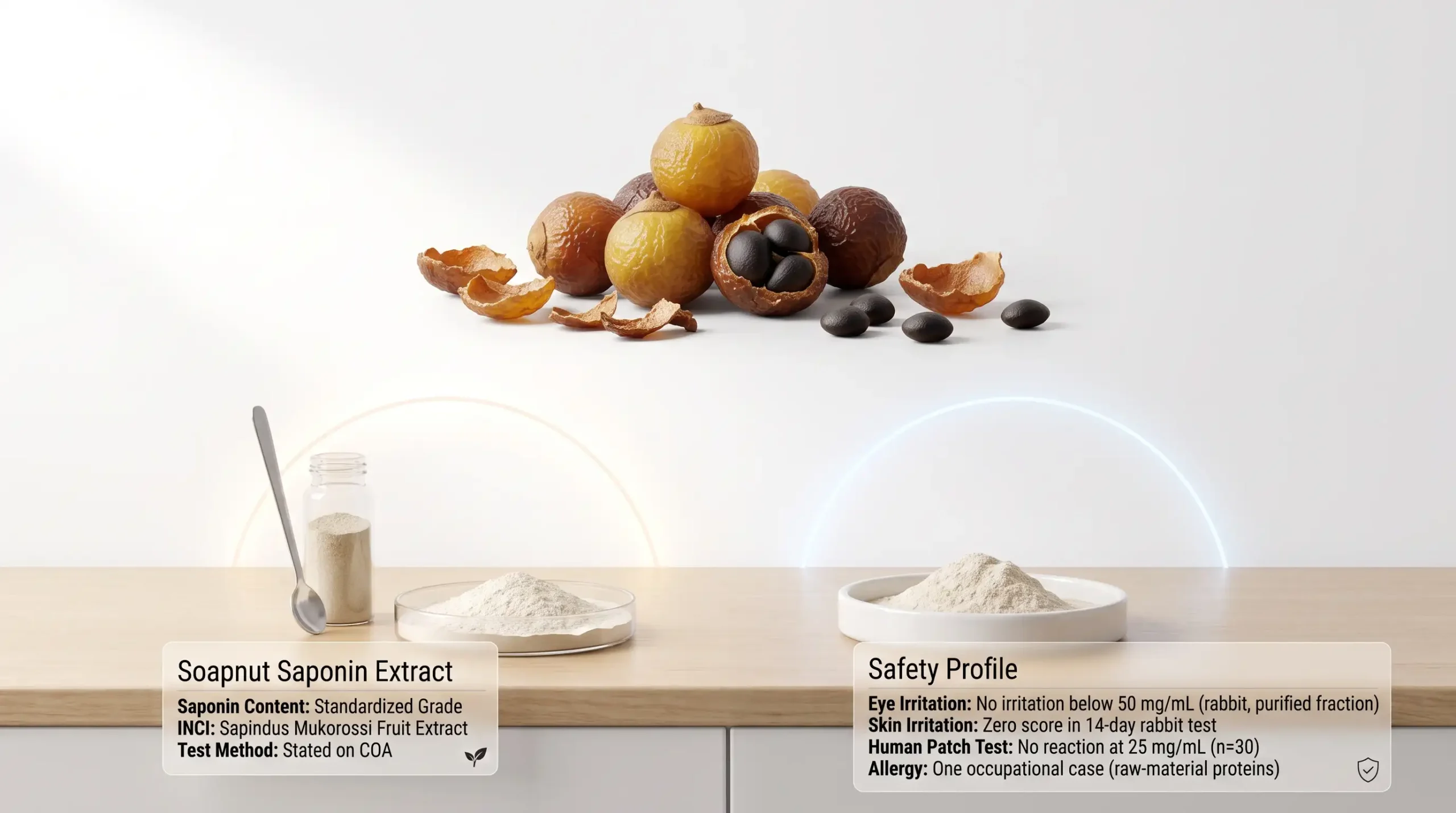

The triterpenoid saponins that make Sapindus mukorossi pericarp foam are not biologically inert. The same amphiphilic structure that lets them lift oil from a surface also lets them interact with cell membranes. For a formulator weighing soapnut saponin eye irritation, skin tolerance or environmental impact, the useful question is not whether soapnut is “natural” but what the safety data actually show, at what concentration, and in which test system.
The short answer: eye contact is the main acute hazard in use. The most widely repeated eye irritation figure comes from a rabbit study of a purified saponin fraction below 50 mg/mL. The one documented soapnut allergy involved raw-material proteins rather than the purified saponin. And aquatic toxicity is real enough to matter for any environmental claim.
| Endpoint | What the evidence shows | Evidence type | Formulation implication |
|---|---|---|---|
| Eye irritation | No acute or repeated eye irritation from a saponin fraction below 50 mg/mL | Animal (rabbit) | Confirm on the finished formula; not a basis for tear-free claims |
| Skin irritation | Zero irritation score in a 14-day rabbit test; no reaction in a 4-hour human patch test at 25 mg/mL | Animal; small human patch test | Supportive for rinse-off use; sensitization not established |
| Allergy | One documented occupational IgE allergy to soapnut raw material; patient IgE did not bind the purified saponin end product | Single case report | Control dust exposure; ask how the extract is purified |
| Hemolysis | Saponins lyse red blood cells through membrane sterol binding | In vitro | Relevant to damaged skin and mucosa, less so to intact rinse-off contact |
| Ingestion | Low acute oral toxicity of a saponin extract in rats | Animal | Low toxicity does not make it a food ingredient |
| Aquatic toxicity | Molluscicidal at low mg/L; saponin toxicity varies about 100-fold by plant source | Laboratory ecotoxicity | Substantiate eco claims with data on the actual material |
Why Saponins Irritate in the First Place
A saponin molecule has a hydrophobic triterpene backbone (the aglycone) joined to one or more hydrophilic sugar chains. In water, saponins adsorb at interfaces, lower surface tension, and above their critical micelle concentration assemble into micelles. That is the basis of their cleansing and foaming performance [1].
In living tissue, the same aglycone interacts with sterols in cell membranes, which in animal cells means cholesterol. This interaction is the documented mechanism behind the hemolytic activity of saponins toward red blood cells [1], and it is the common thread running through every endpoint in this article. Eye irritation, hemolysis and aquatic toxicity are expressions of the same property; what differs is concentration, exposure route and the tissue involved.
Structure matters too. S. mukorossi fruit contains saponins with a single sugar chain, such as sapindosides A to D, alongside others carrying two sugar chains [1]. Extracts made by different processes can carry different proportions of these, which is one reason a safety result obtained on one material does not transfer automatically to another.
Soapnut Saponin Eye Irritation: What the Data Show and Where the Figure Comes From
The figure most often repeated, that soapnut saponins cause no eye irritation below 50 mg/mL, comes from a 2025 study by Wei and colleagues in the Journal of Ethnopharmacology. The researchers tested a purified S. mukorossi saponin fraction (SMSF) on New Zealand rabbits and reported no acute or continuous skin or eye irritation at concentrations below 50 mg/mL [2]. The study’s main purpose was dermatological research; the irritation testing was the safety step that preceded it.
That result is useful, but it has three boundaries that matter when you cite it. First, it describes a specific purified fraction, not a commercial extract grade, so it cannot be converted into a safe use level for a 40% or 70% powder. Second, it is an animal result, and rabbit ocular responses do not map one-to-one onto human eyes. Third, the study reports the absence of irritation below 50 mg/mL; it does not tell you what happens above that concentration or in combination with other surfactants.
We did not identify published human ocular data for Sapindus saponins on their own.
For formulators, the practical conclusion is that eye irritation is a property of the finished product, not of the ingredient alone. Co-surfactants, pH and total surfactant load all change it. Any “tear-free” or “gentle around the eyes” positioning needs testing on the final formula, using validated non-animal methods in markets that restrict animal testing of cosmetics.
Skin Irritation and the “Hypoallergenic” Label
The skin data are more supportive than the eye data. A 2022 review by Sochacki and Vogt summarizes several studies: a rabbit dermal irritation test in which the average daily irritation score stayed at zero over 14 days of continuous application, an acute dermal LD50 above 5000 mg/kg in rats, and a 4-hour human patch test in which 25 mg/mL of two purified saponin fractions produced no swelling or allergic reaction in any of 30 subjects [1]. The 2025 rabbit study likewise found no skin irritation below 50 mg/mL [2].
Two gaps remain. A 4-hour patch test measures primary irritation from a single exposure; it does not measure sensitization, which requires repeated-exposure designs such as a human repeat insult patch test. We did not find published repeat-insult data for S. mukorossi saponins. The authors of the patch-test study also cautioned that saponin toxicity should not be ignored and that further toxicological evaluation is needed [1].
Many consumer pages describe soapnuts as hypoallergenic; we found no human sensitization data behind that description. “Hypoallergenic” is a finished-product claim that needs its own substantiation, and it cannot be inherited from the plant’s reputation.
Allergy: Raw-Material Proteins Versus Purified Saponin
The clearest allergy evidence is a 2021 occupational case report by Merget, Raulf and Sander. A 58-year-old non-atopic chemical worker in saponin production developed work-related asthma and rhinoconjunctivitis about four years after he began handling quillaja bark and soapnut. Skin prick tests with extracts from his workplace were positive, an inhalation challenge with soapnut extract was positive, and he was diagnosed with occupational allergy to both materials [3].
The detail that matters for sourcing is where the allergen sat. In immunoblotting, the patient’s IgE antibodies reacted strongly with proteins of roughly 22 and 32 kDa in the soapnut raw material, but not with the saponin end product [3]. In this case the sensitizing agent was plant protein, not the saponin molecule. Two caveats apply: this is a single case, and the authors note that the low protein content of the soapnut extracts limited some of their tests.
Two practical points follow. Exposure here was airborne dust over several years, so powdered material deserves normal dust controls in manufacturing. And when comparing extracts, how the material is purified tells you more about this risk than a “natural” label, although one case does not establish that a purified extract is free of allergy risk.
Soapnut belongs to the Sapindaceae family, the same family as lychee and longan, and buyers sometimes ask whether that implies cross-reactivity. We found no published data either way.
Hemolysis: A Real Mechanism With Limited Relevance to Rinse-Off Use
Saponins lyse red blood cells in vitro by binding membrane sterols [1], and hemolysis assays are a common screening measure of how membrane-active a saponin preparation is. Safety summaries sometimes list hemolytic activity as if it were a direct hazard to consumers.
For hemolysis to happen, saponin has to reach living cells directly. Intact skin, with its stratum corneum, and a product that is rinsed off within a minute do not create that situation. The scenarios where the mechanism becomes relevant are compromised skin, mucous membranes and prolonged leave-on contact at meaningful concentration. That is not a reason to exclude soapnut extract from rinse-off cleansers, but it is a reason to think carefully before positioning it for damaged or broken skin.
Ingestion and the Edible “Soapberry” Mix-Up
Acute oral toxicity of an S. mukorossi saponin extract in rats was low, with LD50 values of 7940 mg/kg in males and 9260 mg/kg in females [1]. That does not make soapnut a food ingredient; it is supplied as a cosmetic and cleaning raw material.
Part of the confusion around ingestion is a naming problem. “Soapberry” is also the common name of Shepherdia canadensis, a North American shrub in a different plant family whose berries are eaten and traditionally whipped into a foamy dessert. For a side-by-side of the plants sold or described as soapberry, see our guide to what soapberries are and how Sapindus mukorossi differs.
Aquatic Toxicity and Environmental Claims
The membrane activity that makes saponins useful surfactants also affects aquatic organisms. S. mukorossi pericarp extract showed strong molluscicidal activity against golden apple snails, with LC50 values of 85, 22 and 17 ppm after 24, 48 and 72 hours, and an ethanolic pericarp extract reached an LC50 of 2.75 mg/L against the snail Lymnaea acuminata [1]. Computer-based predictions have also classified four saponins from a purified soapnut fraction as at least harmful to fathead minnow and Daphnia magna at under 100 mg/L [1], although those are predicted rather than measured values.
Data from other saponin plants cannot simply be borrowed. When Jiang and colleagues compared saponin-rich extracts from quillaja, tea seed and quinoa, toxicity differed by about 100-fold between plant sources, which led them to call read-across between saponins a dubious exercise [4]. In a companion study on quillaja extract, the saponins accounted for 85.1 to 93.6% of the extract’s toxicity to Daphnia magna and zebrafish embryos, and saponin degradation products were 3 to 7 times less toxic than the parent compounds [5].
The practical point: “biodegradable” and “safe for aquatic life” are separate claims. Degradation does reduce toxicity over time, but concentrated discharges from manufacturing wastewater or spilled concentrate are a different exposure from a diluted rinse. If environmental positioning is part of the product story, it should rest on ecotoxicity data for the soapnut material itself.
Safety Documentation to Request From Your Supplier
Most of the gaps above are closed at the finished-product stage, but the ingredient file should give your safety assessor something to work with:
- Saponin content and the method used to measure it, since irritation potential tracks the amount of saponin actually delivered.
- A description of the extraction and purification process, which bears on protein and other non-saponin carry-over.
- Per-batch results for microbial limits, heavy metals and residual solvents.
- Any irritation or sensitization data held on the material itself, with the test system and concentration stated.
- Ecotoxicity data, if the finished product will carry environmental claims.
Grade specifications and batch COA contents for Valeherb’s material are listed on our standardized soapnut extract product page.
Frequently Asked Questions
Can soapnut extract be used in tear-free or baby products?
Ingredient-level data do not support a tear-free claim. The main eye irritation result for soapnut saponins comes from rabbits exposed to a purified research fraction below 50 mg/mL, which says nothing about a finished shampoo containing other surfactants at a different pH. Tear-free and baby-care positioning require testing of the final formula, and baby products are usually held to stricter safety assessment in most markets. Soapnut extract can be part of such a formula, but the claim has to be earned by the finished product, and substantiating it is the marketer’s responsibility.
Is soapnut safe for people with tree nut allergies?
Botanically, a soapnut is not a nut; it is the dried fruit of the Sapindus tree. We found no published data on cross-reactivity between soapnut and tree nuts. However, “not a nut” is not the same as “no allergy risk.” The one documented soapnut allergy, an occupational case, involved proteins in the raw material, and the patient’s antibodies did not react with the purified saponin end product. Consumers with known allergies should follow their clinician’s advice, and finished products should carry whatever allergen assessment their market requires.
Is soapnut extract suitable for sensitive skin?
The available data are encouraging but limited. Published work includes a 14-day rabbit dermal test with a zero irritation score and a 4-hour human patch test in which 30 subjects showed no reaction to purified saponin fractions at 25 mg/mL. What is missing is repeat-exposure sensitization data such as a human repeat insult patch test. A “suitable for sensitive skin” claim therefore needs testing on the finished product rather than relying on the ingredient’s reputation.
Does a higher saponin percentage mean a higher irritation risk?
Not by itself. Irritation depends mainly on how much saponin reaches the skin or eye in the finished product, not on the grade of the powder. A higher-potency extract used at a lower inclusion rate can deliver the same saponin concentration as a lower-potency extract used at a higher rate. What differs between grades is the non-saponin fraction, such as sugars, pigments and proteins, which higher purification reduces. Compare grades on the saponin concentration actually delivered in your formula.
References
[1] Sochacki M, Vogt O. (2022). Triterpenoid saponins from washnut (Sapindus mukorossi Gaertn.): a source of natural surfactants and other active components. Plants, 11(18), 2355. doi:10.3390/plants11182355
[2] Wei M, Zhou Y, Hu X, Tie H, Chen Q, Yao W. (2025). In vivo bacterial infection acne treatment of Sapindus saponins: skin microbiota, network pharmacology, and transcriptomic analysis. Journal of Ethnopharmacology, 353(Pt A), 120345. doi:10.1016/j.jep.2025.120345
[3] Merget R, Raulf M, Sander I. (2021). Occupational immediate type allergy to soapnut and quillaja bark. Allergologie Select, 5, 77–81. doi:10.5414/ALX02131E
[4] Jiang X, Hansen HCB, Strobel BW, Cedergreen N. (2018). What is the aquatic toxicity of saponin-rich plant extracts used as biopesticides? Environmental Pollution, 236, 416–424. doi:10.1016/j.envpol.2018.01.058
[5] Jiang X, Cao Y, Jørgensen LvG, Strobel BW, Hansen HCB, Cedergreen N. (2018). Where does the toxicity come from in saponin extract? Chemosphere, 204, 243–250. doi:10.1016/j.chemosphere.2018.04.044


