What Withanolides Are — and Why the Percentage Matters
Withanolides are a family of steroidal lactone compounds found in the root of Withania somnifera (ashwagandha), and they are the marker compound class that essentially all standardization and clinical research on this ingredient is built around. The percentage on a product label — 2.5%, 5%, or 10% — is the single most consequential sourcing decision for anyone formulating with ashwagandha, because it determines both dose delivered per gram and cost per functional unit. It is also, as covered further below, a specification that is easier to misrepresent than most buyers realize — which is why understanding what’s actually being measured matters as much as the number itself.
The Chemistry: A Compound Family, Not a Single Molecule
“Withanolides” is not one chemical — it is a class name for naturally occurring C28 steroidal lactones, a structural family built on an ergostane-type steroid skeleton. More than 40 individual withanolides have been identified in Withania somnifera to date, each with its own CAS number and, in many cases, its own distinct studied activity. Three of the most-referenced members illustrate the range within this one compound family:
| Compound | CAS Number | Note |
|---|---|---|
| Withaferin A | 5119-48-2 | The first withanolide identified; concentrated primarily in root tissue |
| Withanolide A | 32911-62-9 | Concentrated more heavily in leaf tissue than root |
| Withanone | 27570-38-3 | Structurally similar to Withaferin A but with distinct studied activity |
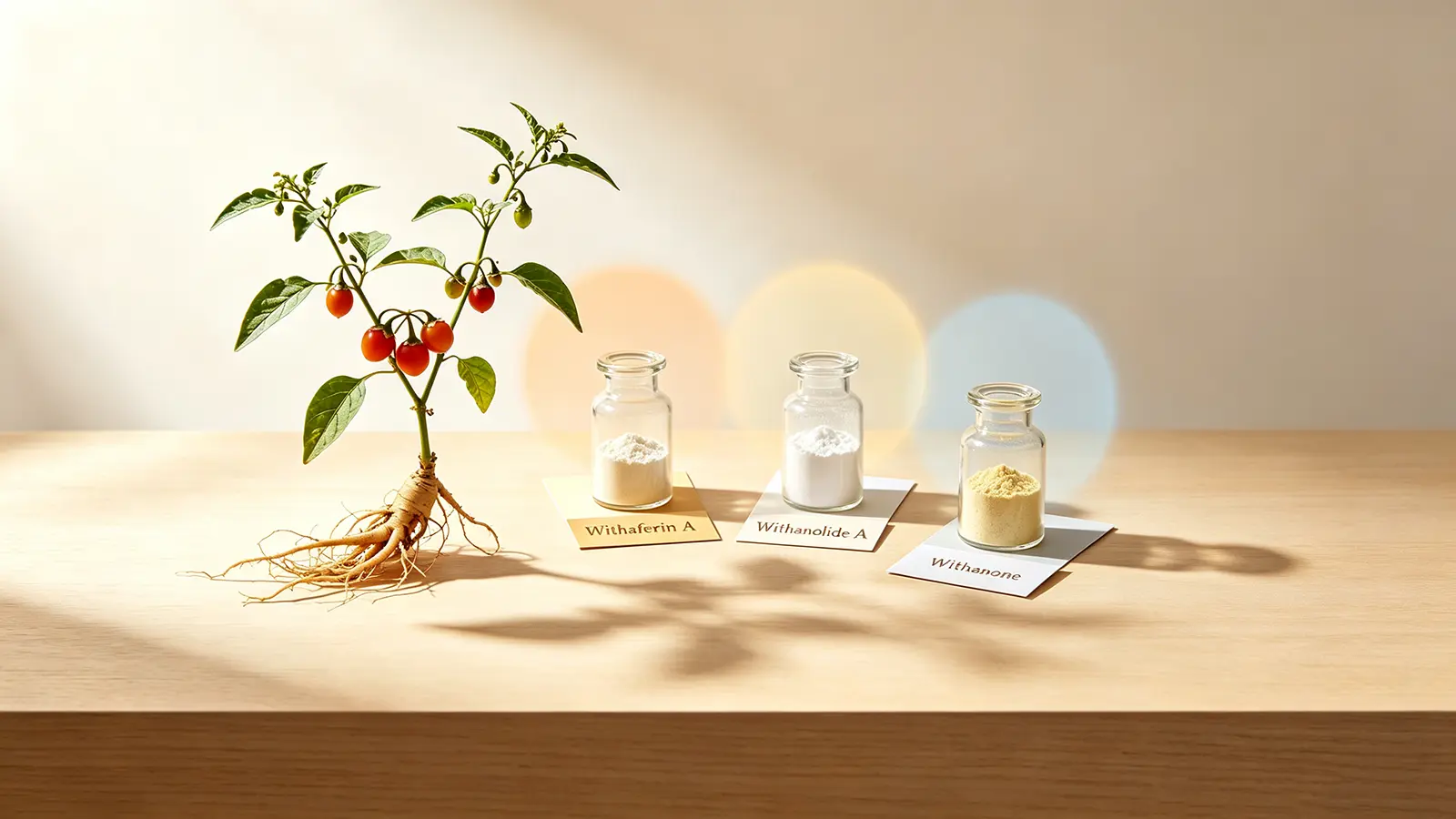
Because these are structurally distinct molecules rather than interchangeable variants of one compound, “total withanolides” on a label is a sum, not a single measured entity — and how that sum is arrived at (discussed in the testing section below) is where a meaningful share of labeling inconsistency in this ingredient category originates.
Why Raw Root Naturally Runs Low
Unconcentrated dried ashwagandha root does not naturally contain much withanolide content — this is precisely why standardized extraction exists as a category. The official USP compendial standard for ashwagandha root powder sets a floor of not less than 0.3% total withanolides on a dried basis, calculated as the sum of withanolide aglycones and glycosides. The USP standard for a standardized dry extract, by contrast, sets a floor of not less than 2.5%.[1] That roughly eight-fold gap between raw root and the lowest common extract grade is the concentration step happening during processing — it is not, on its own, evidence that either material is mislabeled, but it does explain why “ashwagandha powder” and “ashwagandha extract” are not remotely interchangeable specifications despite both technically containing withanolides. This is also why raw root powder and standardized extract are two entirely different sourcing decisions, not two grades of the same thing — a distinction worth its own closer look, which we come back to later in this guide.
2.5% vs 5% vs 10%: Choosing a Grade
Once you’re past the raw-root baseline and into standardized extract territory, the three commonly available grades serve different formulation goals rather than simply representing “better” and “worse” versions of the same thing:
| Grade | Typical positioning | Formulation fit |
|---|---|---|
| 2.5% | Full-spectrum, entry-level standardization | Cost-sensitive formulas where withanolides are one of several supporting ingredients rather than the headline active |
| 5% | Mainstream grade | The concentration most commonly referenced in published clinical research on standardized root extract, making it the default choice when a formula’s positioning leans on research alignment |
| 10% | High-concentration | Compact dosage formats (small capsules, low-fill-weight formulas) where delivering an equivalent withanolide dose at lower total material weight is the priority |
These figures describe the concentration researchers and commercial formulators have referenced in published work and product specifications — they are provided as formulation context, not as a recommended intake for any individual.
The Testing Method Trap: Colorimetric vs. HPLC
This is the area where quality control diligence matters most, and it is also where the industry has a documented, verifiable problem. Two fundamentally different methods are used to determine withanolide percentage: colorimetric (spectrophotometric) assays, which measure total absorbance across a class of related compounds, and HPLC, which separates and quantifies individual withanolide molecules. Colorimetric methods are faster and cheaper to run, but because they are non-specific, they capture other structurally similar compounds alongside the actual withanolides being measured — inflating the reported percentage.
A 2025 analytical chemistry study tested 19 commercial ashwagandha extract products and 5 root powder products using HPLC coupled with ion-mobility mass spectrometry, comparing the measured withanolide and withanoside content against what each product’s label claimed. The measured content deviated from the labeled specification by a factor of at least two, and in the most extreme case, by a factor of 35.[2] That is not a rounding discrepancy — it reflects, at least in part, the gap between what a non-specific assay reports and what a compound-resolving method like HPLC actually finds.
For a buyer, the practical takeaway is straightforward: a percentage on a spec sheet is only as meaningful as the method used to generate it. Ask any prospective supplier directly which method was used, and request the HPLC chromatogram or a compound-level breakdown rather than accepting a single aggregate percentage at face value. For our own sourcing criteria and COA verification guidance on this point, see our Ashwagandha Root Extract product page.
Withanolides Are Not the Only Active Class
Withanolides are the most extensively researched compound class in ashwagandha, but not the only one present. Withanosides — the glycoside (sugar-bound) forms of withanolide compounds — and a set of alkaloids are also naturally occurring constituents, and some analytical methods report withanolides and withanosides as a combined figure rather than separately. This is worth knowing specifically because it affects how you read a spec sheet: two suppliers reporting “5% total withanolides” may not be measuring an identical set of compounds unless their testing methodology is explicitly comparable.
Root vs. Leaf: How Source Tissue Shifts the Profile
Plant part is a second variable that shifts the withanolide profile independent of overall percentage. Root and leaf tissue do not produce the same balance of individual withanolides — Withaferin A concentrates more heavily in root tissue, while Withanolide A is found in comparatively higher concentration in leaf tissue, among other compositional differences between the two plant parts. A published comparative assessment of root-only versus combined root-and-leaf ashwagandha formulations found that this compositional difference has direct implications for both the safety and efficacy profile of the finished material, not just its chemical fingerprint.[3] This is a separate sourcing question from grade percentage — a product can be accurately labeled “5% withanolides” while still differing meaningfully from a root-only 5% product in its underlying compound ratio, depending on which plant part contributed the extract.
From Percentage to Format: What to Check Next
Knowing your target withanolide percentage is only the first sourcing decision, not the last one. The second question most formulators run into is whether to buy a standardized extract at all, or a cheaper raw root powder instead — and the two are not interchangeable on withanolide content, stability, or verifiability, even when a root powder’s label references withanolides. We cover that comparison in full in Ashwagandha Root Extract vs Root Powder: What’s the Difference?, including how to verify actual withanolide content on a raw powder rather than assuming it matches an extract at the same nominal price point.
Sourcing Standardized Withanolides
Put together, the practical sourcing checklist is: confirm the testing method (HPLC, not colorimetric alone), confirm the plant part (root vs. root-and-leaf), and match the grade (2.5%, 5%, or 10%) to your formulation’s dosing and cost targets rather than defaulting to the highest number available. Valeherb supplies HPLC-standardized ashwagandha root extract across all three grades, with method-specific COA documentation available on request — see our bulk ashwagandha root extract product page for full specifications and sourcing criteria.
Frequently Asked Questions
What percentage of withanolides should ashwagandha have?
It depends on formulation goals rather than a single “correct” number. 2.5% is a common entry-level, full-spectrum grade; 5% is the concentration most often referenced in published clinical research on standardized root extract; 10% suits compact, low-fill-weight formats. Raw, unconcentrated root powder naturally contains far less — the USP standard sets its floor at just 0.3%.
Is a higher withanolide percentage always better?
Not necessarily. A higher labeled percentage is only meaningful if it was measured by a specific, compound-resolving method like HPLC. Non-specific colorimetric testing can report inflated percentages, and a published 2025 analytical study found commercial products deviating from their label claims by a factor of 2 to 35. Method verification matters more than chasing the highest printed number.
What’s the difference between withanolides and withanosides?
Withanolides are the steroidal lactone compounds themselves; withanosides are the glycoside (sugar-bound) forms of those same compounds. Some testing methods and product labels report the two as a combined figure rather than separately, which is worth clarifying when comparing specifications across suppliers.
How is withanolide content measured — HPLC vs. colorimetric?
Colorimetric (spectrophotometric) methods measure total absorbance across a class of related compounds and are faster and cheaper, but non-specific — they can capture other similar compounds alongside actual withanolides, inflating the result. HPLC separates and quantifies individual withanolide molecules and is the more accurate, verifiable method. Ask suppliers directly which method generated a given percentage.
Should I buy ashwagandha root powder or a standardized extract?
It depends on whether verified, consistent withanolide content matters for your formulation. Standardized extract gives you a documented, HPLC-verifiable percentage; raw root powder’s actual withanolide content is far less consistent and much harder to verify batch to batch. See our full comparison in Ashwagandha Root Extract vs Root Powder: What’s the Difference?
References
[1] United States Pharmacopeia. Ashwagandha Root Powder (NLT 0.3% withanolides) and Ashwagandha Root Dry Extract (NLT 2.5% withanolides) monographs. USP-NF. https://doi.usp.org/USPNF/USPNF_M2788_02_01.html
[2] Zellner L, Wierer M, Himmelsbach M, Schatzmann B, Thalhamer B, Klampfl CW. Determination of withanolides and withanosides in ashwagandha based products using HPLC-drift-tube-ion-mobility quadrupole time-of-flight mass spectrometry. Electrophoresis. 2025;46(5-6):340-346. https://doi.org/10.1002/elps.202400188
[3] Kumar P, Banik SP, Goel A, Chakraborty S, Bagchi M, Bagchi D. A critical assessment of the whole plant-based phytotherapeutics from Withania somnifera (L.) Dunal with respect to safety and efficacy vis-a-vis leaf or root extract-based formulation. Toxicol Mech Methods. 2023;33(8):698-706. https://doi.org/10.1080/15376516.2023.2242933