

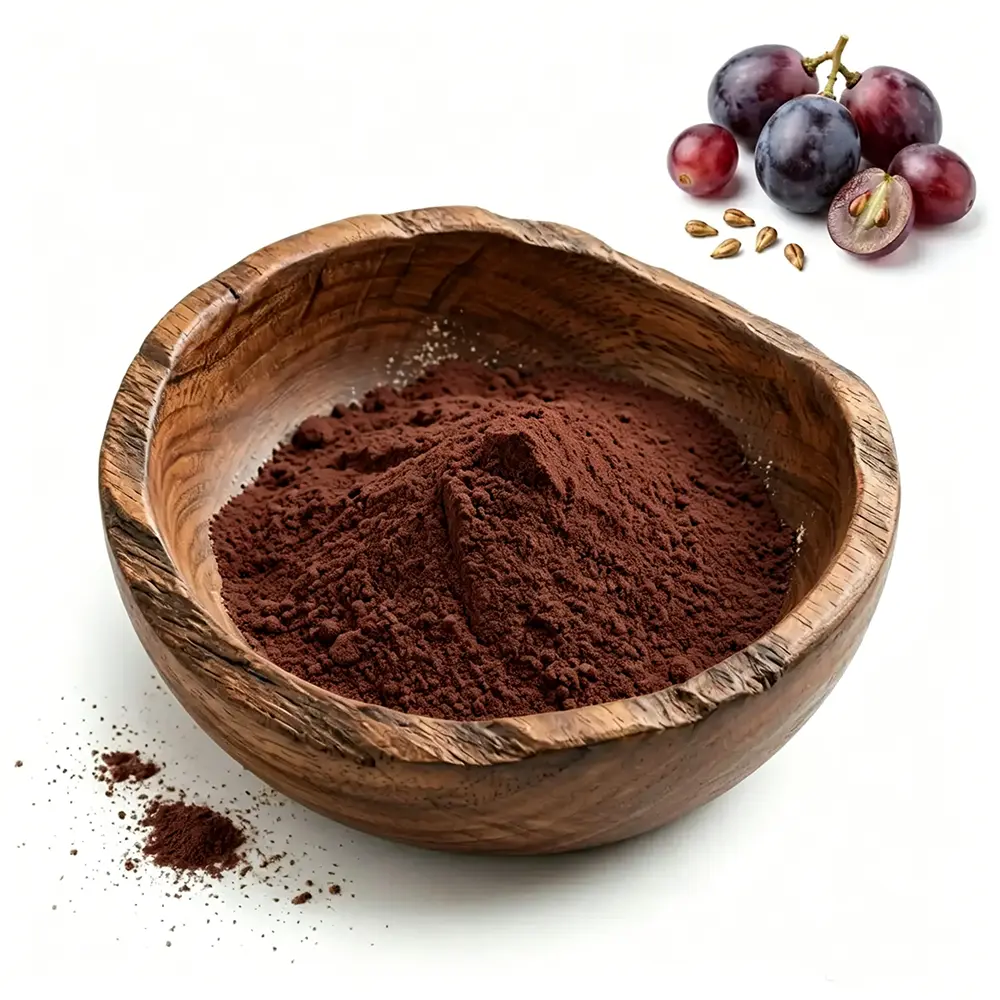
Bulk Grape Seed Extract Supplier — Standardized 95% OPC (Vitis vinifera), B2B Wholesale
If you are sourcing standardized grape seed extract for supplement, cosmeceutical, or functional-food formulation, the specification that anchors the published research is 95% oligomeric proanthocyanidins (OPCs) by UV spectrophotometry — verified per production batch. Grape seed extract from Vitis vinifera pressed seeds, standardized to this OPC benchmark, is one of the most extensively studied antioxidant ingredients in the supplement industry, with research spanning cardiovascular, dermal, and vascular pathways across multiple published RCTs. Valeherb supplies grape seed extract bulk wholesale, standardized to 95% OPC, with batch-level COA, Non-GMO verification, and FDA-registered facility documentation for US supplement supply chains.
Active Compounds: OPCs and Why 95% Standardization Is the Procurement Benchmark
Grape seed extract’s bioactive fraction is composed of oligomeric proanthocyanidins (OPCs) — flavonoid complexes comprising catechin, epicatechin, and their oligomeric forms. These are the same compound class found in pine bark extract, but grape seed delivers them at a significantly lower cost per gram of OPC, making it the dominant commercial choice for high-volume antioxidant formulations.
| Compound Class | Standardization Target | Activity Studied in Research |
|---|---|---|
| Oligomeric Proanthocyanidins (OPCs) | 95% by UV spectrophotometry | Free-radical scavenging (reported in ORAC assays to exceed vitamin C and vitamin E); inflammatory-pathway (NF-κB) research; collagen cross-linking research[1] |
| Monomeric Catechins (Catechin, Epicatechin) | Subset of OPC fraction | Studied for endothelial NO production, vascular-wall integrity, and inflammatory-pathway signaling[2] |
| Gallic Acid | Minor phenolic fraction | Synergistic antioxidant activity; antimicrobial properties in topical applications |
Published Research Across Three Areas
1. Cardiovascular & Vascular Research
Grape seed extract has one of the more developed cardiovascular research bases among OPC ingredients. A 2011 meta-analysis by Feringa et al. of nine randomized controlled trials reported reductions in systolic and diastolic blood-pressure measures with standardized GSE versus control across study participants.[2] In research, the proposed mechanism involves endothelial nitric oxide (NO) production via OPC-catechin interaction with eNOS. Separately, procyanidins from Vitis vinifera have been studied in venous-circulation research, including a clinical study reporting changes in capillary and edema measures over a short supplementation period.[3]
2. Skin & Cosmeceutical Research
Grape seed proanthocyanidins are studied for cross-linking collagen fibers and inhibiting collagen-degrading matrix metalloproteinases (MMP-1, MMP-2, MMP-9), a mechanism of interest for dermal structural research relevant to UV-induced oxidative stress. This is applicable to both oral nutricosmetic and topical cosmeceutical formulation categories.[1]
3. Cellular Antioxidant Research
OPCs are described in research as active in both aqueous and lipid cellular environments — a dual-phase antioxidant property studied in relation to broad-spectrum oxidative-stress reduction.[4] This characteristic is the basis of interest in grape seed extract for cellular-health and longevity formulation categories.
Doses Used in Published Research
| Research Context | Dose Used in Trials | Format Notes |
|---|---|---|
| Cardiovascular research | 150–300 mg/day standardized extract[2] | Capsules or tablets; twice-daily dosing supports sustained plasma OPC levels |
| Venous-circulation research | 300–400 mg/day | Higher range used in venous-circulation RCTs[3] |
| Antioxidant / general | 100–200 mg/day | 100 mg is the most common single-capsule retail format |
| Cosmeceutical (topical) | 0.1–1% w/w in finished formula | Confirm solubility for your serum/emulsion system |
| Functional food | 50–150 mg per serving | Mild astringency at higher levels — flavor masking recommended above 100 mg/serving |
The figures above are doses used in published research, provided as a formulation reference only — not treatment recommendations or dosing instructions for any condition. Finished-product dosing and claims are the marketer’s responsibility under applicable regulations.
Formulation Applications
- Antioxidant & anti-aging stacks: Pairs with resveratrol, vitamin C, and coenzyme Q10. The OPC-vitamin C combination is well documented — catechins help regenerate oxidized vitamin C in situ, extending its antioxidant activity[1]
- Cardiovascular-wellness supplements: Standardized extract in capsule/tablet formats for the cardiovascular-and-circulation product category
- Cosmeceuticals & nutricosmetics: Oral and topical formats for skin-elasticity and antioxidant product lines
- Sports nutrition: Post-exercise oxidative-stress research supports the recovery category; non-stimulant, WADA-compliant. Often combined with vitamin E for dual-phase antioxidant coverage
- Women’s-health formulations: Vascular and collagen research areas relevant to perimenopause supplement lines in the skin and circulation categories
Sourcing Criteria: What to Require from Any Supplier
| Criterion | What to Require |
|---|---|
| OPC Standardization Method | 95% OPC by UV spectrophotometry — not total polyphenol by Folin-Ciocalteu. Specify the assay method on the COA, not just the percentage |
| Source Specification | Vitis vinifera pressed seed — not grape skin or pomace, which have different OPC profiles and lower catechin-to-OPC ratios |
| Third-Party COA | OPC content (UV), heavy metals (USP <232>), pesticide residues, microbial limits (USP <2021>), moisture, residual solvents — per production batch |
| Solubility / Format | Confirm the grade suits your format. Standard dry extract suits capsules/tablets and dry mixes; confirm dispersion data at use concentration for liquid or topical formats |
| ORAC Value | Request ORAC data for antioxidant-claim documentation — a quantifiable benchmark alongside the OPC COA |
| Certifications | Non-GMO, Kosher/Halal for relevant markets. FDA-registered facility required for US supplement supply chains |
Regulatory Guidance
- US (DSHEA): Any structure/function claim on the finished product is the marketer’s responsibility to substantiate and must carry the FDA disclaimer; antioxidant claims are the most readily supported. Cardiovascular and skin claims sit closer to disease territory and need careful wording. Blood-pressure claims in particular must use framing such as “supports healthy blood pressure levels already within the normal range.” Disease treatment claims require drug (NDA) approval
- EU: Grape seed OPCs are not currently on the EU authorized health claims register as a standalone ingredient. Authorized antioxidant claims exist for vitamin C as a co-ingredient under EC 1924/2006 — a relevant consideration for combination formulations
- Canada (NHPs): Grape seed extract has a licensed Health Canada monograph supporting antioxidant and cardiovascular claims under Natural Health Products Regulations (regulatory background for buyers)
References
[1] Shi J et al. (2003). Polyphenolics in grape seeds — biochemistry and functionality. Journal of Medicinal Food, 6(4), 291–299. doi:10.1089/109662003772519831
[2] Feringa HHH et al. (2011). The effect of grape seed extract on cardiovascular risk markers: a meta-analysis of randomized controlled trials. Journal of the American Dietetic Association, 111(8), 1173–1181. doi:10.1016/j.jada.2011.05.015
[3] Costantini A et al. (1999). Clinical and capillaroscopic evaluation of chronic uncomplicated venous insufficiency with procyanidins extracted from Vitis vinifera. Minerva Cardioangiologica, 47(1-2), 39–46. PMID: 10356940
[4] Bagchi D et al. (2000). Free radicals and grape seed proanthocyanidin extract: importance in human health and disease prevention. Toxicology, 148(2–3), 187–197. doi:10.1016/S0300-483X(00)00210-9


