

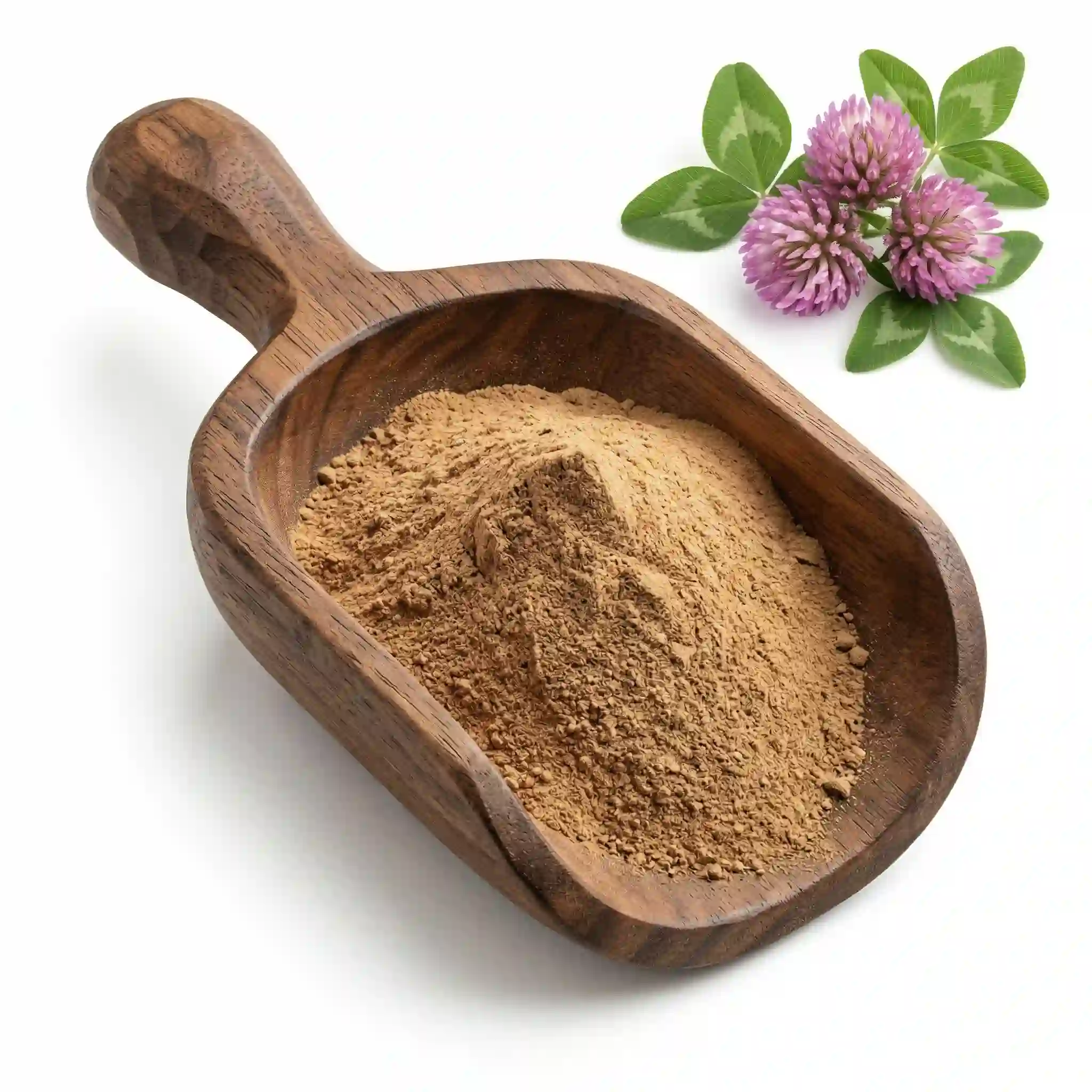
Red Clover Extract Supplier (Trifolium pratense): Standardized Isoflavones 8% / 10% / 20% / 40% | B2B Sourcing Guide
Red clover extract (Trifolium pratense) is one of the most extensively researched botanical sources of isoflavones — phytoestrogen compounds studied in the published literature for their interaction with estrogen receptors. Unlike soy, red clover provides all four major isoflavone subclasses in a single ingredient: formononetin (CAS 485-72-3), biochanin A (CAS 491-80-5), daidzein, and genistein (total isoflavone extract CAS 85085-25-2). Valeherb supplies red clover extract standardized to total isoflavone content of 8%, 10%, 20%, and 40% by HPLC, with the four-isoflavone breakdown available on the COA. For B2B buyers, standardization is the key distinction — only batch-verified isoflavone content gives formulators a defined, reproducible specification.
Active Compounds: The Four-Isoflavone Profile
Red clover’s isoflavone activity comes from four subclasses — a combination uncommon in a single botanical. Soy isoflavones are primarily daidzein and genistein; red clover provides all four:
| Isoflavone | Estrogen-Receptor Binding (Research) | Role / Activity Studied in Research |
|---|---|---|
| Formononetin | Weak ER-β binding; converted to daidzein in vivo | Most abundant subclass in red clover; precursor isoflavone |
| Biochanin A | Weak ER-β binding; converted to genistein in vivo | Precursor isoflavone; studied for inflammatory-pathway activity and 5α-reductase inhibition in vitro[2] |
| Daidzein | Moderate ER-β binding | Studied in bone-marker research[1] |
| Genistein | Strong ER-β binding | The most estrogenically active subclass; studied for menopausal endpoints and bone markers[3] |
Published Research Across Three Areas
1. Menopausal Endpoints
The most extensively studied area. A 2021 meta-analysis by Kanadys et al. of eight randomized controlled trials reported that red clover isoflavone extract was associated with a reduction in daily hot flush frequency versus placebo — a weighted mean difference of −1.73 per day (95% CI: −3.28 to −0.18), most pronounced in participants with five or more hot flushes per day and in trials using doses at or above 80 mg/day.[3] The 80 mg daily total-isoflavone dose is the reference point cited across most published trials.
2. Bone-Marker and Lipid Research
A 12-week randomized, double-blind, placebo-controlled trial by Thorup et al. (2015) in 60 menopausal women reported that daily red clover extract (37.1 mg isoflavones) was associated with preserved lumbar-spine BMD and T-score — with significant decline observed only in the placebo group — and with a reduction in the bone-turnover marker CTx.[1] On lipids, a 2020 systematic review and meta-analysis by Kanadys et al. reported a reduction in total cholesterol in perimenopausal and postmenopausal participants; changes in LDL-C and HDL-C trended favorably but did not reach statistical significance across trials, so total cholesterol is the most consistent lipid finding.[4]
3. Scalp & Cosmeceutical Research
An emerging, commercially active area. Biochanin A from red clover has been shown to inhibit 5α-reductase — the enzyme that converts testosterone to DHT — in in vitro studies, a mechanism of interest for hair and scalp cosmeceutical research. Published cosmeceutical work on a biochanin A and acetyl tetrapeptide-3 combination (Loing et al., 2013) reported changes in follicular inflammatory markers and anagen-to-telogen ratios in human assessment.[2] This is an area of growing cosmeceutical procurement interest in scalp-serum formats.
Standardization: What “80 mg Isoflavone” Actually Means
The 80 mg daily dose referenced in clinical trials is total isoflavone content — not extract weight. This distinction is critical for label accuracy and procurement specifications:
- Valeherb supplies red clover extract standardized to 8%, 10%, 20%, and 40% total isoflavones by HPLC, all standardized to total-isoflavone percentage (these are standardized grades, not ratio extracts)
- At 8% total isoflavones, a 500 mg extract dose delivers 40 mg isoflavones per serving; two servings reaches the 80 mg trial reference
- Higher-concentration grades (20–40%) allow lower extract weights per capsule — useful when combining multiple actives in a fixed capsule size
- The four-isoflavone ratio should be specified separately on the COA: formononetin typically represents 50–60% of total isoflavones in quality red clover extract, with the remainder distributed across biochanin A, daidzein, and genistein[5]
Formulation Applications
- Menopause & women’s-health supplements: Capsules and tablets at 40–80 mg total isoflavones per daily dose — the primary and most studied application. Common pairings: black cohosh, sage leaf, Siberian rhubarb
- Bone-health formulations: Combined with vitamin D3, vitamin K2, and calcium for postmenopausal bone-health product lines
- Women’s wellness formulas: Paired with omega-3, CoQ10, or plant sterols in heart-and-cholesterol wellness lines for women 45+
- Scalp & hair cosmeceuticals: Water-soluble isoflavone fraction or standardized liquid extract for topical serums featuring biochanin A
- Liquid herbal extract: Tincture and liquid-drop formats for herbal wellness lines; alcohol or glycerin-based extraction maintains isoflavone stability in liquid form
Sourcing Criteria: What Every B2B Buyer Should Require
| Criterion | What to Require |
|---|---|
| Total Isoflavone Content | HPLC-verified total isoflavone percentage per batch. Valeherb supplies 8%, 10%, 20%, and 40% grades — specify the target for your format |
| Four-Isoflavone Breakdown | Individual HPLC quantification of formononetin, biochanin A, daidzein, and genistein — not total isoflavones alone. Required to match clinical-trial-equivalent specifications |
| Extraction Source | Flowering aerial parts of Trifolium pratense — not seed or root material, which has a different isoflavone profile |
| Third-Party COA | Total isoflavones (HPLC), four-isoflavone breakdown, heavy metals (USP <232>), pesticide residues, microbial limits (USP <2021>), moisture — per batch |
| Certifications | Non-GMO, Kosher/Halal for relevant markets. FDA-registered facility required for US supplement supply chains |
| Extract Format Options | Dry powder (capsules/tablets), water-soluble fraction (beverages), liquid extract (tinctures). Confirm solvent system for liquid grades |
Regulatory Guidance
- US (DSHEA): Any structure/function claim on the finished product is the marketer’s responsibility to substantiate and must carry the FDA disclaimer. Menopause and hot-flash structure/function claims are commonly made (menopause is a life stage, not a disease), but hormone-related wording is sensitive and should be reviewed; bone-density and cardiovascular claims sit closer to disease territory. Disease treatment claims require drug (NDA) approval
- EU: Trifolium pratense isoflavone extracts are not currently on the EU authorized health claims register. Traditional-use status applies in some member states; consult EMA herbal medicinal product guidance for your specific market
- Canada (NHPs): Red clover isoflavones have a licensed Health Canada monograph supporting relief of menopausal symptoms under Natural Health Products Regulations (regulatory background for buyers)
References
[1] Thorup AC et al. (2015). Intake of novel red clover supplementation for 12 weeks improves bone status in healthy menopausal women. Evidence-Based Complementary and Alternative Medicine, 2015, 689138. PMID: 26265926
[2] Loing E et al. (2013). A new strategy to modulate alopecia using a combination of two specific and unique ingredients. Journal of Cosmetic Science, 64(1), 45–58. PMID: 23449130
[3] Kanadys W et al. (2021). Evaluation of clinical meaningfulness of red clover (Trifolium pratense L.) extract to relieve hot flushes and menopausal symptoms in peri- and post-menopausal women: a systematic review and meta-analysis of randomized controlled trials. Nutrients, 13(4), 1258. PMID: 33920485
[4] Kanadys W et al. (2020). Effects of red clover (Trifolium pratense) isoflavones on the lipid profile of perimenopausal and postmenopausal women — a systematic review and meta-analysis. Maturitas, 132, 7–16. PMID: 31883666
[5] Booth NL et al. (2006). The chemical and biologic profile of a red clover (Trifolium pratense L.) phase II clinical extract. Journal of Alternative and Complementary Medicine, 12(2), 133–139. PMID: 16566677


