

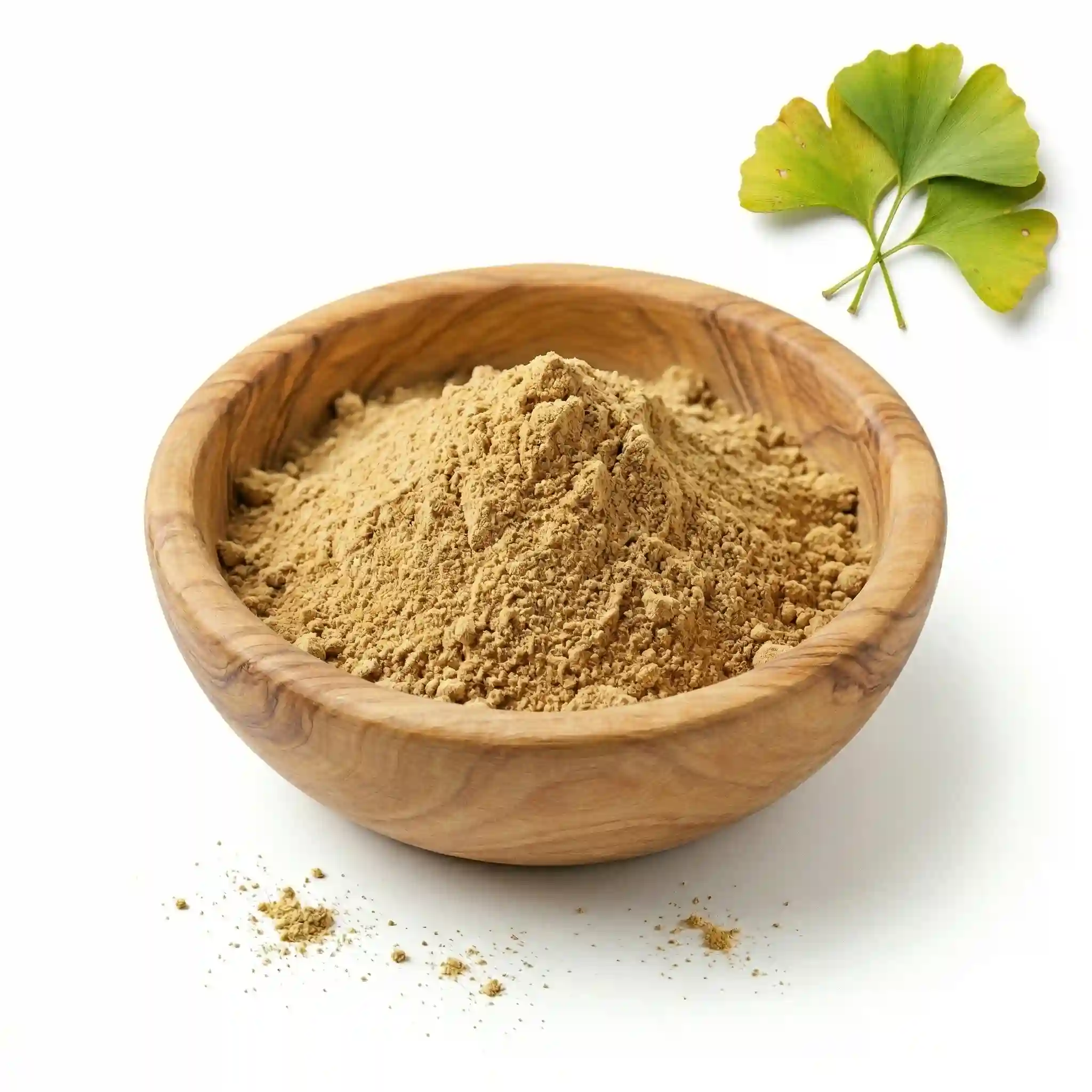
Ginkgo Biloba Extract Supplier — 24/6 Standardized & 4:1/10:1/20:1 Ratio | B2B Sourcing Guide
Not all ginkgo material is equivalent — the gap between a standardized extract and generic ginkgo powder is wide enough to determine whether a finished formula can support its label specification. The industry benchmark is well-established: ginkgo biloba extract standardized to 24% flavone glycosides and 6% terpene lactones (the “24/6 standard”). Valeherb supplies both the 24/6 standardized extract and ratio extracts (4:1, 10:1, 20:1, HPLC fingerprint available). This guide covers the science behind the standard, the published research, and what to require when sourcing bulk material.
The 24/6 Standard: What It Means and Why It Matters
Raw ginkgo leaves contain highly variable concentrations of bioactive compounds — influenced by soil, harvest timing, leaf age, and processing. Standardization reduces that variability by concentrating two compound classes into a defined, reproducible ratio:
| Compound Class | Standardization Target | Activity Studied in Research |
|---|---|---|
| Ginkgo Flavone Glycosides (Flavonols) | 24% by UV spectrophotometry | Studied for antioxidant and neuroprotective activity via free-radical scavenging[1] |
| Terpene Lactones (Ginkgolides A, B, C; Bilobalide) | 6% by HPLC | Studied for platelet-activating factor (PAF) inhibition and effects on microcirculation[2] |
This ratio reflects the naturally occurring compound balance in high-quality Ginkgo biloba leaf material and is the composition used across the most cited clinical trials, including those using the proprietary reference extract EGb761. EGb761 is the reference extract against which standardized ginkgo extracts are commonly compared, and its trials at 120 mg daily form the primary research base for cognitive and circulatory studies.[3]
For a full explanation of what the EGb 761 composition means for sourcing, see our guide to EGb 761 and the ginkgo biloba reference standard.
SOURCING NOTE
Two Supply Forms
| Product Line | Specification | Typical Application |
|---|---|---|
| 24/6 Standardized Extract | 24% flavone glycosides (UV) + 6% terpene lactones (HPLC); ginkgolic acid ≤5 ppm | Cognitive/nootropic supplements and applications referencing the clinically studied composition |
| Ratio Extract | 4:1, 10:1, 20:1 concentration ratios; HPLC fingerprint available | Functional foods & beverages, cost-effective formulations not requiring the 24/6 marker percentages |
Note that the published cognitive research rests on the 24/6 (EGb761-type) composition; it does not automatically transfer to ratio extracts, which are characterised by HPLC fingerprint rather than the 24/6 marker percentages.
Published Research: What the Studies Show
Cognitive Function & Memory
A Cochrane systematic review by Birks & Grimley Evans (2009) analyzing 36 trials reported that standardized ginkgo biloba extract was associated with improvements in cognitive measures — including memory recall, processing speed, and attention — versus placebo across adult study populations.[1] The trials used standardized extract at 120–240 mg daily, with 120 mg the most consistently studied dose.
Circulation Research
Terpene lactones — specifically ginkgolides A and B — are characterised in research as platelet-activating factor (PAF) inhibitors. Through reduced PAF-mediated platelet aggregation and effects on vascular tone, standardized ginkgo extract has been studied in the context of peripheral circulation.[2]
Antioxidant & Neuroprotective Activity
Flavone glycosides are studied for scavenging reactive oxygen species (ROS) — an antioxidant mechanism characterised in research relevant to neuronal tissue, and an area of interest for topical and cosmeceutical applications where flavonoid preparations are studied against UV-induced oxidative stress in skin.[1]
Formulation Applications
- Cognitive & nootropic supplements: The primary application. A common format is 120 mg standardized extract per capsule. Nootropic formulations frequently pair ginkgo with Bacopa monnieri, Lion’s mane, or phosphatidylserine
- Circulation-category supplements: Standardized extract at 120–240 mg/day formulation reference. Common in products for older-adult and general-wellness categories
- Cosmeceuticals & dermaceuticals: Flavone glycosides applied topically are studied for free-radical scavenging and skin-barrier support. Water-soluble extract grades required for serum and emulsion formats
- Functional foods & beverages: Heat-stable extract grades required; ginkgo’s mild bitter profile can be masked with natural flavor systems. Ratio extracts (4:1, 10:1, 20:1) are commonly used in this category
A frequent request we receive is for ginkgo biloba bulk extract for nootropic formulations. In our experience the most important specification discussion is the terpene lactone breakdown — clients building premium cognitive products want ginkgolide B confirmed separately, as it is the most-studied PAF inhibitor among the terpene lactones.
Doses Used in Published Research
| Research Context | Dose Used in Trials | Regimen in Trials |
|---|---|---|
| Cognitive research (general) | 120 mg/day standardized extract[3] | Once daily with food, or split AM/midday |
| Cognitive research (higher dose) | 240 mg/day standardized extract | Split into 2–3 doses with meals |
| Circulation research | 120–240 mg/day | Split doses; sustained daily use over several weeks in study protocols |
The figures above are doses used in published clinical research, provided as a formulation reference only — not treatment recommendations or dosing instructions for any condition. Finished-product dosing and claims are the marketer’s responsibility under applicable regulations.
Sourcing Criteria: What Every B2B Buyer Should Require
| Criterion | What to Require |
|---|---|
| Flavone Glycoside Content | 24% minimum by UV spectrophotometry — batch-specific COA value, not just the specification-sheet minimum (standardized line) |
| Terpene Lactone Content | 6% minimum by HPLC — with breakdown of ginkgolides A, B, C and bilobalide for premium applications (standardized line) |
| Ratio Extract Verification | For 4:1 / 10:1 / 20:1 material, request the HPLC fingerprint and concentration ratio; note these are not standardized to the 24/6 marker percentages |
| Ginkgolic Acid Limit | ≤5 ppm by HPLC — non-negotiable for Ph. Eur. compliance and safety. Commodity extracts frequently exceed this limit |
| Third-Party COA | Heavy metals (USP <232>), pesticide residues, microbial limits (USP <2021>), moisture, ginkgolic acid — per batch |
| Pharmacopeial Compliance | Ph. Eur. monograph (01/2016:1827) or USP monograph compliance for pharmaceutical-use and premium supplement applications |
| Certifications | Non-GMO, Kosher/Halal for relevant markets. FDA-registered facility required for US supplement supply chains |
Regulatory Guidance
- US (DSHEA): Any structure/function claim on the finished product is the marketer’s responsibility to substantiate and must carry the FDA disclaimer; antioxidant and general cognitive/memory support are the more readily supported areas. Circulatory and cerebrovascular claims sit close to disease territory and warrant caution. Disease treatment claims (e.g., dementia, stroke) require drug (NDA) approval
- EU: Ginkgo biloba leaf dry extract has a well-established-use monograph under the European Medicines Agency (EMA/HMPC/244112/2006)[4] covering symptomatic relief in age-related cognitive impairment and peripheral arterial conditions — a strong regulatory background, though this is the status of the herbal medicinal product, not a claim for a supplement
- Germany (Commission E): Approved for symptomatic relief in dementia syndromes and intermittent claudication — the foundational phytomedicine approval that preceded the EMA monograph (regulatory background, not a supplement claim)
References
[1] Birks JS & Grimley Evans J. (2009). Ginkgo biloba for cognitive impairment and dementia. Cochrane Database of Systematic Reviews, Issue 1. doi:10.1002/14651858.CD003120.pub3
[2] Pittler MH & Ernst E. (2000). Ginkgo biloba extract for the treatment of intermittent claudication: a meta-analysis of randomized trials. American Journal of Medicine, 108(4), 276–281. PMID: 11014719
[3] Tan MS et al. (2015). Efficacy and adverse effects of ginkgo biloba for cognitive impairment and dementia: a systematic review and meta-analysis. Journal of Alzheimer’s Disease, 43(2), 589–603. doi:10.3233/JAD-140837
[4] European Medicines Agency. (2014). Assessment report on Ginkgo biloba L., folium. EMA/HMPC/244112/2006. ema.europa.eu


