
Written and reviewed by Dr. Xiaoyan Qiu · Botanical Extract R&D Engineer, Valeherb · June 2026
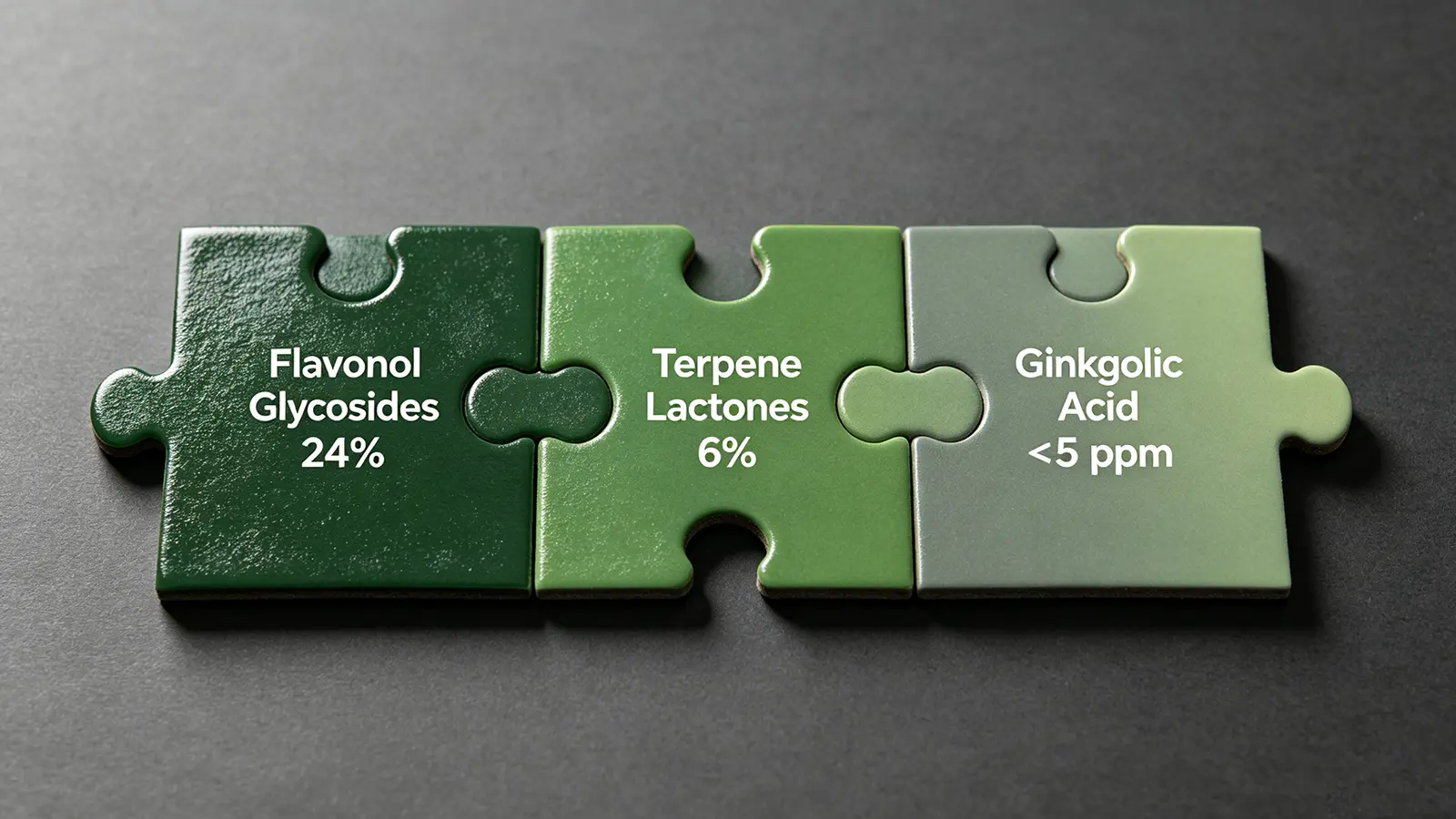
EGb 761 is a standardized dry extract of Ginkgo biloba leaves defined by a precise composition: 24% flavonol glycosides, 6% terpene lactones, and ginkgolic acid below 5 ppm. It was developed by Dr. Willmar Schwabe Pharmaceuticals in Germany and became the reference extract used across the majority of published ginkgo clinical research. It is not a brand you purchase directly — it is a compositional specification, sold under trade names including Tebonin, Tanakan, and Rökan in different markets, and replicated by manufacturers who meet the same three-parameter standard. For anyone sourcing ginkgo extract for a supplement formula, EGb 761 matters because the clinical evidence base attaches to this composition — and any extract that cannot be verified against it is working from a different, less-documented foundation.
Why EGb 761 Was Developed — and Why It Stuck
Raw ginkgo leaf is chemically variable. The concentration of active compounds shifts with harvest timing, leaf age, growing region, and processing method — which means two batches of unspecified “ginkgo extract” can look identical on a label while delivering meaningfully different compositions. This variability made it impossible to run reproducible clinical research or build a consistent evidence base.
EGb 761 was the solution. Developed in Germany in the 1960s and 1970s, it concentrated two compound classes — flavonol glycosides and terpene lactones — into a defined ratio and set a hard upper limit on ginkgolic acid, a cytotoxic constituent in raw leaf that must be removed in any compliant extract. The result was a composition reproducible enough to use across multi-year clinical trials and get the same material in every batch. Subsequent researchers adopted it to keep their results comparable, which is how a single manufacturer’s extract specification became the de facto standard for an entire ingredient category.
Today EGb 761 is less a brand than a benchmark. The Schwabe patents have expired, and any manufacturer can produce an extract meeting the same 24/6 specification with ginkgolic acid below 5 ppm. What matters for sourcing is not the name on the drum but whether the COA verifies all three parameters per batch — that is what alignment with the EGb 761 evidence base actually requires.
Flavonol glycosides: 24% · Terpene lactones: 6% · Ginkgolic acid: <5 ppm · Source: dried Ginkgo biloba leaf · Developer: Dr. Willmar Schwabe Pharmaceuticals · Trade names: Tebonin, Tanakan, Rökan
The 24/6 Composition: What Each Number Represents
The two numbers in the 24/6 designation describe two chemically distinct compound classes, measured by different analytical methods, with different mechanisms studied in research. They are not interchangeable, and a specification that names only one of them is incomplete.
| Marker | Target | Measurement Method | Key Compounds |
|---|---|---|---|
| Flavonol glycosides | 24% | UV spectrophotometry | Quercetin, kaempferol, isorhamnetin glycosides |
| Terpene lactones | 6% | HPLC | Ginkgolides A, B, C, J; bilobalide |
| Ginkgolic acid | <5 ppm | HPLC | Cytotoxic alkylphenols — safety limit, not a marker |
The flavonol glycosides are the antioxidant fraction — quercetin, kaempferol, and isorhamnetin conjugated to sugar units, studied for free-radical scavenging activity in neuronal tissue.[1] The terpene lactones are structurally unique to ginkgo — ginkgolides A, B, C, and J, plus bilobalide — and are the fraction studied in the context of platelet-activating factor inhibition and effects on microcirculation.[2] The two fractions do different things in the research literature, which is why both have to be specified and verified independently on every batch COA.
Ginkgolic acid sits in a separate category: it is not a beneficial marker but a safety limit. Raw ginkgo leaf contains alkylphenol compounds that are cytotoxic in cell studies and need to be removed during extraction. The Ph. Eur. monograph sets the limit at <5 ppm, and EGb 761 complies with this limit by design. It is the most common quality failure in commodity ginkgo extracts — material that hits 24% flavonol glycosides but was not processed to remove ginkgolic acid adequately.
Why EGb 761 Became the Research Standard
The reason EGb 761 dominates the ginkgo research literature is straightforward: it was the extract used in the trials that established the evidence base, and subsequent researchers adopted it to make their results comparable. A Cochrane systematic review covering 36 randomized trials of standardized ginkgo extract used the EGb 761 composition — or extracts matching it — as the primary reference across most included studies.[3] A meta-analysis of trials in cognitive impairment and dementia similarly drew on EGb 761-type compositions at 120–240 mg daily as the studied dose range.[4]
This is not an endorsement of any specific brand. It is a statement about how research works: when a defined composition is used consistently across trials, the results become comparable and cumulative. The clinical data attaches to the composition, not to a trade name. Any extract that matches the 24/6 specification with ginkgolic acid below 5 ppm — verified per batch by HPLC — is working from the same compositional foundation as the studied material. An extract that hits 24% flavonol glycosides but lacks a verified terpene lactone figure, or has not been tested for ginkgolic acid, cannot make that claim.
EGb 761 vs Generic Ginkgo Extract: The Practical Difference
Walk through a typical procurement scenario: two suppliers both list “ginkgo biloba extract 24%” on their product sheet. One COA shows 24% flavonol glycosides by UV, no terpene lactone figure, no ginkgolic acid result. The other shows 24% flavonol glycosides by UV, 6.2% terpene lactones by HPLC, and ginkgolic acid at 1.8 ppm. These are not the same product, even though the headline number is identical.
The first extract cannot be confirmed as meeting the 24/6 standard. The terpene lactones are absent from the documentation, and the ginkgolic acid status is unknown. A brand claiming alignment with the EGb 761 evidence base on a 24%-only COA has a documentation gap that would not survive regulatory scrutiny in the EU, where the EMA monograph is preparation-specific.[5] The second extract is documentable as an EGb 761-type composition — all three parameters are verified per batch.
The terpene lactone breakdown matters further for premium applications, where individual ginkgolide content — particularly ginkgolide B — is relevant beyond the total 6% figure. For a full technical breakdown of the terpene lactone fraction and why ginkgolide B warrants separate specification in high-specification formulas, see our guide to ginkgolide B and the terpene lactone fraction.
How to Align a Purchase Specification with the EGb 761 Standard
The practical translation of EGb 761 into a purchase specification is a short list of non-negotiable COA requirements. None of them are unusual — they are standard analytical work that any compliant manufacturer should be able to provide per batch. The issue is that many buyers do not ask for all of them, and suppliers who cannot provide all of them will not volunteer that information.
| COA Requirement | Why It Matters | What to Accept |
|---|---|---|
| Flavonol glycosides | Primary marker — the 24% target | 24% minimum by UV spectrophotometry, per batch |
| Terpene lactones | Second marker — the 6% target, often missing | 6% minimum by HPLC, per batch; breakdown of ginkgolides A, B, C, J and bilobalide for premium applications |
| Ginkgolic acid | Safety limit — cytotoxic if above 5 ppm | <5 ppm by HPLC, per batch; non-negotiable |
| Third-party testing | Heavy metals, pesticides, microbiology | Per batch, not a one-time type test |
| Pharmacopeial compliance | Ph. Eur. 01/2016:1827 or USP monograph | Required for EU and pharmaceutical-grade supply chains |
One habit that saves time: ask for the terpene lactone breakdown first, before the price discussion. Suppliers who cannot provide a per-batch ginkgolide and bilobalide breakdown are almost certainly not producing to EGb 761-type specifications, regardless of what the product sheet says. The flavonol glycoside number is easy to hit; the terpene lactone verification with a full breakdown is where the real quality separation happens.
For a complete breakdown of what the 24% and 6% markers represent chemically and how they are measured, see our technical guide to ginkgo flavone glycosides and terpene lactones. For the full sourcing specification and available grades, see the Valeherb ginkgo biloba extract product page.
Regulatory Context for EGb 761-Type Extracts
The regulatory standing of EGb 761-type compositions is stronger than most botanical ingredients, particularly in Europe. The European Medicines Agency’s HMPC has issued a well-established-use monograph for Ginkgo biloba leaf dry extract — the only tier that allows claims beyond “traditional use” — and that monograph is written for a specific preparation: the 35–67:1 concentrated dry extract standardized to 22–27% flavone glycosides and 5–7% terpene lactones, with ginkgolic acid below 5 ppm.[5] The monograph is preparation-specific. It does not extend automatically to ratio extracts (4:1, 10:1, 20:1) or to unstandardized leaf powder.
In the United States, ginkgo biloba extract is regulated as a dietary supplement under DSHEA. Structure/function claims are the marketer’s responsibility to substantiate, and the FTC has scrutinized cognitive and memory claims closely. The practical guidance here is the same as for any YMYL ingredient: the research base is genuinely strong for the EGb 761 composition, but that does not translate automatically into permitted label claims — the claim type, the wording, and the applicable regulation in the destination market all determine what can appear on the finished product.
Frequently Asked Questions
What does EGb 761 stand for?
EGb 761 is a product code, not an acronym — EGb refers to “Egb” (extract of ginkgo biloba) and 761 is the development batch designation from Dr. Willmar Schwabe Pharmaceuticals, who developed the extract in Germany. The name became the standard identifier for the composition used in clinical research: 24% flavonol glycosides, 6% terpene lactones, and ginkgolic acid below 5 ppm. It is marketed under trade names including Tebonin, Tanakan, and Rökan in different markets.
Is EGb 761 the same as standardized ginkgo biloba extract?
Not automatically. EGb 761 is a specific standardized composition — 24% flavonol glycosides, 6% terpene lactones, ginkgolic acid below 5 ppm — but not all products labelled “standardized ginkgo extract” meet this specification. Many products standardize to 24% flavonol glycosides only, without verifying terpene lactone content or ginkgolic acid. To confirm alignment with the EGb 761 composition, a COA must show all three parameters, per batch, with the terpene lactone figure measured by HPLC rather than estimated.
Why do most ginkgo clinical trials use EGb 761?
EGb 761 was the first rigorously defined ginkgo composition used in controlled clinical research, starting in the 1970s and 1980s. Because the composition was reproducible across batches, trials using it could be compared and pooled in meta-analyses. Later researchers adopted the same composition to keep their results comparable with the existing evidence base. The result is that the majority of the published human trial data on ginkgo — including the Cochrane review and multiple meta-analyses — is based on EGb 761-type compositions, which is why the research base effectively attaches to that specification.
Can I source an EGb 761-equivalent extract without buying the branded product?
Yes. EGb 761 is a composition specification, not a patent on all ginkgo extract. Any manufacturer can produce an extract that meets the 24/6 standard with ginkgolic acid below 5 ppm — what matters is whether the COA verifies all three parameters per batch with appropriate analytical methods. The key requirements are 24% flavonol glycosides by UV, 6% terpene lactones by HPLC with a full ginkgolide and bilobalide breakdown, and ginkgolic acid below 5 ppm by HPLC. Material meeting all three per batch is working from the same compositional foundation as the studied extract.
What is the difference between EGb 761 and a ratio extract like 50:1?
A ratio extract (4:1, 10:1, 50:1) describes a concentration factor — how much raw leaf went into a unit of extract — but does not specify marker compound content. The 24/6 standard of EGb 761 describes verified percentages of specific compound classes measured per batch. The two are different types of specifications: a 50:1 ratio extract could contain widely varying flavonol glycoside and terpene lactone levels depending on the starting material, while a 24/6 standardized extract has verified marker content regardless of concentration ratio. The published research is based on the 24/6 composition, not on any specific ratio.
References
[1] Birks JS, Grimley Evans J. (2009). Ginkgo biloba for cognitive impairment and dementia. Cochrane Database of Systematic Reviews, Issue 1. doi:10.1002/14651858.CD003120.pub3
[2] Pittler MH, Ernst E. (2000). Ginkgo biloba extract for the treatment of intermittent claudication: a meta-analysis of randomized trials. American Journal of Medicine, 108(4), 276–281. PMID: 11014719
[3] Yoshitake T et al. (2010). The Ginkgo biloba extract EGb 761 and its main constituent flavonoids and ginkgolides increase extracellular dopamine levels in the rat prefrontal cortex. British Journal of Pharmacology, 159(3), 659–668. doi:10.1111/j.1476-5381.2009.00580.x
[4] Tan MS et al. (2015). Efficacy and adverse effects of ginkgo biloba for cognitive impairment and dementia: a systematic review and meta-analysis. Journal of Alzheimer’s Disease, 43(2), 589–603. doi:10.3233/JAD-140837
[5] European Medicines Agency, HMPC. (2014). Assessment report on Ginkgo biloba L., folium. EMA/HMPC/244112/2006. ema.europa.eu
FDA Notice: These statements have not been evaluated by the Food and Drug Administration. This article is for informational purposes only; all references describe published peer-reviewed research at the compound and ingredient level and are not health claims for any product or medical advice. Products must comply with applicable regulations in the buyer’s jurisdiction, and all finished-product claims are the brand’s responsibility. © 2026 Valeherb. All rights reserved.