
Solubility: The Property Behind the pH Testing Method
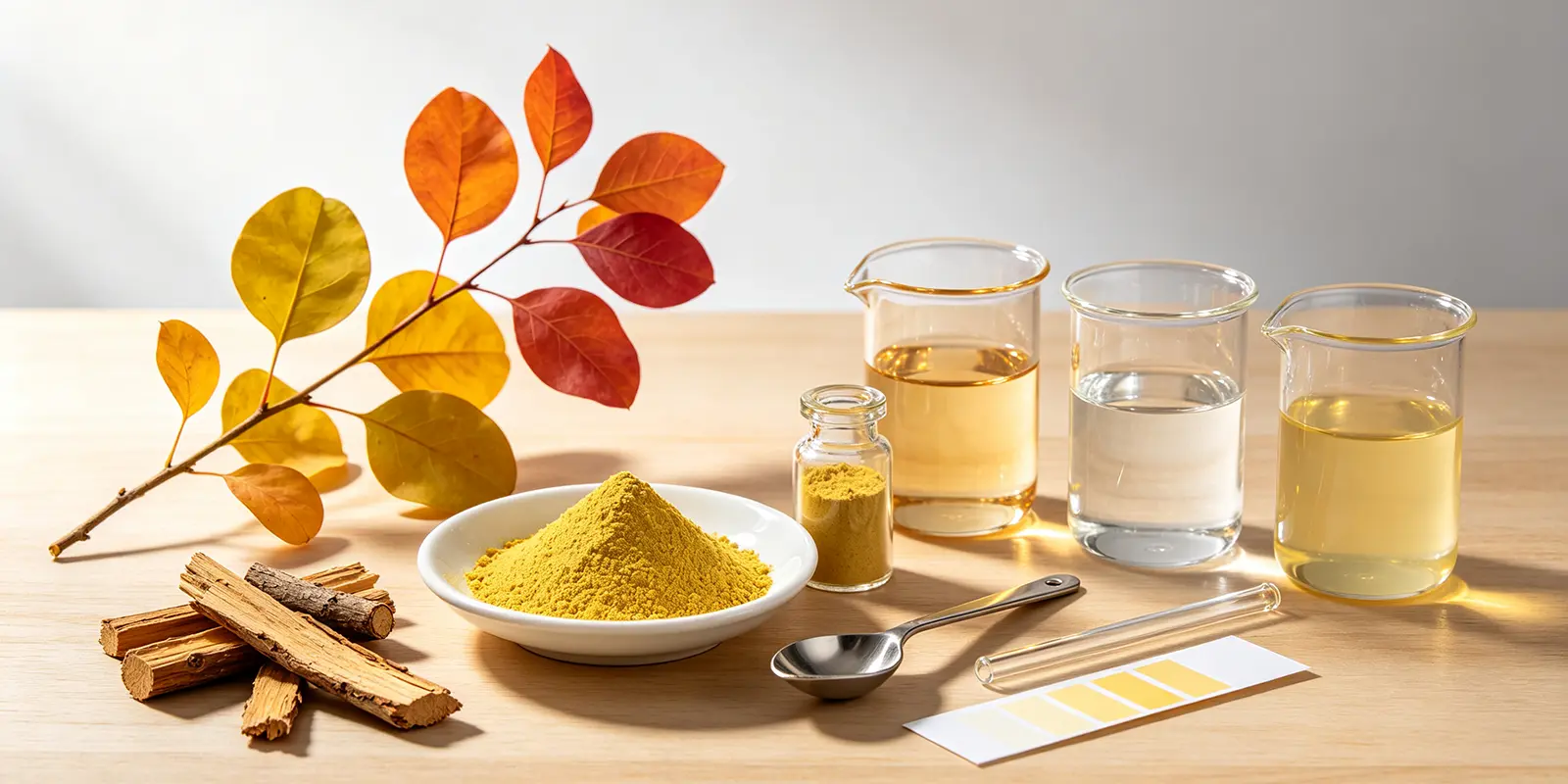
Fisetin is practically insoluble in water and dissolves meaningfully only in alcohol-type and similar organic solvents — a fixed physicochemical property, not a processing variable. Across independent analytical and chemical supplier data, fisetin’s solubility is consistently reported at roughly 5 mg/mL in ethanol, with water solubility negligible; it is also soluble in methanol, acetone, and acetic acid.[1] This is why the pH stability testing referenced below was conducted in an aqueous-alcoholic solution rather than pure water — fisetin has to be carried into solution by the alcohol component first.
This solubility profile is classified as BCS Class II (low solubility, high permeability) in the biopharmaceutical classification system[1] — a formal way of stating that fisetin’s limiting factor for aqueous or oral delivery isn’t crossing biological membranes, it’s getting into solution in the first place. This is also the underlying reason liposomal and other enhanced-delivery fisetin formats exist as a commercial category: encapsulation technologies exist specifically to work around exactly this kind of poor water solubility, not to add an unrelated benefit. Formulators targeting an aqueous-phase or beverage format should treat solubility, not just chemical stability, as a primary formulation constraint.
What the Full Stability Dataset Actually Shows
Fisetin is sensitive to open-air heat, humidity, and light, and severely unstable in alkaline solution — but stable for years when sealed, cool, dark, and kept out of alkaline systems. That’s the practical summary. This guide walks through the complete batch-level stability data behind that summary, from stress testing through long-term storage, so formulators can make informed packaging and formulation decisions rather than relying on general flavonoid assumptions.
Stress Testing: Where Fisetin Actually Breaks Down
A full stability study on our own 98% HPLC-purity production batches (Report No. YZK-QS-WD-20260603) tested fisetin under forced-degradation conditions across heat, humidity, light, and pH, following China’s Guidelines for Stability Studies of Chemical Drugs and plant-extract quality stability testing standards.
| Condition | Duration | Content Remaining | Observation |
|---|---|---|---|
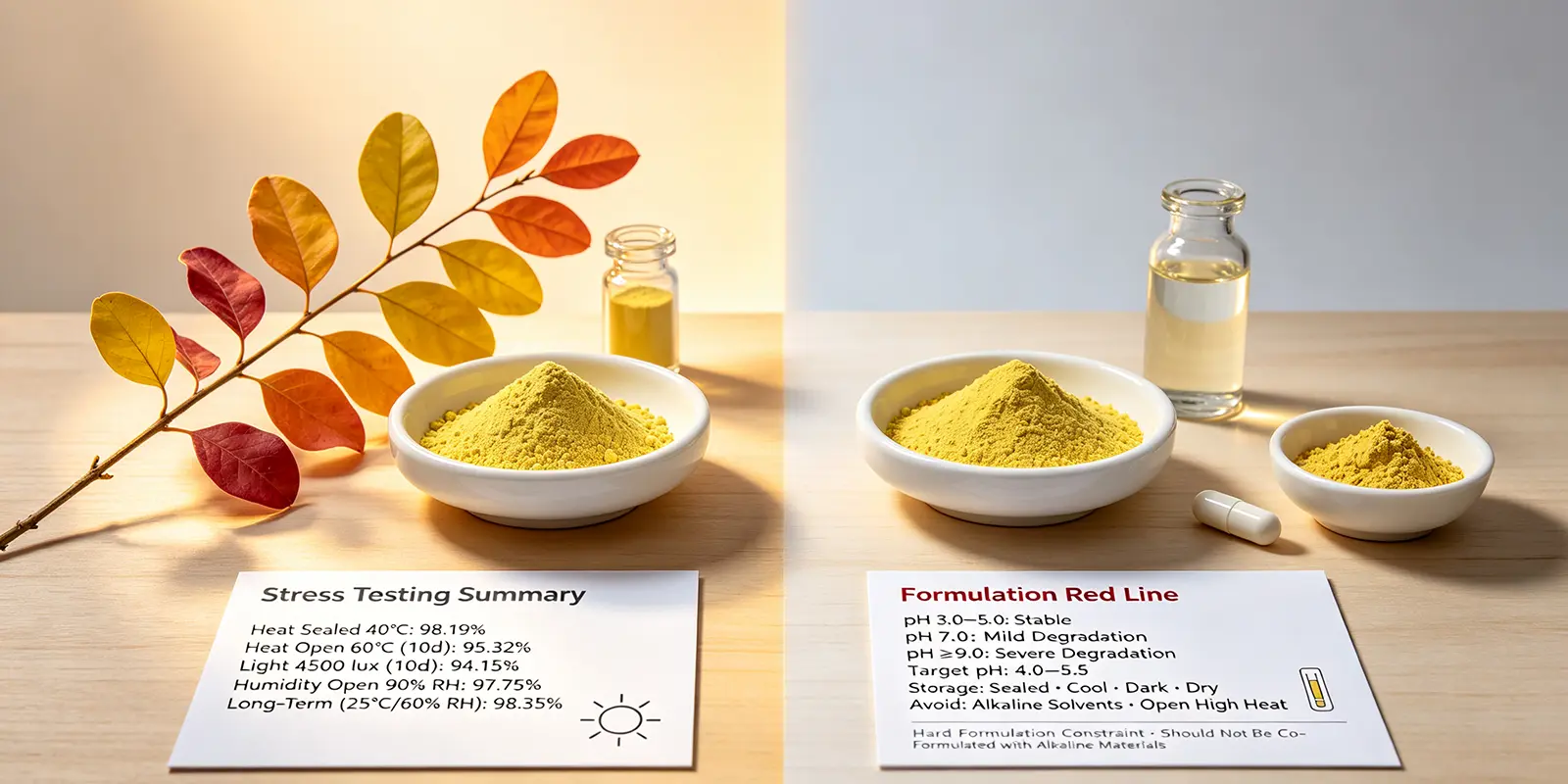
| Heat, sealed, 40°C | 10 days | 98.19% | No visible change — sealed high-heat resistance is good |
| Heat, open, 60°C | 5 days | 97.08% | Slightly darker yellow |
| Heat, open, 60°C | 10 days | 95.32% | Darkened to dark yellow — open high-heat exposure accelerates oxidative degradation |
| Humidity, open, 90% RH | 10 days | 97.75% | Slight moisture uptake — exposed conditions absorb moisture readily |
| Humidity, sealed, 75% RH | 10 days | 98.32% | No caking or discoloration — sealed moisture resistance is good |
| Light, 4500 lux | 5 days | 96.68% | Color darkening — light-sensitive, mild degradation |
| Light, 4500 lux | 10 days | 94.15% | Deep yellow — continuous strong light exposure drives oxidative degradation readily |
The pattern across all three stress variables is consistent: fisetin tolerates sealed conditions well even at elevated temperature or humidity, but degrades measurably faster once exposed to open air — heat, moisture, and light all accelerate oxidative degradation once the sealed barrier is removed.
pH Stability: The Sharpest Sensitivity
Fisetin’s most pronounced sensitivity by far is to pH, tested in aqueous-alcoholic solution at pH 3.0, 5.0, 7.0, 9.0, and 11.0 over 24 and 72 hours:
| pH Range | 72-Hour Result |
|---|---|
| 3.0–5.0 (acidic) | Content loss under 1.2%, solution remained clear with no color change — excellent stability |
| 7.0 (neutral) | Content loss of approximately 3.7% — mild degradation |
| ≥9.0 (alkaline) | Solution discolored (turned reddish) within 24 hours; content loss exceeded 20% by 72 hours — severe, rapid degradation |
This pattern is independently corroborated in the published literature, not just our own batch data. A kinetic study measuring fisetin’s degradation rate constant (k) across a pH and temperature range found that raising the medium pH from 6.0 to 7.5 at 37°C increased fisetin’s degradation rate 24-fold — from k = 8.30×10⁻³ h⁻¹ to k = 0.202 h⁻¹ — with degradation rate also increasing sharply with temperature (k = 0.124 h⁻¹ at 50°C, rising to k = 0.490 h⁻¹ at 65°C).[3] The same study found fisetin more stable than quercetin under every condition tested, and identified coexisting proteins (casein and soy protein performed best) as an effective stabilizer against degradation via hydrophobic interaction with the flavonoid.[3] This is worth knowing specifically for any formulation combining fisetin with a protein-containing matrix, where that protein may be doing useful stabilizing work independent of its own functional role in the formula.
Accelerated and Long-Term Storage Data
Sealed finished-batch data (mean of three production lots) supports the shelf life claimed for this product:
| Test | Timepoint | Content | Total Impurities |
|---|---|---|---|
| Accelerated (40°C/75% RH) | 0 months | 98.51% | 0.34% |
| Accelerated (40°C/75% RH) | 1 month | 98.23% | 0.46% |
| Accelerated (40°C/75% RH) | 2 months | 97.96% | 0.59% |
| Accelerated (40°C/75% RH) | 3 months | 97.65% | 0.73% |
| Long-term (25°C/60% RH) | 0 months | 98.51% | 0.34% |
| Long-term (25°C/60% RH) | 3 months | 98.35% | 0.41% |
Under accelerated conditions, purity remains comfortably above the 98% specification floor even after 3 months, with impurity growth increasing gradually rather than sharply — the basis for the product’s 24-month shelf life when kept in sealed, food-grade aluminium foil vacuum packaging.[1]
Practical Formulation Guidance
Storage: sealed, light-protected, cool, dry storage at ≤25°C and relative humidity below 65%, isolated from alkaline materials. Formulation pH: target 4.0–5.5 for any system containing fisetin. Processing: avoid open high-temperature exposure and alkaline solvents throughout production, dispensing, and blending — process under light-protected conditions where practical. These aren’t generic flavonoid-handling assumptions; they’re derived directly from the batch data above.
Full product specifications, sourcing criteria, and COA requirements are available on our bulk fisetin product page.
Frequently Asked Questions
What pH is fisetin stable at?
Fisetin is most stable in acidic conditions, pH 3.0–5.0, showing less than 1.2% content loss over 72 hours in testing. At neutral pH 7.0, degradation is mild (about 3.7% loss). At alkaline pH 9.0 and above, degradation is severe — over 20% content loss within 72 hours, with visible discoloration starting within 24 hours. A formulation pH of 4.0–5.5 is recommended.
Is fisetin water-soluble?
No — fisetin is practically insoluble in water. It dissolves meaningfully in ethanol (approximately 5 mg/mL) and other organic solvents such as methanol and acetone. This poor water solubility is classified as BCS Class II and is the underlying reason enhanced-delivery formats, such as liposomal encapsulation, exist as a formulation approach for aqueous or oral applications.
Does fisetin degrade in heat or light?
Sealed fisetin is stable at 40°C for at least 10 days with minimal change. Open exposure to 60°C heat or continuous 4500 lux light both cause measurable degradation and visible darkening over 5–10 days. Sealed, light-protected packaging is essential for maintaining stability during storage and shipping.
What is the shelf life of fisetin powder?
24 months when stored in sealed, food-grade aluminium foil vacuum packaging under recommended conditions (≤25°C, relative humidity below 65%). This is supported by accelerated stability testing (40°C/75% RH showing 97.65% content retained at 3 months) and long-term testing (25°C/60% RH showing 98.35% retained at 3 months) on production batches.
Can fisetin be used in an alkaline formulation?
No — alkaline conditions (pH 9.0 and above) cause rapid, severe degradation, with solution discoloration within 24 hours and content loss exceeding 20% by 72 hours in testing. Fisetin should not be formulated or processed alongside alkaline solvents or raw materials; a weakly acidic system (pH 4.0–5.5) is the recommended target.
Does adding protein to a formulation help stabilize fisetin?
Published kinetic research found that coexisting proteins, particularly casein and soy protein, measurably reduced fisetin’s degradation rate constant compared to a protein-free solution, attributed to hydrophobic interaction between the protein and the flavonoid. This is a genuine formulation consideration for any product combining fisetin with a protein-containing matrix, such as a protein powder or functional food base.
References
[1] Fisetin: physicochemical properties and BCS classification, compiled from independent chemical analytical supplier data (Selleck Chemicals, Cayman Chemical). Ethanol solubility ~5 mg/mL; water solubility negligible. Cayman Chemical product insert
[2] Wang J, Zhao X-H. Degradation kinetics of fisetin and quercetin in solutions affected by medium pH, temperature and co-existed proteins. J Serb Chem Soc. 2016;81(3):243-253. https://doi.org/10.2298/JSC150706092W