
One Hydroxyl Group, Two Different Research Strengths
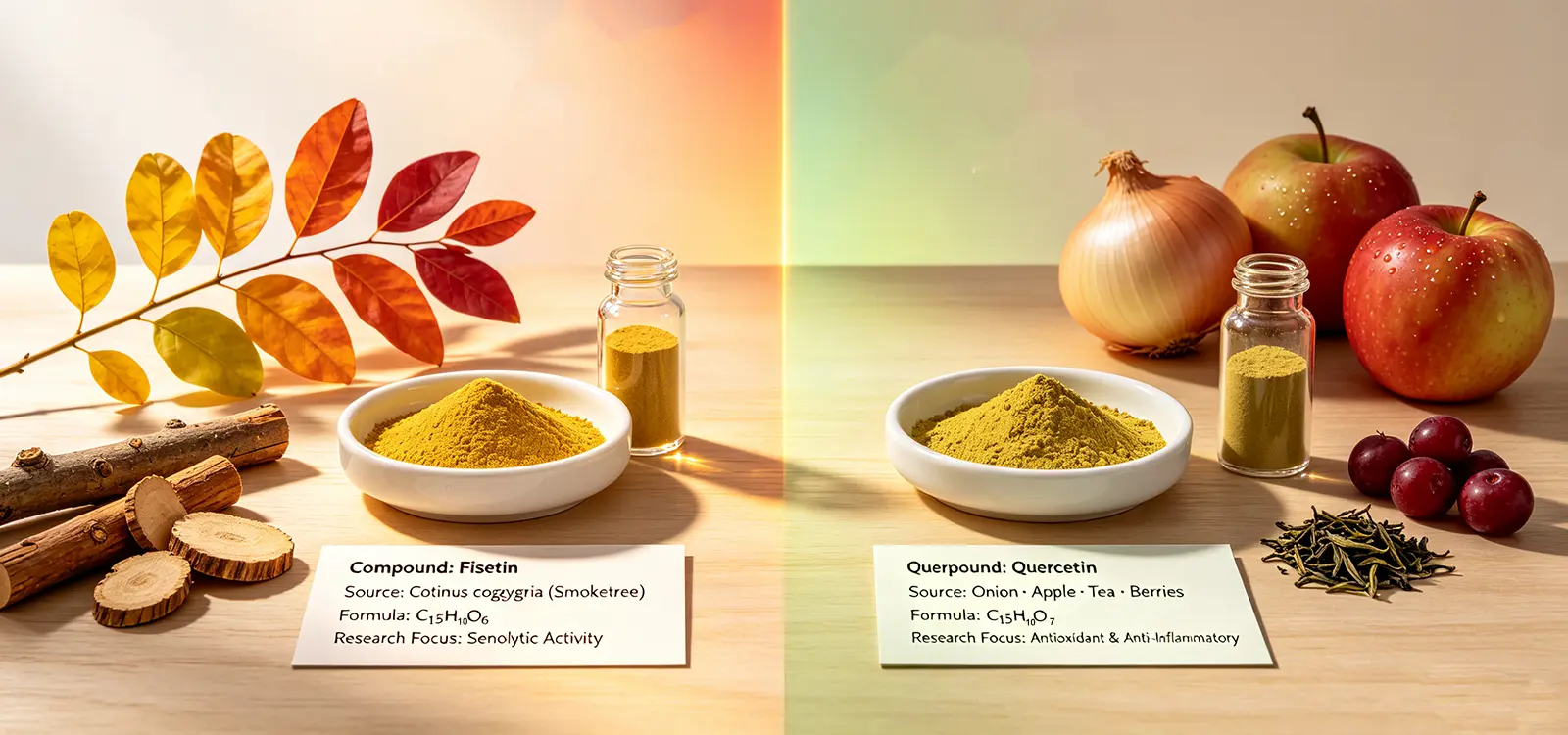
Fisetin and quercetin are structurally near-identical flavonols, differing by exactly one hydroxyl group — but the useful comparison isn’t “which one wins,” it’s which compound’s research base actually matches your formulation’s positioning. Fisetin’s molecular formula is C₁₅H₁₀O₆; quercetin’s is C₁₅H₁₀O₇ — quercetin carries one additional oxygen, corresponding to an extra hydroxyl group at the 5-position on the flavonoid A-ring. Quercetin’s largest research base sits in antioxidant and anti-inflammatory activity; fisetin’s distinguishing research base is senolytic — its ability to selectively clear senescent cells in preclinical models. Both claims come from real, separate bodies of research, not a single “better compound” verdict.
| Fisetin | Quercetin | |
|---|---|---|
| Molecular formula | C₁₅H₁₀O₆ | C₁₅H₁₀O₇ |
| Hydroxyl groups | 4 | 5 (one additional, at the A-ring 5-position) |
| Distinguishing research base | Senolytic activity (senescent cell clearance) | Antioxidant and anti-inflammatory activity |
| Reported human elimination half-life | ~1.14 hours (oral, healthy volunteers) | Independently reported as poorly bioavailable due to low aqueous solubility |
| Comparative oral absorption (mouse study, 6 flavonoids tested) | Among the most highly absorbed of the group | Included in the same comparative panel |
The Screening Data: What Was Actually Measured
The senolytic comparison between these two compounds traces back to a single foundational study: a 2018 screen of ten flavonoid polyphenols for senotherapeutic activity in oxidatively-stressed murine embryonic fibroblasts and etoposide-induced senescent human fibroblasts.[1] At a concentration of 5 μM in this cell-culture assay, fisetin was the most effective compound tested at reducing the fraction of senescence-associated β-galactosidase-positive cells, while quercetin was ineffective at the concentrations tested in the same screen — a directly measured, head-to-head result, not an indirect inference.[1] Luteolin and curcumin showed weak activity under the same conditions where quercetin showed none, positioning fisetin as a clear standout among the ten-compound panel specifically for this senolytic screen.
It’s worth being precise about what this concentration represents: 5 μM is a cell-culture assay concentration, not a human or animal dose, and this study’s own senolytic activity findings in vivo — where fisetin reduced senescence markers across tissues in progeroid and aged wild-type mice, with associated improvements in health span and lifespan — used a separate experimental design specific to that murine model.[1] Neither the cell-culture concentration nor the mouse study dosing translates directly into a human intake recommendation, and this article does not attempt that conversion.

Bioavailability and Handling: A Real, Practical Difference
Beyond the senolytic screening comparison, the two compounds differ in properties that matter directly for formulation and delivery. A human pharmacokinetic study cited in a 2024 review found that after oral administration of fisetin to healthy volunteers, plasma levels showed a short elimination half-life of approximately 1.14 hours, with fisetin detectable in plasma for only about two hours post-dose — consistent with fisetin’s generally rapid metabolism and low oral bioavailability due to poor aqueous solubility.[2] A separate, direct comparative study measuring the oral bioavailability of six structurally related flavonoids in mice — including both fisetin and quercetin — found that fisetin was among the most highly absorbed of the six compounds tested, with absorption differences across the group linked to subtle structural variation, including differences in lipophilicity (LogP) between compounds.[3] For formulators, these are practical, structural, and delivery-relevant differences — not a health-outcome comparison — and they’re part of why fisetin and quercetin are not simply interchangeable in a formulation targeting a specific absorption profile.
A Safety Consideration Worth Flagging
Fisetin, along with related flavones and flavonoids, has been documented to inhibit cytochrome P450 2C9 — a liver enzyme responsible for metabolizing a range of common medications, including warfarin.[4] This finding comes from a registered clinical trial protocol, which specifically notes this as a reason for precaution around drug-drug interactions in trial participants. This is a genuine formulation and labeling consideration for finished products, not a mechanism to be positioned as a benefit — buyers combining fisetin with other actives, or targeting populations likely to be on anticoagulant medication, should factor this into their own safety and interaction review.
For complete product specifications, sourcing criteria, and the full senolytic research background, see our bulk fisetin product page.
Frequently Asked Questions
Is fisetin more potent than quercetin?
For senolytic activity specifically, yes: the foundational 2018 screening study found fisetin the most effective of ten flavonoids tested at reducing senescent cell markers in cultured cells, while quercetin was ineffective at the concentrations tested in the same screen. This is a specific, measured in vitro finding, not a general “better compound” verdict — quercetin’s own largest research base is in antioxidant and anti-inflammatory activity, a different area of strength.
Does fisetin have better bioavailability than quercetin?
A human pharmacokinetic study found fisetin has a short elimination half-life (approximately 1.14 hours) after oral administration, consistent with rapid metabolism. A separate comparative study of six related flavonoids in mice, including both fisetin and quercetin, found fisetin among the most highly absorbed of the group. These are structural and delivery-relevant differences relevant to formulation, not a health-outcome comparison.
What is the structural difference between fisetin and quercetin?
Fisetin (C15H10O6) and quercetin (C15H10O7) differ by exactly one oxygen atom — quercetin carries an additional hydroxyl group at the 5-position on the flavonoid A-ring. Despite this being a minor structural difference, it corresponds to measurably different biological activity, including the potency gap observed in senolytic screening research.
Can fisetin and quercetin be used together in a formulation?
The two compounds are frequently discussed and combined in the research and consumer literature, reflecting their structural similarity and shared classification as flavonols under senolytic research. Formulators combining the two, or combining fisetin with other actives generally, should conduct independent safety and interaction review — fisetin has been documented to inhibit an enzyme (CYP2C9) involved in metabolizing certain common medications.
Does fisetin interact with medications?
A registered clinical trial protocol notes that fisetin, along with related flavones and flavonoids, has been shown to inhibit cytochrome P450 2C9, an enzyme involved in metabolizing several common medications including warfarin. This is a genuine interaction consideration for finished-product formulation and labeling, and buyers should conduct independent safety review for their specific target population.
References
[1] Yousefzadeh MJ, Zhu Y, McGowan SJ, Angelini L, Fuhrmann-Stroissnigg H, Xu M, et al. Fisetin is a senotherapeutic that extends health and lifespan. EBioMedicine. 2018;36:18-28. https://doi.org/10.1016/j.ebiom.2018.09.015
[2] Tavenier J, Nehlin JO, Houlind MB, Rasmussen LJ, Tchkonia T, Kirkland JL, Andersen O, Rasmussen LJH. Fisetin as a senotherapeutic agent: evidence and perspectives for age-related diseases. Mech Ageing Dev. 2024;222:111995. https://doi.org/10.1016/j.mad.2024.111995
[3] Maeda N, Hashimoto A, Morita R, Munemasa S, Murata Y, Nakamura Y, Nakamura T. Comparison of bioavailability of quercetin and its structural analogs in mice. Arch Biochem Biophys. https://doi.org/10.1016/j.abb.2026.110775
[4] Senolytic Drugs Attenuate Osteoarthritis-Related Articular Cartilage Degeneration: A Clinical Trial. Protocol and Statistical Analysis Plan. ClinicalTrials.gov Identifier: NCT04210986. ClinicalTrials.gov (ClinicalTrials.gov may be temporarily inaccessible due to a U.S. government shutdown; the registered protocol can be verified once federal systems resume normal operation.)