

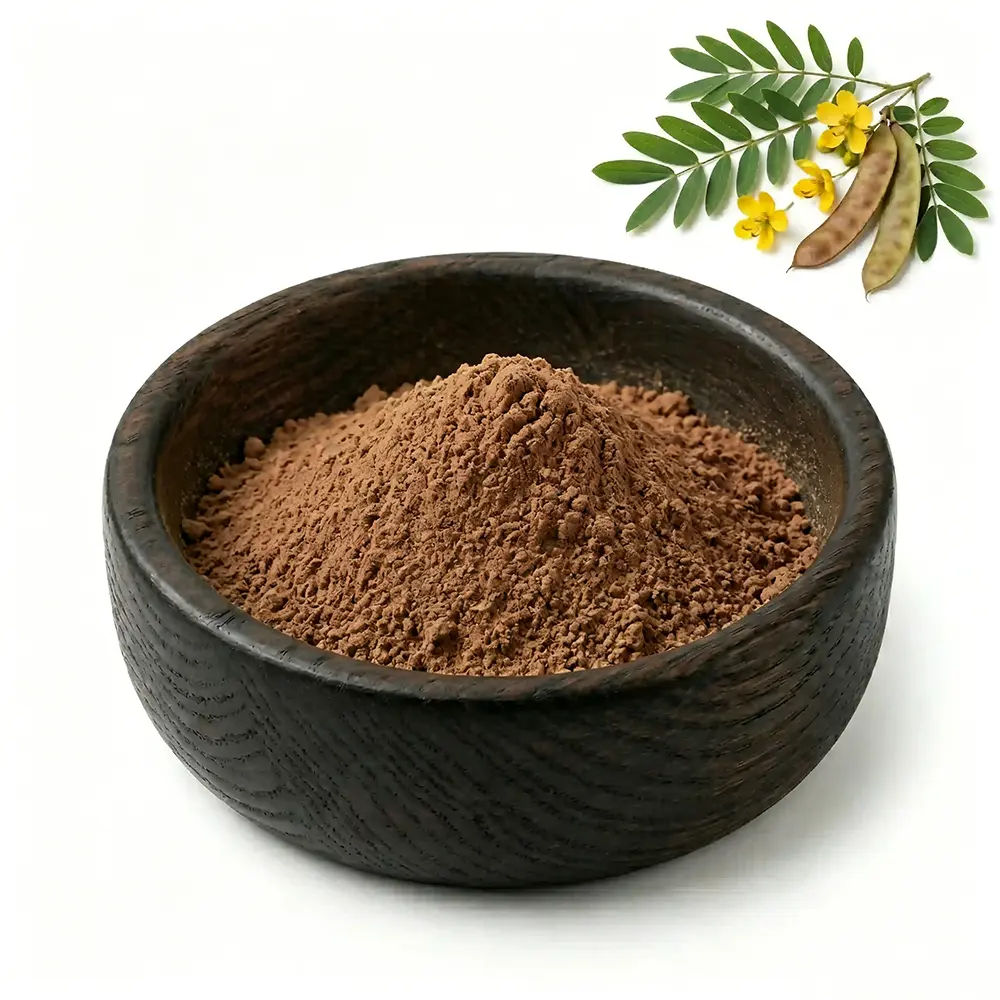
Bulk Senna Leaf Extract Supplier — Standardized Sennosides A+B 10% & 20%, B2B Wholesale
Valeherb supplies standardized senna leaf extract in bulk at two HPLC-verified potencies — 10% and 20% total sennosides (A+B) — with custom packaging and full batch documentation for nutraceutical, functional food, and OTC laxative formulators. Derived from the leaves of Cassia angustifolia (Senna alexandrina), senna is one of the few botanicals marketed within the FDA OTC drug framework as a stimulant laxative active — a clearer regulatory reference point than most botanical ingredients can offer in the US market. Whether your downstream product is a gentle-cleanse functional tea or a concentrated OTC laxative capsule, we supply the sennoside grade and COA documentation your production line requires.
Active Compounds and Mechanism
Senna’s characteristic activity is driven by anthraquinone glycosides — primarily sennoside A and sennoside B, the two compounds Valeherb’s extract is standardized against. In pharmacological research these sennosides are described as prodrugs: they pass through the stomach and small intestine largely unabsorbed, becoming active only when colonic bacteria metabolize them into rheinanthrone in the large intestine. This colon-localized activation is a well-characterized feature of senna’s pharmacology and accounts for its delayed onset and predominantly local action.
In published research, rheinanthrone has been characterized as acting through two pathways: stimulating the myenteric nerve plexus to increase colonic motility, and increasing fluid in the colonic lumen — in part by lowering colonic aquaporin-3 (AQP3) expression through macrophage-mediated prostaglandin E2 signaling, which reduces water reabsorption from the colon.[2] The clinical effect of this profile has been evaluated directly — in a randomized, placebo-controlled trial, senna significantly improved bowel-movement frequency and constipation-related quality-of-life scores versus placebo over a 28-day period.[1]
Available Grades and Specifications
| Grade | Sennoside (A+B) Content | Typical Downstream Application |
|---|---|---|
| Standardized Extract 10% | 10% total sennosides (A+B), HPLC-verified | Mainstream OTC laxative capsules and tablets; standard-format digestive-support supplements; functional tea blends |
| Standardized Extract 20% | 20% total sennosides (A+B), HPLC-verified | Concentrated formats requiring lower extract weight per dose; high-potency OTC laxative product lines; compact capsule formulations |
Both grades are standardized to total sennosides A+B and supplied with a per-batch HPLC COA. Custom potencies and packaging are available on request.
Formulation Applications
- OTC laxative capsules and tablets: The FDA OTC drug framework references a standard adult sennosides dose of 17.2 mg. At 10% standardization, ~172 mg of extract delivers that reference dose; at 20%, ~86 mg does — enabling a more compact capsule. Finished-product dosing, indications, and label language are determined by the marketer under the applicable OTC monograph
- Functional and herbal teas: Lower per-serving inclusion of standardized extract supports “gentle cleanse” and overnight digestive positioning where consumers self-regulate intake. The 10% grade is the common choice for tea and sachet formats
- Digestive-wellness blends: Senna extract is frequently paired with psyllium husk (adds fiber bulk, moderates transit), ginger extract, and fennel seed in combination formulas. These pairings broaden a product’s positioning and are commonly used to temper the intensity of senna alone
- Weight-management and “detox” lines — regulatory note: Senna is sometimes included in cleanse and detox products. Marketers should review label claims carefully: a laxative indication is supportable under the OTC drug framework, but weight-loss claims are not supported by senna’s mechanism and have drawn FTC and consumer-safety scrutiny. Position conservatively
Regulatory Status — FDA OTC Drug Framework
Senna is legally marketed in the US as an OTC stimulant laxative active — a meaningful regulatory reference point that few botanical ingredients can offer. It falls under FDA’s OTC laxative monograph (Monograph M007), in which the adult sennosides labeling dose is referenced at 17.2 mg for adults and children 12 and over.[3] One nuance formulators should understand: while the laxative monograph order itself was deemed final, senna’s classification within it is not finalized. FDA had proposed reclassifying senna (including sennosides A and B) from Category I (generally recognized as safe and effective) to Category III (further data required) in 1998, and senna OTC products are accordingly marketed under “OTC Monograph Not Final” status. It remains legally available OTC with established labeling, but buyers should not represent its status as a finalized “Category I, safe and effective” determination. A systematic review of OTC constipation therapies graded senna among the agents with good supporting evidence.[4]
Sourcing Criteria
| Criterion | What to Require |
|---|---|
| Sennoside Standardization | HPLC-verified total sennosides (A+B) per batch. Request sennoside A and B reported separately — combined total alone does not confirm the compound profile |
| Species Confirmation | Cassia angustifolia (Senna alexandrina) — the pharmacopoeial species. Cassia acutifolia is an accepted synonym; Cassia alata has a different compound profile and should not be substituted |
| Regulatory Documentation | For US OTC laxative products: confirm the extract supports the OTC laxative monograph (M007) sennosides specifications. Request supplier regulatory-support documentation |
| Third-Party COA | Sennoside content (HPLC), heavy metals (USP <232>), pesticide residues, microbial limits (USP <2021>), moisture — per production batch |
| Certifications | Non-GMO, Kosher/Halal for relevant markets. FDA-registered facility required for US OTC and supplement supply chains |
References
[1] Morishita D, Tomita T, Mori S, et al. (2021). Senna versus magnesium oxide for the treatment of chronic constipation: a randomized, placebo-controlled trial. American Journal of Gastroenterology, 116(1), 152–161. doi:10.14309/ajg.0000000000000942
[2] Kon R, Ikarashi N, Nagoya C, et al. (2014). Rheinanthrone, a metabolite of sennoside A, triggers macrophage activation to decrease aquaporin-3 expression in the colon, causing the laxative effect of rhubarb extract. Journal of Ethnopharmacology, 152(1), 190–200. doi:10.1016/j.jep.2013.12.055
[3] U.S. Food and Drug Administration. (2023). Over-the-Counter Monograph M007: Laxative Drug Products for Over-the-Counter Human Use (Final Administrative Order OTC000032). FDA OTC Monograph M007
[4] Rao SSC & Brenner DM. (2021). Efficacy and safety of over-the-counter therapies for chronic constipation: an updated systematic review. American Journal of Gastroenterology, 116(6), 1156–1181. doi:10.14309/ajg.0000000000001222


