

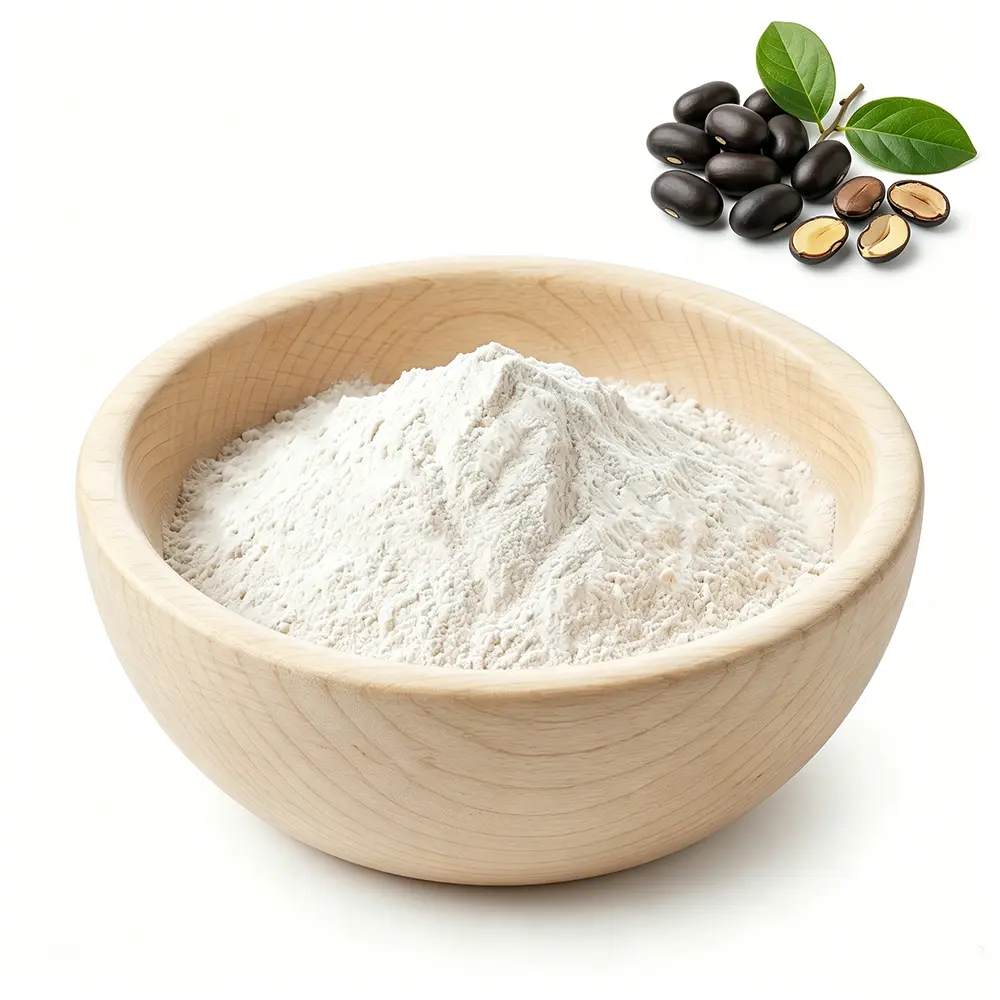
Bulk Griffonia Simplicifolia Extract Supplier — 5-HTP 95–98% Seed Extract | B2B Wholesale
Valeherb supplies Griffonia simplicifolia seed extract standardized to 95–98% 5-HTP by HPLC, with lower-purity grades available on a customization basis. Griffonia simplicifolia is the primary commercial botanical source of 5-hydroxytryptophan (5-HTP), the direct biosynthetic precursor to serotonin. For formulators of mood-support, sleep, and satiety product categories, high-purity standardized extract with HPLC-verified 5-HTP content is the specification that supports consistent dosing and a defensible label. Every batch ships with a COA confirming 5-HTP content by HPLC.
What Is 5-HTP and Why Griffonia Seed Extract Is the Preferred Source
5-Hydroxytryptophan (5-HTP) is an amino-acid derivative and the immediate biosynthetic precursor to serotonin. Unlike L-tryptophan — which must first be converted to 5-HTP by tryptophan hydroxylase before serotonin synthesis can proceed — 5-HTP bypasses this rate-limiting enzymatic step. Once absorbed, 5-HTP crosses the blood-brain barrier and is decarboxylated to serotonin via aromatic amino acid decarboxylase (AADC).[4]
Griffonia simplicifolia seeds naturally contain 5-HTP at concentrations of roughly 5–20% dry weight — the highest found in any commercially viable botanical source. This makes standardized Griffonia simplicifolia seed extract the industry-standard raw material for 5-HTP globally, and it is preferred over synthetic 5-HTP in clean-label and natural-positioned product lines.
Available Grades and Specifications
Valeherb’s primary offering is high-purity 5-HTP; lower-purity grades are available on a customization basis.
| Grade | 5-HTP Content | Typical Application |
|---|---|---|
| High-Purity Extract (primary) | 95–98% 5-HTP by HPLC | Mood-support, sleep, and satiety supplements; applications requiring precise dosing |
| Mid-Purity Extract (customization) | 20–40% 5-HTP by HPLC | Mid-range supplement capsules and blends |
| Standard Seed Powder (customization) | 5–10% 5-HTP by HPLC | Herbal blends, entry-level and cost-sensitive formulations |
Published Research
1. Serotonin Pathway & Mood Research
Because 5-HTP is the direct precursor to serotonin and crosses the blood-brain barrier without the rate-limiting step that applies to tryptophan, it has been studied as a way to support central serotonin availability. 5-HTP has been examined in mood-related clinical research over several decades.[2] Griffonia extract is one of the few botanical ingredients with a direct mechanistic basis for serotonergic activity rather than only indirect antioxidant support.
2. Sleep Research
As a precursor to both serotonin and melatonin, 5-HTP has been studied in relation to sleep through complementary pathways. A clinical review by Birdsall (1998) discussed 5-HTP’s serotonergic mechanism and summarised studies relevant to sleep parameters at doses around 100–300 mg.[1] This dual serotonin/melatonin basis distinguishes 5-HTP from single-pathway ingredients in the sleep category.
3. Appetite & Satiety Research
Central serotonin is involved in appetite regulation via 5-HT2C receptor signaling. A 1992 randomized controlled trial by Cangiano et al. reported changes in eating behavior and reduced energy intake in study participants supplementing with 5-HTP versus placebo.[3] This mechanism is of interest for the satiety and weight-management formulation category and is distinct from stimulant-based approaches.
Doses Used in Published Research
| Research Context | 5-HTP Dose in Trials | Timing / Notes |
|---|---|---|
| Mood-related research | 50–100 mg/day[2] | Between meals in study protocols; lower doses reduce peripheral conversion |
| Sleep research | 100–300 mg before bed[1] | 30–45 min before sleep in study protocols |
| Appetite / satiety research | up to ~900 mg/day divided[3] | Before meals in study protocols |
The figures above are doses used in published research, provided as a formulation reference only — not treatment recommendations or dosing instructions for any condition. Given the serotonergic drug-interaction profile (below), finished-product dosing and label language are the marketer’s responsibility under applicable regulations.
Sourcing Criteria: What to Require from Any Supplier
| Criterion | What to Require |
|---|---|
| 5-HTP Standardization | HPLC-verified 5-HTP content per batch (Valeherb: 95–98%) — not total alkaloid content, which includes non-5-HTP alkaloids in the seed matrix |
| Seed-Specific Origin | Confirm Griffonia simplicifolia seed extract specifically — leaf or pod material has a lower, different 5-HTP profile. Request botanical identity documentation[4] |
| Adulterant Testing | Request specific testing for synthetic 5-HTP adulteration — a known supply-chain risk. Isotope ratio analysis (IRMS) can distinguish botanical from synthetic origin |
| Third-Party COA | 5-HTP content (HPLC), heavy metals (USP <232>), pesticide residues, microbial limits (USP <2021>), moisture — per production batch |
| Peak Harvest Timing | 5-HTP concentration peaks at a specific seed maturity stage — request harvest documentation confirming seed maturity at collection |
| Certifications | Non-GMO, Kosher/Halal for relevant markets. FDA-registered facility required for US supplement supply chains |
Regulatory Guidance
- US (DSHEA): 5-HTP from Griffonia simplicifolia is an established dietary supplement ingredient. Any structure/function claim on the finished product is the marketer’s responsibility to substantiate and must carry the FDA disclaimer. Given the serotonin-syndrome risk profile, claims must be carefully worded — wording such as “supports healthy serotonin levels” is structure/function, whereas language implying treatment of depression, anxiety, or other disorders is a drug claim and requires drug approval
- EU: 5-HTP is treated as a novel food ingredient in several EU member states under Novel Food Regulation (EU) 2015/2283. Requirements vary by member state — consult regulatory counsel before finalizing EU distribution
- Canada (NHPs): 5-HTP has a licensed Health Canada monograph supporting sleep and mood claims under Natural Health Products Regulations; the serotonin-syndrome contraindication must appear on the label
References
[1] Birdsall TC. (1998). 5-Hydroxytryptophan: a clinically-effective serotonin precursor. Alternative Medicine Review, 3(4), 271–280. PMID: 9727088
[2] van Praag HM, van den Burg W, Bos ERH & Dols LCW. (1974). 5-Hydroxytryptophan in combination with clomipramine in “therapy-resistant” depressions. Psychopharmacologia, 38(3), 267–269. PMID: 4547418
[3] Cangiano C et al. (1992). Eating behavior and adherence to dietary prescriptions in obese adult subjects treated with 5-hydroxytryptophan. American Journal of Clinical Nutrition, 56(5), 863–867. doi:10.1093/ajcn/56.5.863
[4] Maffei ME. (2021). 5-Hydroxytryptophan (5-HTP): natural occurrence, analysis, biosynthesis, biotechnology, physiology and toxicology. International Journal of Molecular Sciences, 22(1), 181. doi:10.3390/ijms22010181


