

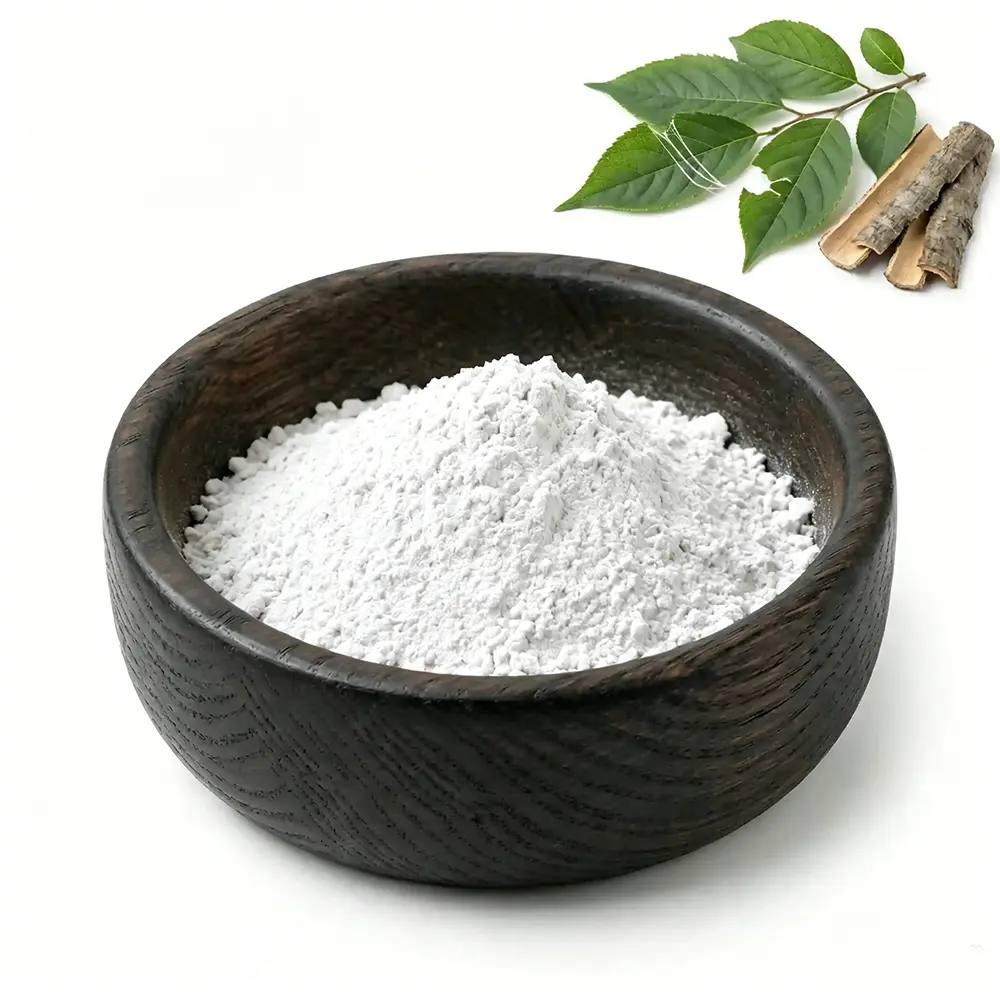
Valeherb supplies eucommia leaf extract bulk wholesale in two standardized chlorogenic-acid (CGA) grades — 50% CGA and 98% CGA, among the highest-purity CGA grades commercially available from any botanical source, including green coffee bean, and at zero caffeine. Every batch ships with a full HPLC COA, and custom specifications are available on request.
On this page: how leaf and bark differ, the leaf’s active-compound profile, the two CGA grades (50% & 98%) and the 98% cost advantage, formulation applications, and quality/regulatory notes. For CGA mechanisms, isomer profiles, and bioavailability data, see our technical guide: Chlorogenic Acid Benefits, Sources & Applications.
Leaf vs. Bark: Why the Distinction Matters
Eucommia ulmoides bark (Du Zhong) and leaf (Du Zhong Ye) carry separate monographs in the Chinese Pharmacopoeia (ChP 2020) — a recognition that they have meaningfully different compound profiles, not just different plant parts. Valeherb standardizes on the leaf for chlorogenic-acid grades; the comparison below is provided as sourcing context for buyers evaluating CGA raw material.
| Parameter | Eucommia Leaf Extract | Eucommia Bark Extract |
|---|---|---|
| Primary Bioactives | Chlorogenic acid (dominant), aucubin, geniposidic acid, quercetin, rutin | Pinoresinol diglucoside, aucubin, geniposidic acid (lower chlorogenic acid) |
| Chlorogenic Acid Content | Up to 98% standardized extract — preferred source for high-purity CGA | Lower — not the standard source for chlorogenic acid specifications |
| Typical Application Areas | High-purity CGA supplements and functional foods, antioxidant-positioned products, cosmetics | Traditional TCM Du Zhong formulas; adaptogen and herbal tonic blends |
| Sustainability | Renewable harvest — leaves collected without felling trees | Bark harvest requires tree sacrifice; longer regeneration cycle |
| ChP Monograph | Folium Eucommiae | Cortex Eucommiae |
Active Compounds and Studied Mechanisms
The mechanisms below describe activity reported for these compounds in published research. They are provided as scientific context for formulators, not as claims for any Valeherb product.
| Compound Class | Key Compounds | Mechanisms Reported in Research |
|---|---|---|
| Phenolic Acids | Chlorogenic acid — dominant in leaf | Studied for antioxidant activity and suppression of oxidative stress, platelet-aggregation and vasodilatory/circulatory endpoints, and regulation of glucose and lipid metabolism[1] |
| Iridoid Glycosides | Aucubin, geniposidic acid | Studied in animal models for longitudinal bone-growth and growth-plate endpoints[2], and for vascular and lipid-metabolism endpoints via gut-microbiota and AhR/TGF-β signaling[3] |
| Flavonoids | Quercetin, rutin, kaempferol derivatives | Co-occurring antioxidant constituents of the leaf matrix; present mainly in lower-standardization grades |
Valeherb’s grades are quantified and standardized on chlorogenic acid by HPLC. The 98% grade is near-pure CGA, while the 50% grade retains more of the native leaf matrix (and therefore more of the co-occurring iridoid and flavonoid fraction).
Available Grades and Specifications
Both grades are HPLC-verified per batch from Eucommia ulmoides leaf. For reference, the industry standard for green coffee bean extract is 50% CGA — Valeherb’s 50% grade matches this at zero caffeine, and the 98% grade is among the highest-purity CGA available at present.
| Grade | Chlorogenic Acid (HPLC) | Appearance | Typical Application |
|---|---|---|---|
| High-Potency Extract | 50% | Light yellow powder | High-CGA supplement and functional-food formulations; caffeine-free alternative to green coffee bean extract |
| Ultra-High Purity Extract | 98% | White to off-white powder | For pharmaceutical & nutraceutical use; minimal inclusion rate; cosmetic actives; caffeine-sensitive product lines |
Formulation Applications
- CGA-standardized supplements: 200–500 mg per serving using the 50% grade. A caffeine-free CGA source that blends with botanicals such as hawthorn, olive leaf, and hibiscus in multi-ingredient supplement systems
- High-purity actives (pharmaceutical & nutraceutical use): 98% grade for precise dosing, tight documentation, low inclusion rate, and caffeine-free formulation
- Antioxidant functional foods and beverages: caffeine-free CGA for clean-label capsules, powders, and RTD fortification, paired with complementary botanicals in functional-food systems
- Cosmetics and skincare: 98% grade as a high-purity natural antioxidant active; neutral flavor and zero caffeine suit both topical and ingestible-beauty formats
Quality and Regulatory Notes
- US (DSHEA): Any structure/function claims on finished products must be substantiated by the marketer and carry the required FDA disclaimer. Antioxidant structure/function claims are the most readily supported; for blood-pressure positioning, only “supports healthy blood pressure levels already within the normal range” style wording is permissible — disease treatment claims require drug approval
- China (ChP 2020): Folium Eucommiae (杜仲叶) and Cortex Eucommiae (杜仲) both carry separate standardized monographs — directly relevant for domestic and export regulatory documentation
- EU / Canada: Novel food status may apply for certain extract preparations in the EU; Canada NHP leaf-extract status should be confirmed with a regulatory consultant
- Facility: FDA-registered. COA per batch includes HPLC active-compound content, heavy metals (USP <232>), pesticide residues, and microbial limits (USP <2021>)


