

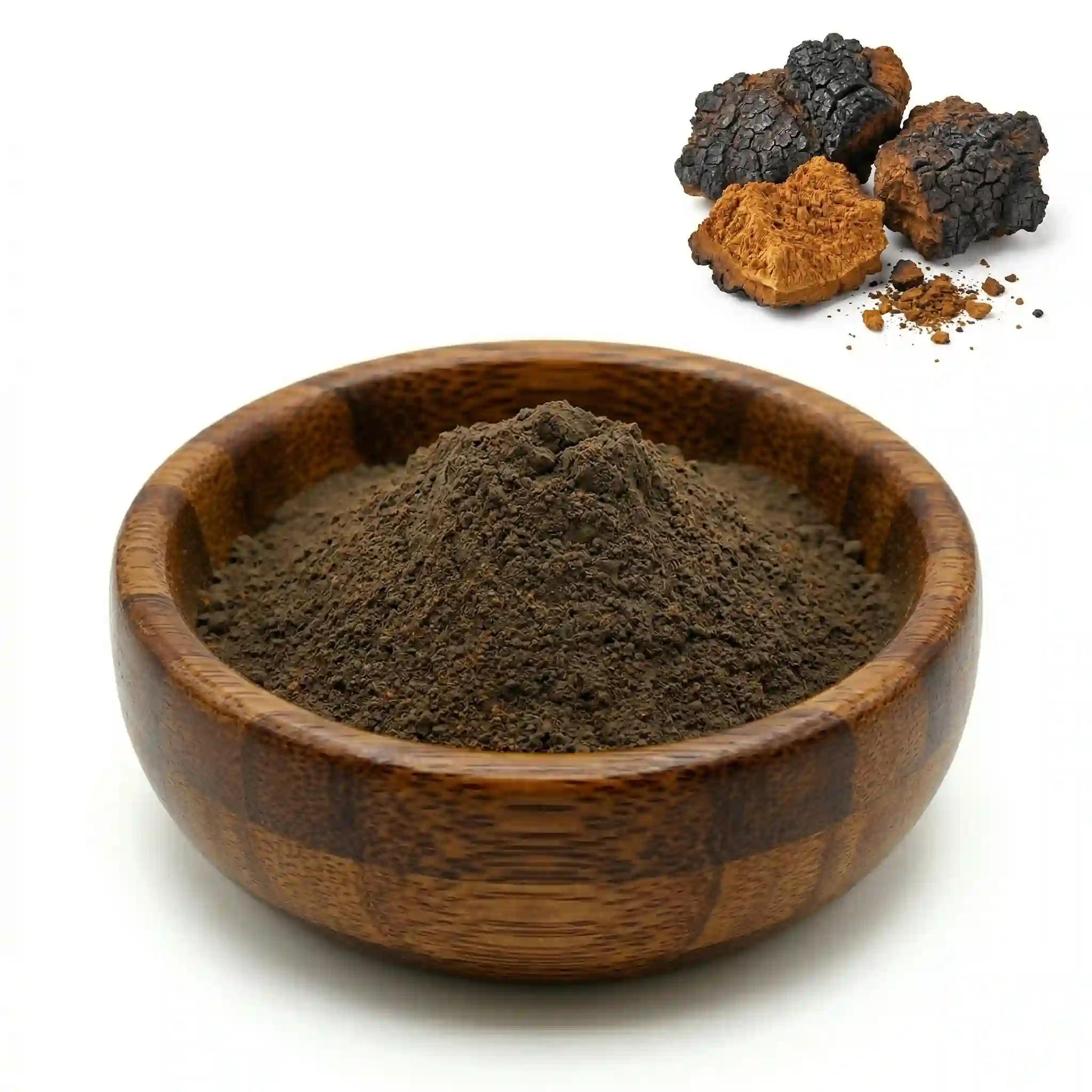
Bulk Chaga Mushroom Extract Powder Supplier — 30%, 40% & 50% Beta-Glucan Polysaccharides, B2B Wholesale
Valeherb supplies chaga mushroom extract powder (Inonotus obliquus (Ach.) P. Karst., sclerotium) bulk wholesale in three standardized polysaccharide grades — 30%, 40%, and 50% beta-glucan polysaccharides — each AOAC 995.16-verified per batch. Source material is wild-harvested sclerotium (the black conk) from birch trees, not mycelium biomass. The bioactive profile of the sclerotium covers four compound classes: beta-glucan polysaccharides, lanostane-type triterpenoids (including inotodiol and betulinic acid), melanin pigments, and phenolic compounds — each relevant to different formulation endpoints.[1]
On this page: the compound profile and what each fraction does, the three polysaccharide grades, a note on sclerotium vs. mycelium-on-grain sourcing, formulation applications, and regulatory notes.
What’s Actually in Chaga Sclerotium
The sclerotium is the clinically and commercially relevant part of Inonotus obliquus — not the fruiting body (which rarely forms) and not the mycelium. Its compound profile is shaped by decades of growth on birch bark, and the four main fractions each have distinct formulation relevance.[2]
| Compound Class | Key Compounds | Studied Activity | Formulation Relevance |
|---|---|---|---|
| Beta-glucan polysaccharides | β-1,3/1,6-D-glucans | Macrophage polarization, Dectin-1 receptor agonism, cytokine modulation studied in published in vitro models[3] | Immune support supplements, functional foods, adaptogenic blends — the primary standardization target |
| Lanostane triterpenoids | Inotodiol, betulinic acid, lanosterol | Inflammatory-pathway and oxidative-stress research in keratinocyte models; inotodiol studied for anti-aging endpoints in HaCaT cells[4] | Skin-health supplements, cosmetic actives; present in higher concentrations in dual-extracted grades |
| Melanin | Polyphenolic pigment complex | Free-radical scavenging, genoprotective activity | Antioxidant-positioned formulations; contributes to the characteristic dark color of sclerotium extract |
| Phenolic compounds | Hispidin, protocatechuic acid | Antioxidant activity; α-glucosidase inhibition in preclinical models | Antioxidant blends; functional beverages |
Valeherb’s grades are standardized on polysaccharide content. The 50% grade concentrates the beta-glucan fraction most aggressively; the 30% grade retains more of the native sclerotium matrix, including a higher proportion of melanin and phenolic co-extractives.
Available Grades and Specifications
All three grades use hot-water extraction from wild-harvested sclerotium. Beta-glucan content is quantified by the AOAC 995.16 enzymatic method — not total polysaccharide by UV, which inflates readings by including non-beta-glucan starch.
| Grade | Beta-Glucan Polysaccharides (AOAC 995.16) | Appearance | Typical Application |
|---|---|---|---|
| Standard Extract | 30% | Dark brown powder | Multi-ingredient immune blends, functional food fortification, cost-sensitive nutraceutical SKUs |
| Mid-Potency Extract | 40% | Brown powder | Mainstream immune support capsules and powders; adaptogenic stacks |
| High-Potency Extract | 50% | Brown to tan powder | Premium immune supplement SKUs, functional beverages, pharmaceutical & nutraceutical ingredient applications |
Research Background
The compounds below describe published research on Inonotus obliquus constituents. This is scientific context for formulators — not claims for any Valeherb product.
Shen et al. (2022) studied chaga polysaccharide fractions in RAW264.7 macrophage models, examining M0 and LPS-induced M1 macrophage polarization. The extracts were reported to modulate IL-1β, TNF-α, and NO levels through M1/M2 marker expression — providing a mechanistic basis for beta-glucan immune-support positioning in the supplement literature.[3]
For the triterpenoid fraction, Park et al. (2023) isolated lanostane triterpenoids from chaga and tested inotodiol against UVB- and TNF-α-induced inflammatory stress in HaCaT keratinocytes. At 0.44–4.0 µg/mL, pure inotodiol suppressed IL-1β, IL-6, and IL-8 gene expression and was also studied for collagen and hyaluronan synthesis endpoints — findings relevant to cosmetic and ingestible-beauty formulation contexts.[4]
A 2024 review in Heliyon covering chaga’s phytochemistry and health-associated research noted hot-water extraction as the most effective method for polysaccharide recovery, and dual extraction (hot water + ethanol) as the approach needed to capture the fat-soluble triterpenoid fraction alongside polysaccharides.[1]
Formulation Applications
- Immune support capsules and powders: 500 mg–1 g per serving using the 40% or 50% grade is the standard nutraceutical format. Chaga pairs well with reishi, turkey tail, lion’s mane, and astragalus in multi-mushroom immune formulations. The 30% grade suits cost-sensitive multi-ingredient blends where capsule-size constraints allow a higher inclusion mass
- Functional beverages: The hot-water extract is water-soluble and compatible with hot-fill beverage processing. Polysaccharides retain activity through thermal processing. The flavor profile is mildly earthy with a slight vanilla-like note from hispidin — compatible with coffee, cacao, and chai bases; common in the Siberian wellness tea tradition
- Adaptogenic and stress-support supplements: Combined with cordyceps, ashwagandha, or lion’s mane in adaptogenic blends targeting formulator audiences familiar with dual-extract quality standards
- Skin-health and nutricosmetic formulations: The triterpenoid fraction (present in greater concentration in dual-extracted material) is of interest for ingestible-beauty and topical antioxidant applications based on the inotodiol research in keratinocyte models
- Pharmaceutical & nutraceutical ingredient applications: Full chain-of-custody COA available; 50% grade for tighter documentation and precise labeling
What to Check Before You Buy Chaga Extract
| Criterion | What to Require |
|---|---|
| Source Material | Wild-harvested sclerotium (conk) from birch-growing specimens. Request species confirmation and source documentation — not mycelium biomass or mycelium-on-grain |
| Beta-Glucan Method | AOAC 995.16 enzymatic assay specifically. Total polysaccharide figures by UV without alpha-glucan subtraction are not sufficient for immune support claim substantiation |
| Oxalate Disclosure | Request oxalate content per batch. Chaga sclerotium contains elevated calcium oxalate — a documented concern for high-dose or long-term use in kidney-sensitive populations |
| Heavy Metals | ICP-MS panel (Pb, As, Cd, Hg) per batch — USP <232> or EU limits. Wild-harvested fungi bioaccumulate environmental contaminants from their host substrate |
| Complete COA | Beta-glucan % (AOAC 995.16), alpha-glucan %, oxalate, heavy metals, pesticide residues, microbial limits — per batch from an accredited laboratory |
Regulatory Notes
- United States (DSHEA): Dietary supplement ingredient; structure/function claims (immune support, antioxidant) require marketer substantiation and the required FDA disclaimer. Oxalate disclosure is advisable on high-dose finished-product labeling. FDA-registered facility (21 CFR Part 111 cGMP)
- European Union: Food supplement ingredient with established use history; no Novel Food Regulation restriction at current update. INCI for cosmetic applications: Inonotus Obliquus (Mushroom) Extract
- China: 桦褐孔菌 recognized in traditional medicine; domestic supplement applications governed by NMPA health food regulations. Export documentation available for international shipments


