
Written and reviewed by Dr. Xiaoyan Qiu · May 2026
Chlorogenic acid (CGA) is one of the most thoroughly researched polyphenols in botanical science, yet its biological complexity is routinely underestimated in supplement formulation. Most product developers know CGA as an antioxidant from green coffee bean — a useful but incomplete picture. The compound operates through at least four distinct biological mechanisms, exists as a family of structurally related isomers with different functional profiles, and behaves very differently depending on the delivery format and processing conditions it encounters.
This article covers the science that procurement teams and formulators need before specifying a CGA ingredient: what chlorogenic acid actually is at the molecular level, how its key biological mechanisms work, why isomer composition matters, and how bioavailability considerations affect formulation decisions.
What Is Chlorogenic Acid? Molecular Structure and Plant Function
Chlorogenic acid is a phenolic ester formed by the condensation of caffeic acid and quinic acid. It belongs to the hydroxycinnamic acid family — a class of plant polyphenols characterized by a phenylpropanoid backbone with hydroxyl groups that confer both antioxidant activity and the capacity to interact with enzyme active sites.[1]
Inside plants, CGA is not a passive metabolite. It functions as an active defense compound — regulating cell wall lignification during growth, protecting leaf tissue against UV radiation damage, and triggering pathogen resistance responses. The same hydroxyl group architecture that enables these plant defense functions is what drives CGA’s biological activity in human physiology: the ability to donate electrons to reactive oxygen species, bind to enzyme active sites, and interact with cell signaling pathways.[1]
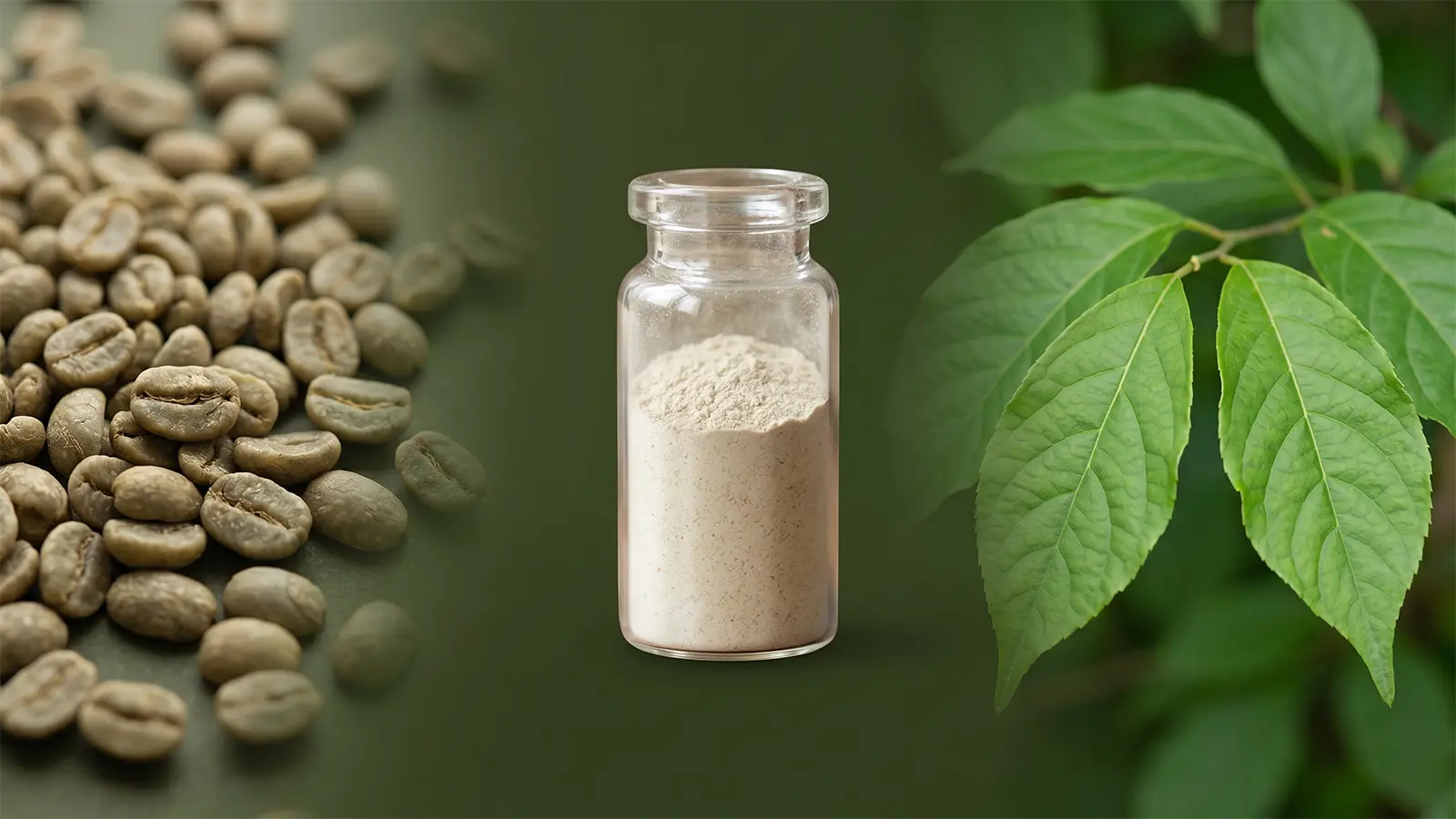
CGA is among the most abundant polyphenols in the human diet, present at meaningful concentrations in coffee, apples, blueberries, artichokes, and — at the highest standardized extract concentrations — in Eucommia ulmoides leaf. Its widespread distribution across plant species reflects its fundamental role in plant biology, not a coincidence of taxonomy.
The Isomer Problem: Why CGA Is Not One Compound
One of the most consequential misunderstandings in CGA ingredient specification is treating chlorogenic acid as a single compound. It is not. CGA is a family of structurally related isomers — differing in the position of the caffeoyl ester group on the quinic acid core — and these structural differences translate into measurably different bioavailability and biological activity profiles.[2]
| Isomer | Full Name | Typical Abundance | Key Functional Notes |
|---|---|---|---|
| 5-CQA | 5-O-caffeoylquinic acid | Dominant isomer in most sources | Most studied; strongest glucose-6-phosphatase inhibition data; primary reference standard in HPLC quantification |
| 3-CQA | 3-O-caffeoylquinic acid | Minor; higher in some botanical sources | Different absorption kinetics in small intestine; some evidence of stronger ACE inhibitory activity than 5-CQA |
| 4-CQA | 4-O-caffeoylquinic acid | Minor in most extracts | Least studied of the three monocaffeoylquinic acids; similar antioxidant capacity to 5-CQA |
| diCQA forms | 3,4-, 3,5-, 4,5-dicaffeoylquinic acids | Present in coffee, eucommia, and other sources | Higher molecular weight; stronger antimicrobial activity; different metabolic fate in colon |
A COA specifying “total chlorogenic acids” is measuring something broader than a COA specifying “5-O-caffeoylquinic acid (chlorogenic acid) by HPLC.” These are not interchangeable measurements. For structure-function claims referencing specific mechanisms — glucose metabolism, ACE inhibition, antioxidant activity — the relevant isomer should be specified and verified independently.[2]
Chlorogenic Acid Benefits: Four Biological Mechanisms Explained
CGA’s commercial versatility stems from its ability to engage multiple pathways simultaneously. Understanding each mechanism helps formulators match CGA to the right application and substantiate claims accurately.
1. Glucose Metabolism: Hepatic Glucose-6-Phosphatase Inhibition
The most extensively replicated mechanism involves hepatic glucose regulation. CGA — primarily the 5-CQA isomer — inhibits glucose-6-phosphatase (G6Pase), the enzyme responsible for catalyzing the final step of gluconeogenesis and glycogenolysis in the liver: the release of free glucose into the bloodstream. By moderating G6Pase activity, CGA reduces the rate of hepatic glucose output, which in turn blunts post-meal blood glucose elevation and reduces the glycemic load associated with carbohydrate-rich meals.[3]
This mechanism has been confirmed in multiple randomized controlled trials. A systematic review and meta-analysis by Onakpoya et al. found a statistically significant reduction in body weight in participants supplementing with standardized CGA-rich green coffee extract, with the effect attributed to CGA’s modulation of glucose absorption and hepatic glucose metabolism at doses studied across included trials.[3] The clinical relevance extends beyond weight management into metabolic syndrome formulations, pre-diabetic support products, and functional beverages positioned around glycemic balance.
2. Antioxidant Activity: Reactive Oxygen Species Neutralization
CGA’s polyphenolic hydroxyl groups donate electrons to reactive oxygen species (ROS), interrupting oxidative chain reactions before they cause cumulative cellular damage. This mechanism is among the most thoroughly documented in CGA literature, replicated across cell culture models, animal studies, and human trials.[1]
CGA functions both as a direct ROS scavenger and as an inducer of endogenous antioxidant enzyme systems including superoxide dismutase (SOD) and catalase. This indirect upregulation of the body’s own antioxidant defenses means CGA’s effective antioxidant impact extends beyond what its direct radical-scavenging capacity would suggest. For cosmetic formulators, this dual mechanism supports both immediate and longer-term anti-aging positioning.
3. Anti-Inflammatory Action: NF-κB Pathway Suppression
CGA suppresses the NF-κB signaling pathway — one of the primary transcription factor systems controlling pro-inflammatory gene expression in human cells. By inhibiting NF-κB nuclear translocation and IκB kinase activity, CGA reduces the transcription of inflammatory cytokines including TNF-α, IL-6, and IL-1β in a dose-dependent manner.[4]
This mechanism has broad formulation relevance. Chronic low-grade inflammation is implicated in metabolic syndrome, cardiovascular disease, neurodegenerative conditions, and skin aging — product categories where botanical anti-inflammatory actives command significant market interest. CGA’s NF-κB inhibition positions it alongside quercetin, resveratrol, and curcumin as a substantiable anti-inflammatory botanical, with the advantage of higher achievable purity and more established clinical data than many comparable polyphenols.
4. ACE Inhibition and Blood Pressure Modulation
Chlorogenic acid inhibits angiotensin-converting enzyme (ACE) and attenuates oxidative stress in the vasculature, leading to improved endothelial function and increased nitric oxide bioavailability — all of which contribute to blood pressure reduction. ACE inhibition is the primary pharmacological mechanism of a major class of antihypertensive drugs, making botanical ACE inhibitors a commercially significant category for cardiovascular supplement formulation.[5]
A mechanistic review by Zhao et al. synthesizing both animal and human data confirmed that CGA and its metabolites produce measurable antihypertensive effects through combined ACE inhibition and nitric oxide pathway modulation, with the effect attributed to attenuation of reactive oxygen species that would otherwise impair vascular endothelial function.[5] This positions CGA-rich eucommia leaf extract in the botanical blood pressure management category alongside hibiscus and hawthorn, with a mechanistic evidence base that supports structure-function claim substantiation.
Bioavailability: What Actually Reaches Target Tissues
CGA’s biological activity in a finished product depends not just on the concentration in the extract but on how much survives processing, reaches the bloodstream, and arrives at target tissues in an active form. Bioavailability is the variable that most formulators underestimate when specifying CGA ingredients.[2]
CGA absorption occurs in two stages. In the small intestine, a portion of intact CGA — primarily 5-CQA — is absorbed directly and appears in plasma within 30–60 minutes of oral intake. The remainder passes to the colon, where gut microbiota metabolize CGA into secondary metabolites including caffeic acid, ferulic acid, dihydrocaffeic acid, and dihydroferulic acid. These colonic metabolites are themselves bioactive, contributing to the total systemic effect of CGA supplementation — but with a delayed onset (2–6 hours post-ingestion) and a different functional profile than intact CGA.[2]
| Absorption Stage | Location | Timing | Key Metabolites | Formulation Implication |
|---|---|---|---|---|
| Primary absorption | Small intestine | 30–60 min post-dose | Intact 5-CQA, 3-CQA | Rapid onset; higher bioavailability with acidic pH; relevant for glycemic and antioxidant claims |
| Colonic metabolism | Large intestine | 2–6 hours post-dose | Caffeic acid, ferulic acid, dihydrocaffeic acid | Delayed but sustained activity; microbiome-dependent; supports anti-inflammatory claims |
Three formulation variables significantly affect bioavailability outcomes. First, delivery format: liquid formats generally accelerate CGA absorption compared to hard capsules or tablets, but also increase degradation risk under alkaline processing conditions. Second, pH: CGA stability and absorption are favored in acidic environments (pH 3–5); alkaline conditions accelerate isomerization and hydrolysis. Third, purity: higher-purity extracts deliver more CGA per unit of inclusion, reducing the burden on the absorption pathway and improving the consistency of pharmacokinetic outcomes across batches.[2]
Stability and Processing Considerations
CGA is sensitive to three processing variables that formulators must account for when designing stable finished products.
Heat. CGA undergoes measurable degradation above 80°C, with degradation accelerating significantly above 100°C. This eliminates it from hot-fill beverage processing without encapsulation protection, and requires careful attention to drying temperatures in powder manufacturing. Spray drying at controlled inlet temperatures is compatible with CGA stability; high-temperature extrusion is not.
UV exposure. CGA’s phenolic chromophore absorbs UV radiation, triggering photodegradation reactions that reduce potency and alter the isomer profile. UV-protective packaging is non-negotiable for liquid formats and recommended for transparent powder packaging intended for shelf display.
Alkaline pH. Above pH 7, CGA undergoes isomerization and ester hydrolysis at measurable rates. Formulations in alkaline matrices — certain mineral-rich beverages, effervescent tablets, and some topical cosmetic bases — require pH adjustment or encapsulation to maintain CGA stability through shelf life.[1]
For applications where stability is a primary concern, cyclodextrin complexation significantly improves CGA’s resistance to all three degradation pathways by encapsulating the molecule within a protective hydrophobic cavity. The trade-off is added formulation cost and the need to include cyclodextrin on the ingredient label.
Safety and Tolerability: What the Research Shows
CGA’s biological versatility only translates into a viable ingredient if the safety profile supports the intended dose range and application. A 2024 systematic review characterized CGA as having a good overall safety profile, with no obvious adverse effects or toxicity to normal cells or tissues reported across the reviewed literature, and good tolerability in human studies.[6] Acute toxicity data cited in that review found no adverse effects in animal models at oral intakes as high as 1–2 g/kg, and no adverse effects over a three-month feeding period at doses of 250–1000 mg/kg.[6]
On dosing, a 2022 intake-guidance review estimated typical dietary CGA intake at 5–1000 mg/day, with population intervention studies using supplemental doses in the range of 13.5–1200 mg/day to demonstrate effects on fasting blood glucose, glucose tolerance, weight management, and blood pressure — most consistently at daily intakes of 200 mg or more.[7] The same review noted that CGA has been reported to be allergenic in some individuals, and that available safety data does not yet support formulation of a formal tolerable upper intake level.[7]
For formulators working with coffee-derived CGA specifically, an additional consideration applies: green coffee bean extract carries residual caffeine, which introduces its own set of dose-dependent effects (sleep disturbance, elevated heart rate) that are unrelated to CGA itself. Caffeine-free sources such as Eucommia ulmoides leaf extract avoid this confound entirely, isolating CGA’s own safety and activity profile from caffeine-related effects — a meaningful differentiator for formulations targeting caffeine-sensitive populations or products requiring caffeine-free label claims.
Selecting a CGA Extract: What the Science Requires
The biological mechanisms reviewed above — G6Pase inhibition, antioxidant activity, NF-κB suppression, ACE inhibition — are all purity-dependent. Below a threshold concentration, CGA’s activity in a finished product becomes inconsistent across batches and insufficient to support clinical dose ranges. This is why source selection and extract specification are not interchangeable decisions.
For formulators requiring the highest achievable CGA concentration in a caffeine-free matrix, Eucommia ulmoides leaf extract standardized to 98% CGA by HPLC represents the current ceiling of commercial availability. Valeherb’s eucommia leaf extract is produced in an FDA-registered facility and HPLC-verified per batch — with isomer-specific quantification available on request for applications requiring 5-CQA or 3-CQA specification.
Frequently Asked Questions
What are the most well-supported chlorogenic acid benefits in clinical research?
The four mechanisms with the strongest clinical evidence base are glucose metabolism regulation via hepatic glucose-6-phosphatase inhibition, antioxidant activity through direct ROS scavenging and endogenous antioxidant enzyme upregulation, anti-inflammatory action via NF-κB pathway suppression, and ACE inhibition supporting blood pressure modulation. Each mechanism has been replicated in peer-reviewed studies at doses of 120–400 mg CGA per day, with the glucose and antioxidant mechanisms having the largest body of human trial data.
Is chlorogenic acid safe, and what side effects have been reported?
Published safety reviews describe chlorogenic acid as generally well tolerated, with no significant toxicity reported in animal studies at doses well above typical supplemental levels. Population intervention studies have used doses from 13.5 mg to 1200 mg per day without a defined upper safety limit yet established in the literature, though allergenic reactions have been reported in some individuals. Green coffee bean extract, a common CGA source, also carries residual caffeine that can independently cause sleep disturbance or an elevated heart rate — an effect unrelated to CGA itself and avoided entirely with caffeine-free sources such as Eucommia ulmoides leaf extract. This information is not medical advice, and finished products should carry appropriate safety substantiation for their intended use and market.
Why does the chlorogenic acid isomer profile matter for formulation?
Different CGA isomers — 5-CQA, 3-CQA, 4-CQA, and dicaffeoylquinic acid forms — have different absorption kinetics, enzyme interaction profiles, and metabolic fates. The 5-CQA isomer has the strongest glucose-6-phosphatase inhibition data; 3-CQA shows stronger ACE inhibitory activity in some models. A COA specifying “total chlorogenic acids” does not confirm which isomers are present or in what ratio. For mechanism-specific label claims, the relevant isomer should be quantified independently using an appropriate HPLC reference standard.
How does gut microbiota affect chlorogenic acid’s biological activity?
A significant portion of ingested CGA is not absorbed in the small intestine but passes to the colon, where gut bacteria metabolize it into secondary metabolites including caffeic acid, ferulic acid, and dihydroferulic acid. These metabolites are themselves bioactive and contribute to CGA’s total systemic effect — particularly its anti-inflammatory and antioxidant activity — but with a delayed onset of 2–6 hours post-ingestion. Individuals with disrupted gut microbiome composition may therefore have different CGA response profiles than those observed in healthy-population clinical trials.
What formulation formats are most compatible with chlorogenic acid stability?
Powder matrices — capsules and tablets — are the most stable formats for CGA, provided they are stored away from heat, UV exposure, and moisture. Liquid formats are more technically demanding: CGA degrades under alkaline pH and elevated temperatures, requiring pH 3–5 formulation, UV-protective packaging, and cold-fill processing for adequate shelf stability. Cyclodextrin encapsulation significantly improves stability across all three degradation pathways but adds formulation cost and label complexity. Stability testing under the specific processing and storage conditions planned for the product should always be conducted before commercial launch.
What is the difference between chlorogenic acid from green coffee bean and from Eucommia ulmoides leaf?
The primary technical differences are purity ceiling and caffeine content. Green coffee bean extract can be standardized to approximately 45–50% CGA; Eucommia ulmoides leaf extract can reach 98% CGA — roughly double the concentration. Eucommia-derived CGA also contains no caffeine, eliminating the regulatory and formulation complexity associated with caffeine management in sensitive-population products. The flavor profile of Eucommia-derived CGA is also considerably milder than coffee-based extracts, making it more versatile in beverage and cosmetic applications where coffee flavor is undesirable.
References
[1] Tajik N., Tajik M., Mack I., Enck P. (2017). The potential effects of chlorogenic acid, the main phenolic components in coffee, on health: a comprehensive review of the literature. European Journal of Nutrition, 56(7), 2215–2244. https://doi.org/10.1007/s00394-017-1379-1
[2] Clifford M.N., Jaganath I.B., Ludwig I.A., Crozier A. (2017). Chlorogenic acids and the acyl-quinic acids: discovery, biosynthesis, bioavailability and bioactivity. Natural Product Reports, 34(12), 1391–1421. https://doi.org/10.1039/C7NP00030H
[3] Onakpoya I., Terry R., Ernst E. (2011). The use of green coffee extract as a weight loss supplement: a systematic review and meta-analysis of randomised clinical trials. Gastroenterology Research and Practice, 2011, 382852. https://doi.org/10.1155/2011/382852
[4] Hwang S.J., Kim Y.W., Park Y., Lee H.J., Kim K.W. (2014). Anti-inflammatory effects of chlorogenic acid in lipopolysaccharide-stimulated RAW 264.7 cells. Inflammation Research, 63(1), 81–90. https://doi.org/10.1007/s00011-013-0674-4
[5] Zhao Y., Wang J., Ballevre O., Luo H., Zhang W. (2012). Antihypertensive effects and mechanisms of chlorogenic acids. Hypertension Research, 35(4), 370–374. https://doi.org/10.1038/hr.2011.195
[6] Nguyen V., Taine E.G., Meng D., Cui T., Tan W. (2024). Chlorogenic acid: a systematic review on the biological functions, mechanistic actions, and therapeutic potentials. Nutrients, 16(7), 924. https://doi.org/10.3390/nu16070924
[7] Yu Y. et al. (2022). Chlorogenic acid intake guidance: sources, health benefits, and safety. Asia Pacific Journal of Clinical Nutrition, 31(4), 602–610. PMID: 36576278
Dr. Xiaoyan Qiu
Botanical Extract R&D Engineer · Associate Professor, Huaihua University. Research focuses on medicinal plant resources including Eucommia ulmoides, Lithocarpus litseifolius, and pharmaceutical botanical extraction.
These statements have not been evaluated by the Food and Drug Administration. This content is intended for business-to-business informational purposes only and does not constitute medical advice. © 2026 Valeherb