Bulk Black Garlic Extract Supplier — Standardized S-Allyl Cysteine (SAC) 0.1% / 1% / 3%, B2B Wholesale
Valeherb supplies standardized black garlic extract (Allium sativum L., fermented bulb) in bulk, with S-allyl cysteine (SAC) standardized by HPLC at three levels — 0.1%, 1%, and 3% — for heart-health supplements, functional food fortification, and antioxidant formulations. Produced via Maillard reaction under controlled heat (60–90°C) and humidity (70–90%) over several weeks, raw garlic’s unstable allicin converts into stable, water-soluble organosulfur compounds centered on SAC.[1][4] SAC is the industry standardization marker for this ingredient, and standardized aged black garlic has been studied in human trials for blood-pressure and vascular endpoints (see Research below). Valeherb supplies the SAC grade, COA documentation, and technical support your development pipeline requires.
Active Compounds and Research Profile
Fermentation converts raw garlic’s volatile chemistry into a stable, water-soluble profile centered on three compound classes.[1] S-Allyl Cysteine (SAC) is the primary marker and industry standardization target — virtually absent in fresh garlic, it accumulates specifically during aging and is reported to have high oral bioavailability with consistent batch-to-batch concentration. S-Allyl-Mercapto Cysteine (SAMC) is a secondary organosulfur compound studied for antioxidant and inflammatory-pathway activity. Polyphenols and melanoidins accumulate during fermentation, giving black garlic a substantially higher total antioxidant capacity than raw garlic in laboratory assays (DPPH inhibition roughly 4× higher at equivalent concentration).
| Compound | Type | Research Characterization | Application Relevance |
|---|---|---|---|
| S-Allyl Cysteine (SAC) | Water-soluble organosulfur compound | Primary standardization marker; studied for blood-pressure / vascular and antioxidant endpoints | Heart-health supplements; standardization marker |
| S-Allyl-Mercapto Cysteine (SAMC) | Organosulfur compound | Studied for antioxidant and inflammatory-pathway (NF-κB) activity | Antioxidant blends |
| Polyphenols / Melanoidins | Maillard reaction products | Free-radical scavenging in laboratory assays | Antioxidant capsules; functional food fortification |
| 5-HMF | Maillard reaction marker | Fermentation maturation indicator | Process validation; quality-control reference |
Available Grades and Specifications
| Grade | Marker Compound (SAC) | Form | Typical Downstream Application |
|---|---|---|---|
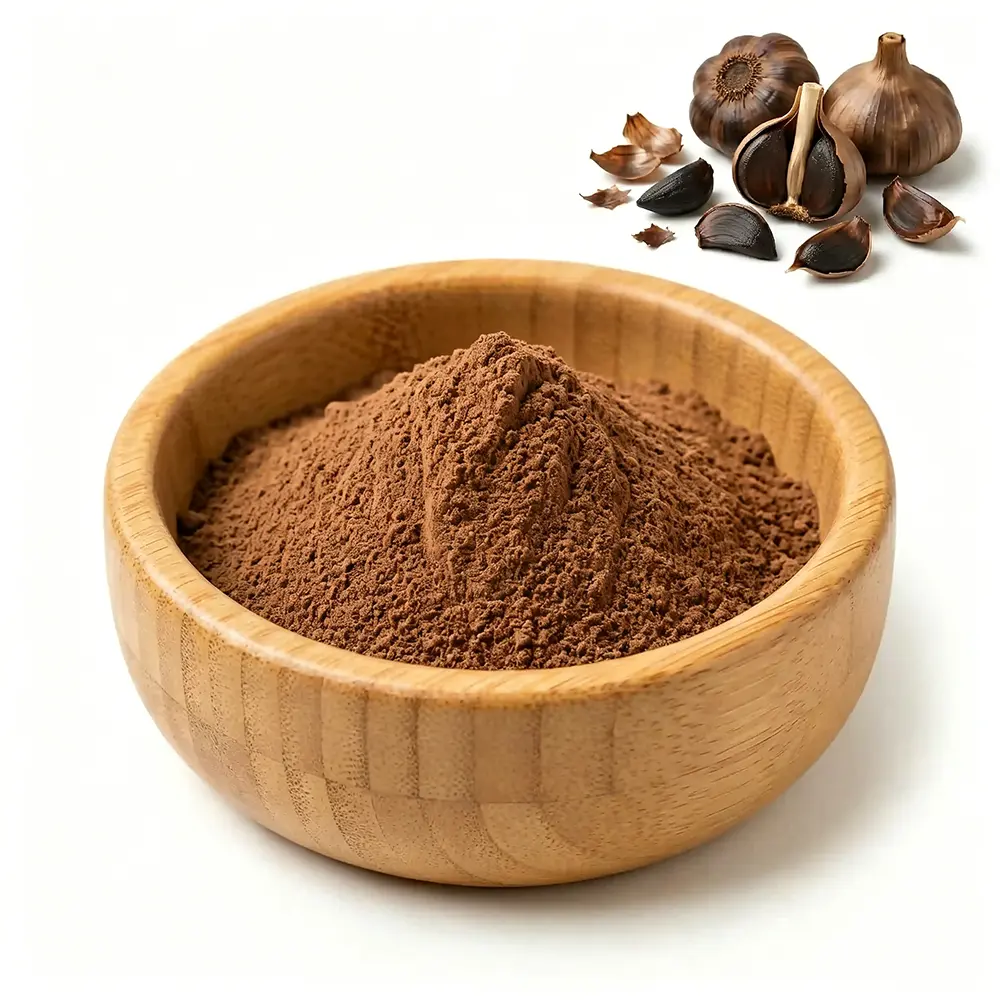
| Standard Extract 0.1% | 0.1% SAC (HPLC) | Dark brown powder, odorless | Functional food & beverage fortification, clean-label blends, low-SAC formats matching low studied doses |
| Standard Extract 1% | 1% SAC (HPLC) | Dark brown powder, odorless | Standardized heart-health supplement capsules; multi-ingredient blends |
| High-Potency Extract 3% | 3% SAC (HPLC) | Brown powder, odorless | Concentrated formats requiring low extract weight per dose; premium SKU development |
All grades are standardized to SAC by HPLC against a certified reference standard and ship with a per-batch COA. Custom potencies and packaging on request.
Research on Standardized Aged Black Garlic
Standardized aged black garlic has been evaluated in randomized controlled trials for blood-pressure and vascular endpoints. In a 2022 crossover, double-blind trial (n=67), an optimized aged black garlic extract delivering 1.25 mg SAC/day over 6 weeks was associated with a diastolic blood-pressure reduction of −5.85 mmHg versus placebo in moderately hypercholesterolemic subjects.[2] In a 2023 triple-blind trial in Grade I hypertensive subjects already receiving antihypertensive medication, 0.25 mg SAC/day over 12 weeks was associated with reductions in systolic and diastolic blood pressure alongside increased blood nitric oxide and antioxidant capacity, consistent with a nitric-oxide-pathway mechanism.[3]
Formulation Applications
- Heart-health supplement capsules: The 1% grade is the typical standardized format. The SAC doses used in the published trials were low (0.25–1.25 mg SAC/day) — a useful reference point when setting serving size. The odorless profile removes the organoleptic barrier of raw garlic. Commonly combined with CoQ10, nattokinase, and olive leaf extract in multi-ingredient blends
- Functional food & beverage fortification: The 0.1% grade integrates into gummies, beverages, and protein bars without organoleptic impact — a key advantage over raw garlic ingredients
- Antioxidant supplement blends: The polyphenol/melanoidin and SAMC fractions contribute to total antioxidant capacity (DPPH inhibition ~4× higher than raw garlic in laboratory assays), relevant to antioxidant-positioned formats
- TCM-aligned formulas: Compatible with hawthorn extract, danshen, and astragalus in multi-ingredient heart-health blends
Sourcing Criteria for B2B Buyers
| Criterion | What to Require |
|---|---|
| SAC Standardization | HPLC-verified SAC % per production batch against a certified reference standard. Extract ratio is insufficient — request the individual compound report confirming marker content |
| Fermentation Validation | Process documentation: temperature range (60–90°C), humidity control (70–90%), aging duration. 5-HMF content serves as an additional maturation marker confirming a completed Maillard reaction |
| Odor Profile | Confirm odorless specification. Residual allicin indicates incomplete fermentation; request quantification for organoleptic-sensitive applications |
| Heavy Metal Testing | ICP-MS panel (lead, arsenic, cadmium, mercury) per batch — USP <232> or EU Pharmacopoeia limits. Allium crops can accumulate soil metals |
| Third-Party COA | Marker compound % (HPLC), heavy metals, pesticide residues, microbial limits, moisture — per production batch from an accredited laboratory |
| Certifications | Non-GMO; Kosher/Halal; FDA-registered facility (21 CFR Part 111); ISO 22000 or equivalent |
Regulatory Guidance
United States
Dietary supplement ingredient under DSHEA. Any blood-pressure structure/function claim must use compliant language (“supports healthy blood pressure already within the normal range”) and be substantiated by the marketer with the required FDA disclaimer; claims to treat hypertension are disease claims requiring drug approval. FDA-registered facility (21 CFR Part 111 cGMP) required.
European Union
Food-supplement ingredient with an established history of use. Health claims require EFSA authorization under Regulation (EC) No 1924/2006. Confirm that specific high-purity SAC fractions do not trigger novel-food status before EU market entry.
China
Allium sativum is a listed food ingredient; concentrated extract products are governed by NMPA health-food regulations. ChP-aligned documentation is available from Valeherb for China-market supply.
References
[1] Ahmed T & Wang CK. (2021). Black Garlic and Its Bioactive Compounds on Human Health Diseases: A Review. Molecules, 26(16), 5028. doi:10.3390/molecules26165028
[2] Valls RM, Companys J, Calderón-Pérez L, et al. (2022). Effects of an Optimized Aged Garlic Extract on Cardiovascular Disease Risk Factors in Moderate Hypercholesterolemic Subjects: A Randomized, Crossover, Double-Blind, Sustained and Controlled Study. Nutrients, 14(3), 405. doi:10.3390/nu14030405
[3] Serrano JCE, Castro-Boqué E, García-Carrasco A, et al. (2023). Antihypertensive Effects of an Optimized Aged Garlic Extract in Subjects with Grade I Hypertension and Antihypertensive Drug Therapy: A Randomized, Triple-Blind Controlled Trial. Nutrients, 15(17), 3691. doi:10.3390/nu15173691
[4] Ryu JH & Kang D. (2017). Physicochemical Properties, Biological Activity, Health Benefits, and General Limitations of Aged Black Garlic: A Review. Molecules, 22(6), 919. doi:10.3390/molecules22060919