Bulk Hibiscus Flower Extract Supplier — Anthocyanins 5–25%, Multiple Grades, B2B Wholesale
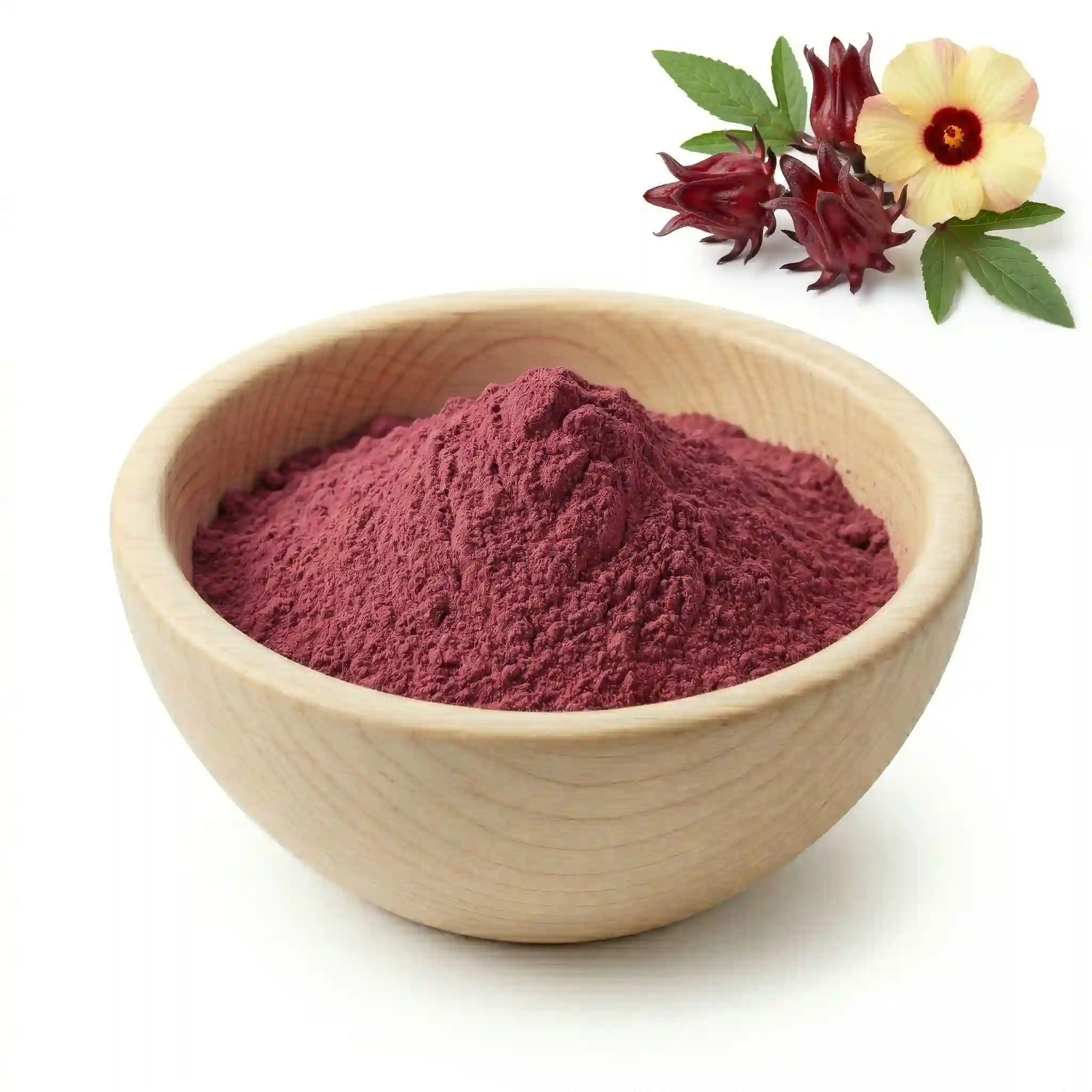
Valeherb supplies hibiscus flower extract bulk wholesale standardized to anthocyanins from 5% to 25% — with custom specifications available for cardiovascular-support supplement, functional beverage, natural colorant, and cosmetic applications. Derived from the calyces of Hibiscus sabdariffa, this ingredient is unusual in the botanical market: it delivers both a stable, vivid crimson pigment and a well-researched bioactive profile in a single raw material. Whether you are sourcing for a cardiovascular- or antioxidant-support supplement, a clean-label RTD beverage, a natural food colorant, or a cosmetic active, we supply the anthocyanin grade and format that fits your formulation.
Active Compounds: What Makes Hibiscus sabdariffa Functionally Distinct
Hibiscus sabdariffa calyces contain a multi-compound profile. Three compound classes account for its characterised functional activity:
| Compound Class | Key Compounds | Activity Studied in Research |
|---|---|---|
| Anthocyanins | Delphinidin-3-sambubioside (dominant), cyanidin-3-sambubioside | Studied for ACE-inhibitory and antioxidant activity; natural pH-sensitive crimson colorant, stable at acidic pH[1] |
| Organic Acids | Hibiscus acid, hydroxycitric acid, citric acid, malic acid | Mild alpha-hydroxy acid (AHA) character relevant to cosmetic actives; contributes the tart flavour profile in beverages[3] |
| Flavonoids & Polyphenols | Quercetin, kaempferol, chlorogenic acid | Studied for antioxidant, inflammatory-pathway (NF-κB), LDL-oxidation, and in vitro collagenase/elastase-inhibitory activity[3] |
Available Grades and Specifications
We supply hibiscus flower extract standardized to anthocyanins from 5% to 25%. Custom anthocyanin targets, particle sizes, and solubility formats (dry powder or water-soluble) are available on request:
| Grade | Anthocyanin Content | Format | Typical Application Category |
|---|---|---|---|
| Standard Grade | 5–8% anthocyanins by HPLC | Dry powder | Functional teas, food fortification, herbal blends, entry-level supplement capsules |
| Mid Grade | 10–15% anthocyanins by HPLC | Dry powder or water-soluble | Supplement capsules, antioxidant stacks, functional beverage concentrates |
| High Grade | 20–25% anthocyanins by HPLC | Dry powder or water-soluble | High-standardization supplements, premium antioxidant formulations, natural colorant applications requiring high colour intensity |
Published Research
Blood-Pressure and Cardiovascular Research
This is the most-studied research area for hibiscus. A meta-analysis by Serban et al. (2015) of randomized, placebo-controlled trials reported that standardized Hibiscus sabdariffa extract was associated with reductions in systolic blood pressure (weighted mean difference −7.58 mmHg) and diastolic blood pressure (−3.53 mmHg) versus placebo, with effects larger at higher baseline values.[1] The mechanism studied in research is ACE-inhibitory activity of hibiscus anthocyanins; this is a compound-level research mechanism and is not a basis for presenting any product as equivalent to an antihypertensive medication. Under DSHEA, the only compliant finished-product framing for this area is “supports healthy blood pressure levels already within the normal range,” and that claim must be substantiated by the marketer.
Antioxidant and Lipid Research
Hibiscus polyphenols — particularly quercetin and chlorogenic acid — have been studied for inhibition of LDL oxidation and free-radical scavenging.[4] In a clinical study, Gurrola-Díaz et al. (2010) reported improvements in HDL and reductions in total cholesterol and triglycerides in participants with metabolic syndrome versus a comparison group.[2] The broader lipid evidence is mixed — some later trials reported no significant overall lipid effect — so this remains an area of ongoing research rather than a settled effect.
Cosmetic and Skin-Research Applications
In vitro research has characterised Hibiscus sabdariffa extract and its polyphenols for collagenase- and elastase-inhibitory activity and for antioxidant protection against UV-induced oxidative stress — the mechanistic basis for its use as a cosmetic active.[3] The organic-acid fraction additionally provides mild AHA character relevant to skin-texture formulations. These mechanisms operate independently of the anthocyanin colorant function.
Application Categories
- Cardiovascular- and antioxidant-support supplements: capsules at formulation-reference amounts (commonly 250–1,000 mg standardized extract per serving). Often combined with CoQ10, aged garlic extract, and magnesium in multi-ingredient cardiovascular formulations. Healthy-blood-pressure positioning must use the “within the normal range” wording and marketer substantiation.
- Functional beverages and RTD formats: water-soluble grade for clear liquid applications. Hibiscus delivers natural crimson colour and a researched bioactive profile in one ingredient — reducing the need for synthetic colorants. Specify pH range and request stability data before finalizing grade.
- Natural food colorant: high-anthocyanin grades (20–25%) give intense colour at low inclusion. Stable in acidic systems (pH <4.5); monitor colour shift in neutral/alkaline applications.
- Cosmetics and topical formulations: water-soluble powder for serum and emulsion incorporation; supplied for antioxidant and skin-texture cosmetic actives.
Sourcing Criteria: What to Require from Any Supplier
| Criterion | What to Require |
|---|---|
| Anthocyanin Standardization | HPLC-verified total anthocyanin content per batch — not total polyphenol by Folin-Ciocalteu, which inflates the number. Specify delphinidin-3-sambubioside as the primary marker |
| Species Confirmation | Hibiscus sabdariffa calyx specifically — not leaf, stem, or other Hibiscus species. Request botanical identity documentation |
| pH Stability Data | For beverage and cosmetic applications, request colour stability documentation at your target pH. Anthocyanin behaviour varies significantly between pH 3 and pH 7 |
| Third-Party COA | Anthocyanin content (HPLC), heavy metals (USP <232>), pesticide residues, microbial limits (USP <2021>), moisture — per production batch |
| Solubility Grade | Specify standard dry powder (capsules/tablets) or water-soluble grade (beverages/topicals). Confirm clarity data at your intended use concentration for liquid formats |
| Certifications | Non-GMO, Kosher/Halal for relevant markets. FDA-registered facility for US supplement supply chains |
Regulatory Background
- US (DSHEA): antioxidant structure/function claims are the most defensible category. Blood-pressure wording is disease-adjacent: only “supports healthy blood pressure levels already within the normal range” is appropriate, and it must be substantiated by the marketer and carry the FDA disclaimer. Disease treatment claims are prohibited without drug approval.
- EU (food colorant): anthocyanins are authorized as the natural food colour E163 under Regulation (EC) 1333/2008 — a direct regulatory pathway for beverage and food colorant applications.
- EU (supplements): no authorized health claims for Hibiscus sabdariffa under Regulation (EC) 1924/2006 as of 2026; traditional-use positioning may apply in some member states.
- Canada (NHPs): hibiscus has a Health Canada NHP monograph; permitted claims are defined within that monograph.
References
[1] Serban C, Sahebkar A, Ursoniu S, Andrica F, Banach M. (2015). Effect of sour tea (Hibiscus sabdariffa L.) on arterial hypertension: a systematic review and meta-analysis of randomized controlled trials. Journal of Hypertension, 33(6), 1119–1127. doi:10.1097/HJH.0000000000000585
[2] Gurrola-Díaz CM, García-López PM, Sánchez-Enríquez S, Troyo-Sanromán R, Andrade-González I, Gómez-Leyva JF. (2010). Effects of Hibiscus sabdariffa extract powder and preventive treatment (diet) on the lipid profiles of patients with metabolic syndrome (MeSy). Phytomedicine, 17(7), 500–505. doi:10.1016/j.phymed.2009.10.014
[3] Da-Costa-Rocha I, Bonnlaender B, Sievers H, Pischel I, Heinrich M. (2014). Hibiscus sabdariffa L. — A phytochemical and pharmacological review. Food Chemistry, 165, 424–443. doi:10.1016/j.foodchem.2014.05.002
[4] Hopkins AL, Lamm MG, Funk JL, Ritenbaugh C. (2013). Hibiscus sabdariffa L. in the treatment of hypertension and hyperlipidemia: a comprehensive review of animal and human studies. Fitoterapia, 85, 84–94. doi:10.1016/j.fitote.2013.01.003