Bulk Butterfly Pea Flower Extract Supplier — Natural Blue Colorant, Color Value E3–E50, B2B Wholesale
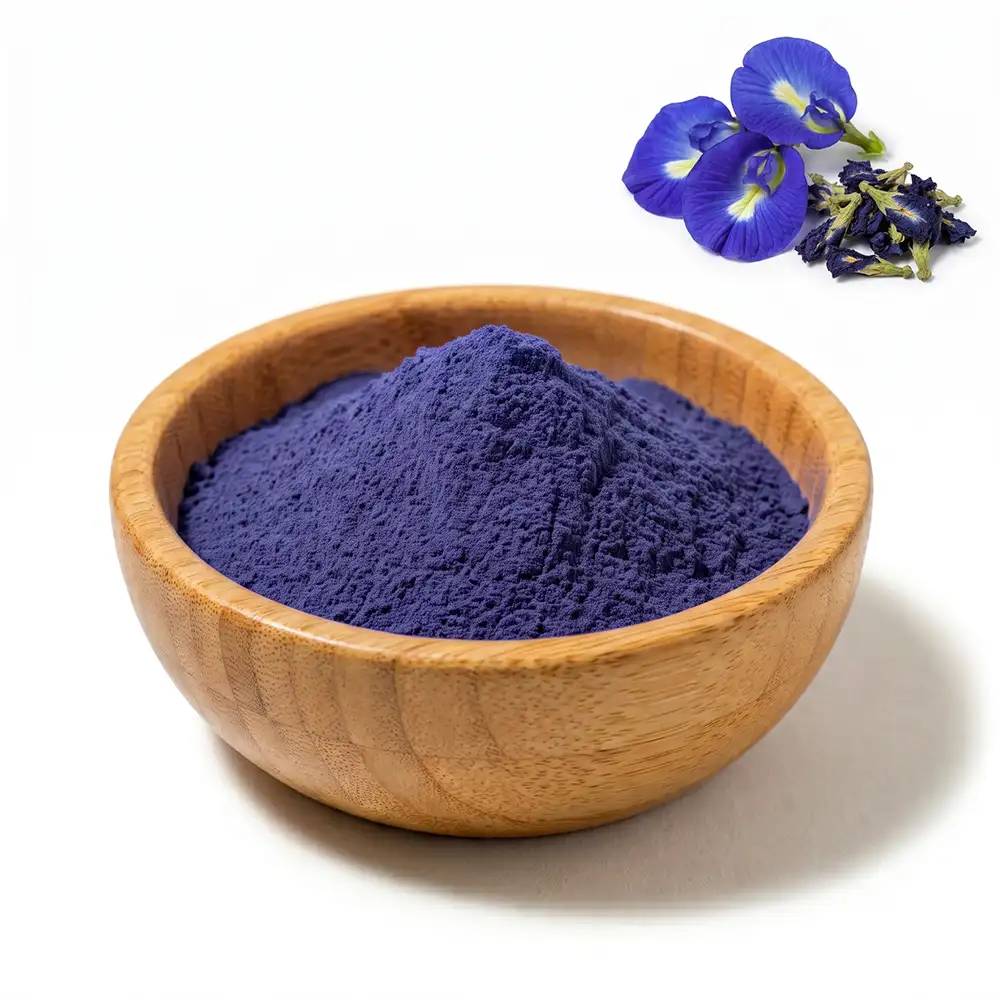
Valeherb supplies butterfly pea flower extract bulk wholesale — Clitoria ternatea L. flower extract — in color value grades E3, E10, E20, and E50 (E1%1cm method), available in powder and liquid concentrate formats. The extract’s blue color comes from ternatins, a family of highly acylated anthocyanins unique to this flower that give it substantially better thermal and storage stability than typical non-acylated anthocyanins — making it one of the most practical natural blue colorants available for food and beverage formulation.[1]
On this page: available grades, active compound profile, research background, formulation applications, sourcing criteria, and regulatory guidance.
Available Grades
| Grade | Color Value (E1%1cm) | Typical Application |
|---|---|---|
| E3 | ~3 | Entry-level tinting; large-volume food and beverage applications where a lighter blue is required |
| E10 | ~10 | Mainstream beverage and confectionery coloring; balances cost and tinting strength |
| E20 | ~20 | Concentrated color applications; reduced inclusion rate for cost-sensitive formulations |
| E50 | ~50 | High-concentration master batch; premium formulations requiring minimal inclusion rate and maximum tinting efficiency |
Available in powder (water-soluble) and liquid concentrate formats. MOQ, lead time, and current pricing available on inquiry.
Active Compound Profile
| Compound | Class | Notes |
|---|---|---|
| Ternatins (A1–A3, B1–B4, C1–C5, D1–D3) | Polyacylated anthocyanins — primary color compounds | Polyacylated derivatives of delphinidin 3,3′,5′-triglucoside; the acylation is what gives ternatins substantially better thermal and storage stability than typical anthocyanins[1] |
| Delphinidin glycosides | Anthocyanidin backbone | The base anthocyanidin structure from which all ternatins derive |
| Flavonol glycosides | Secondary polyphenols | Present alongside the anthocyanin fraction; contribute to overall antioxidant activity |
Research Background
Provided as scientific context for formulators, not as claims for any Valeherb product.
Color Stability and Natural Colorant Comparison
Vidana Gamage et al. (2021, Frontiers in Plant Science) published a comprehensive review of butterfly pea flower anthocyanins, covering biosynthesis, extraction, stability, antioxidant activity, and applications. The review confirmed good thermal and storage stability but comparatively lower photostability, and documented an intense blue color specifically in the pH 3.2–5.2 range. The review also compared butterfly pea anthocyanins against two other natural blue colorants used in the food industry — phycocyanin (spirulina blue) and genipin-derived pigments — noting butterfly pea’s advantage in acylated-anthocyanin stability relative to typical non-acylated sources.[1]
pH and Temperature Stability — Quantified Data
Fu et al. (2021, Molecules) characterised the spectral properties, storage stability, and antioxidant properties of C. ternatea anthocyanin extract across a pH range of 0.5–13. The extract showed strong resistance to acidic and alkaline conditions, with notably higher thermal stability at pH 7 (blue) compared to pH 0.5 (magenta) or pH 10 (blue-green) — a practical advantage for neutral-pH food applications. Stability declined with increasing temperature, with stable storage documented for months at 4°C.[2]
Formulation Applications
- Beverages and functional drinks: E10 or E20 grade in acidic to neutral-pH beverages, where the natural pH shift from blue to purple can be used as a visual formulation feature (e.g., color-changing drinks with citrus addition)
- Confectionery and bakery: E20 or E50 grade for consistent blue coloring in candies, icing, and baked goods; formulate at neutral pH for best thermal stability during baking
- Dairy and frozen desserts: E10 grade for natural blue coloring in yogurts, ice cream, and similar neutral-pH applications
- Cosmeceutical and skin-care applications: Anthocyanin extract in antioxidant-positioned topical formulations; INCI name: Clitoria Ternatea Flower Extract
- Natural colorant replacement: Positioned as a plant-based alternative to synthetic blue dyes (e.g., Brilliant Blue FCF) in clean-label reformulation projects
Sourcing Criteria
| Criterion | What to Require |
|---|---|
| Species Confirmation | Clitoria ternatea L. flower confirmed on COA — the sole commercial source of ternatin-type anthocyanins |
| Color Value | E1%1cm color value verified per batch, matched to grade (E3/E10/E20/E50). Request stability data at your target formulation pH |
| Format | Powder (water-soluble, longer shelf life) or liquid concentrate — specify at order based on your formulation and handling requirements |
| Third-Party COA | Color value, heavy metals, pesticide residues, microbial limits, moisture — per production batch from accredited laboratory |
Regulatory Guidance
- EU (Novel Food): A 2022 EFSA opinion assessed dried Clitoria ternatea flowers as a traditional food from a third country under Regulation (EU) 2015/2283, and raised safety objections to market placement, citing limited data on cyclotides present in the flower.[3] Buyers targeting EU food markets should confirm current authorisation status with regulatory counsel before finalizing formulation, as novel food status in the EU remains an active area requiring case-by-case verification
- US (FDA): Butterfly pea flower extract is used as a food colorant and ingredient; confirm current FDA color additive and food ingredient status for your specific application and intended use level
- Southeast Asia: Long-standing traditional food and beverage use in Thailand, Malaysia, and neighbouring countries, with established regulatory acceptance in several regional markets
- Cosmetics (EU/US): INCI name Clitoria Ternatea Flower Extract. Confirm safety assessment under EU Cosmetics Regulation 1223/2009 for your specific formulation and concentration