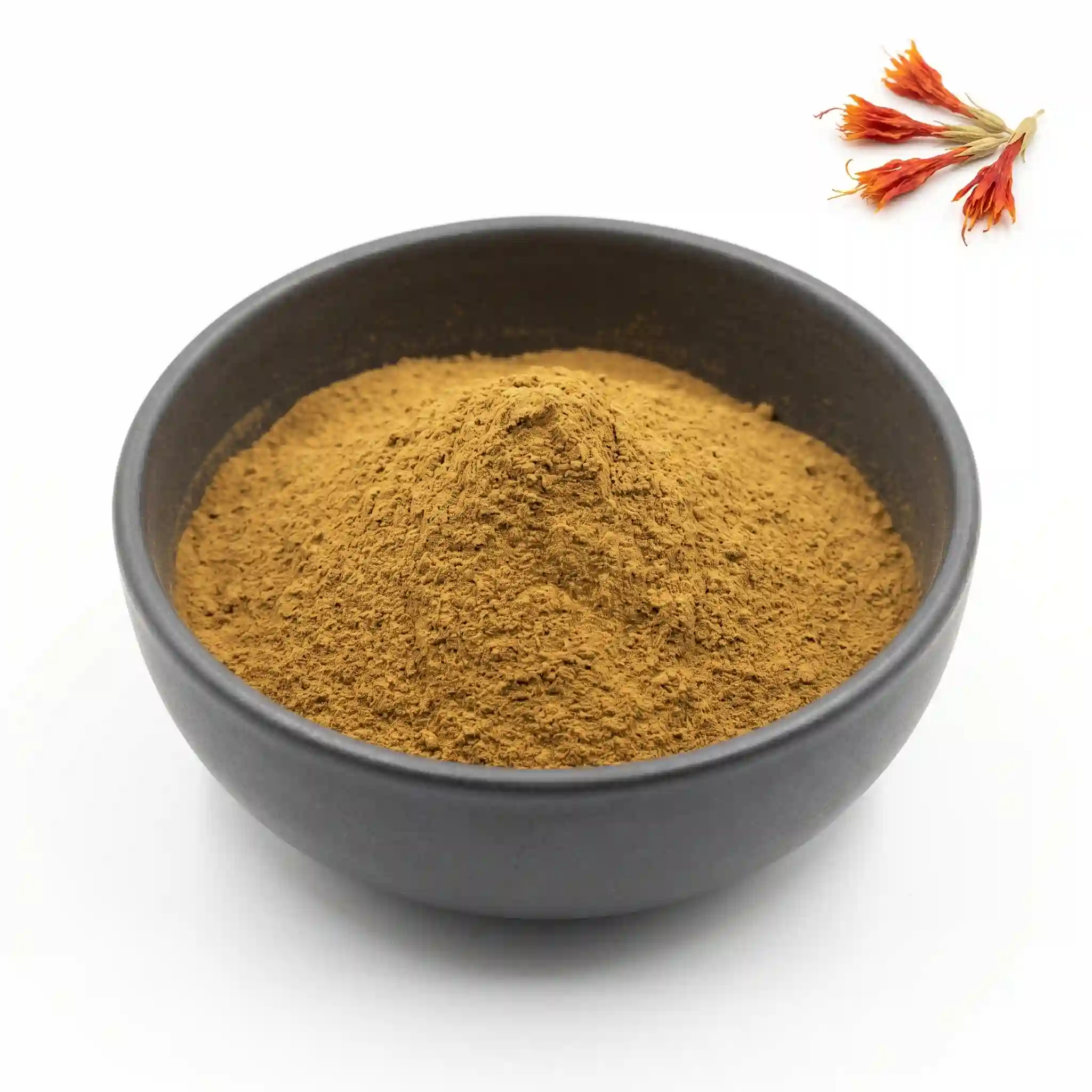
Bulk Carthamus tinctorius Extract Supplier — Safflower, HSYA & Kaempferol, 4:1 / 10:1 / 20:1 Ratio Extracts, B2B Wholesale
Valeherb supplies Carthamus tinctorius flower extract bulk wholesale — safflower (红花, Honghua) — in 4:1, 10:1, and 20:1 concentration ratio extracts, with custom specifications available for circulation support, antioxidant, and cosmeceutical formulation. Derived from the dried florets of Carthamus tinctorius L. (Asteraceae/Compositae), this extract has over 1,000 years of documented use in traditional Chinese medicine for promoting circulation and addressing blood stasis, and an extensively characterised modern pharmacological evidence base centred on its flavonoid fraction — principally hydroxysafflor yellow A (HSYA) and kaempferol glycosides. HSYA is the primary HPLC quality marker specified in the Chinese Pharmacopoeia (ChP 2020) for Carthami Flos (红花).[1]
On this page: available grades, active compound profile, research background, formulation applications, sourcing criteria, regulatory guidance, and references.
Available Grades and Specifications
All three ratio grades are derived from the dried floret (flower) of Carthamus tinctorius L. HSYA content and total flavonoid content are reported as-tested per batch on the COA. Aqueous extraction concentrates the water-soluble HSYA fraction; ethanol extraction yields a broader flavonoid profile including the less polar kaempferol glycosides.
| Grade (Ratio) | Extraction Format | Concentration Profile | Typical Application |
|---|---|---|---|
| 4:1 | Aqueous / Ethanol | Full-spectrum — HSYA + kaempferol glycosides + polysaccharides | Traditional TCM tonic blends, circulation-support supplements, food and beverage colouring applications |
| 10:1 | Aqueous / Ethanol | Concentrated flavonoid fraction; HSYA-enriched (aqueous) or broad-flavonoid (ethanol) | Mainstream antioxidant capsules, circulation-support formulas, nutraceutical ingredient applications |
| 20:1 | Ethanol (preferred) | High active density per gram; concentrated HSYA and kaempferol fraction | Premium antioxidant stacks, cosmeceutical actives, compact dosing formats |
Custom ratios and individual compound-standardized grades (HSYA % by HPLC) available on request. MOQ, lead time, and current pricing available on inquiry.
Active Compounds: HSYA-Led Flavonoid Profile
The pharmacological activity of Carthamus tinctorius flower extract is attributed to its flavonoid fraction — one of the best-characterised compound classes in the TCM circulation-support category.[4]
| Compound | Class | Notes |
|---|---|---|
| Hydroxysafflor Yellow A (HSYA) | Chalcone glycoside — primary ChP marker; water-soluble | Principal bioactive of safflower yellow pigment fraction; ChP 2020 HPLC quality marker for Carthami Flos; studied for antioxidant and vascular endothelial activity in published research[2] |
| Kaempferol & Kaempferol glycosides | Flavonol and flavonol glycosides | Antioxidant; inflammatory-pathway modulation via NF-κB studied in published research; present in ethanol extract alongside HSYA[4] |
| Quercetin & Rutin | Flavonol and flavonol glycoside | Antioxidant co-activity; synergistic with HSYA in flavonoid fraction; present across extraction methods[4] |
| Safflower Yellow (SY) pigment complex | Chalcone-type flavonoids — HSYA dominant | Water-soluble yellow pigment fraction; HSYA comprises the majority of the SY complex; the basis for approved pharmaceutical preparations in China[1] |
| Safflower Red (SR) | Quinochalcone pigment | Natural red colorant derived from floret; distinct from the yellow HSYA fraction; present at low levels in dried floret material |
Research Background
The activity described below is reported in published research on Carthamus tinctorius flower extract and its constituent compounds. It is provided as scientific context for formulators, not as claims for any Valeherb product.
1. Pharmacological Profile of Safflower Yellow — Comprehensive Review
Chen et al. (2022, Evidence-Based Complementary and Alternative Medicine) reviewed the pharmacological activities and clinical applications of safflower yellow (SY) — the water-soluble flavonoid pigment fraction of which HSYA is the principal component. The review documented a broad spectrum of published in vitro and in vivo research covering antioxidant activity, inflammatory-pathway modulation, and vascular research endpoints. HSYA injection (a safflower yellow preparation containing approximately 80% HSYA) has been approved by China’s NMPA for clinical use in specific vascular-related applications.[1] This review is described here as scientific background; clinical drug approval status does not transfer to dietary supplement or food ingredient applications.
2. Antioxidant Activity in Vascular Endothelial Cell Model
Xie et al. (2020, Evidence-Based Complementary and Alternative Medicine) investigated the effects of HSYA on hydrogen peroxide-induced oxidative damage in human umbilical vein endothelial cells (HUVECs) in an in vitro model. HSYA treatment significantly attenuated H₂O₂-induced cell damage, increased intracellular GSH/GSSG ratio and SOD activity, and decreased intracellular ROS levels. Western blot analysis showed increased expression of AKT and Bcl-2 proteins and inhibited expression of BAX and PTEN proteins, with the authors proposing these as possible mechanisms for the observed cytoprotective effects.[2] These are in vitro findings described here as research context.
3. Systematic Review: Botanical Sources, Pharmacokinetics, and Pharmacological Effects
Zhao et al. (2021, Frontiers in Pharmacology) conducted a systematic review of HSYA covering its botanical sources, physicochemical properties, pharmacokinetics, and pharmacological activities documented in published research. The review noted HSYA’s water solubility, its characterisation as a ChP quality marker, and the broad range of in vitro and in vivo research across antioxidant, inflammatory-pathway, and vascular biology endpoints. Pharmacokinetic data indicated low oral bioavailability of HSYA — a relevant formulation consideration for supplement applications.[3]
4. Safflower Flavonoid Fraction — Kaempferol and Quercetin Activity
A 2025 review by Liang et al. (Frontiers in Pharmacology) systematically reviewed the pharmacological actions and applications of safflower flavonoids — including kaempferol, quercetin, rutin, and chalcone compounds alongside HSYA. The review confirmed that these flavonoids collectively exhibit diverse published biological activities, including antioxidant effects, inflammatory-pathway modulation, and neuroprotective activity in published preclinical models, and noted their applications in food, cosmetic, and nutraceutical formulation contexts.[4]
Formulation Applications
- Antioxidant and circulation-support supplements: 10:1 or 20:1 aqueous extract at 300–600 mg per serving. Pairs with danshen (Salvia miltiorrhiza) extract, rutin, and grape seed OPC in multi-mechanism antioxidant and circulation formulas; or with Eucommia and Poria in TCM-positioned tonic blends
- TCM-format practitioner supplements: 4:1 full-spectrum extract in classical Honghua formula blends; ChP 2020 Carthami Flos compliance documentation available
- Food and beverage colouring: 4:1 aqueous extract as a natural yellow food colorant in functional beverages, health drinks, and food products. The water-soluble HSYA fraction provides pH-stable natural yellow colouring in aqueous matrices; confirm EU E-number status (E120-adjacent natural pigment category) with regulatory counsel for each target market
- Cosmeceutical actives: 10:1 or 20:1 ethanol extract in antioxidant serums, skin-brightening formulas, and anti-aging topical products. The kaempferol and HSYA fractions have published in vitro antioxidant and cytoprotective activity relevant to oxidative-stress-related skin aging positioning. INCI name: Carthamus Tinctorius Flower Extract
- Sports and recovery formulations: Antioxidant positioning in post-exercise recovery blends alongside coenzyme Q10 and vitamin C, based on the flavonoid fraction’s ROS-scavenging activity characterised in published research
Sourcing Criteria
| Criterion | What to Require |
|---|---|
| Plant Part | Floret (dried flower) confirmed on COA — not seed, leaf, or whole plant. The flower is the ChP-specified part and the sole source of HSYA and safflower yellow pigment |
| HSYA Content | HPLC-verified HSYA content per batch — the ChP 2020 primary quality marker for Carthami Flos. For supplement applications, HSYA % is the most meaningful potency indicator; total flavonoid colorimetric figures alone are insufficient for premium applications |
| Ratio & Extraction Format | Confirm stated ratio (4:1 / 10:1 / 20:1) against raw-to-finished input; specify aqueous (HSYA-led) or ethanol (broad-flavonoid) as appropriate for target compound fraction |
| Colour Stability (if food/beverage use) | Request pH stability data and light stability data — HSYA is water-soluble but can degrade under acidic conditions or UV exposure; confirm stability under your target formulation conditions |
| Third-Party COA | HSYA content (HPLC), total flavonoids (UV), heavy metals (USP <232>), pesticide residues (multi-residue screen), microbial limits (USP <2021>), moisture — per production batch from accredited laboratory |
| Certifications | Non-GMO, Kosher/Halal for relevant markets; FDA-registered facility for US supply chains; ChP 2020 documentation for China domestic market |
Regulatory Guidance
- US (DSHEA): Antioxidant and circulation support structure/function claims are supportable with published research — each must be self-substantiated by the marketer and carry the required FDA disclaimer. Disease treatment claims require drug approval. FDA-registered facility (21 CFR Part 111)
- China (ChP 2020): Carthami Flos (红花) is a listed medicinal herb in the Chinese Pharmacopoeia with HSYA as the primary HPLC quality marker. HSYA injection is an NMPA-approved pharmaceutical preparation for specific clinical indications — supplement applications are separate from pharmaceutical registration and carry different claim restrictions
- EU (food colouring): Safflower yellow pigment (Carthamus tinctorius extract) is used as a natural food colorant in some EU markets. Confirm authorised use, permitted categories, and maximum levels with regulatory counsel before finalizing EU food product specifications
- Cosmetics (EU/US): INCI name is Carthamus Tinctorius Flower Extract. Listed in EU Cosing database; FDA 21 CFR cosmetic ingredient nomenclature. Confirm safety assessment under EU Cosmetics Regulation 1223/2009 for your specific formulation and concentration
- Canada (NHPs): Safflower (Honghua) is recognized in Traditional Chinese Medicine under Natural Health Products Regulations — confirm permitted claim language with a qualified Canadian regulatory consultant