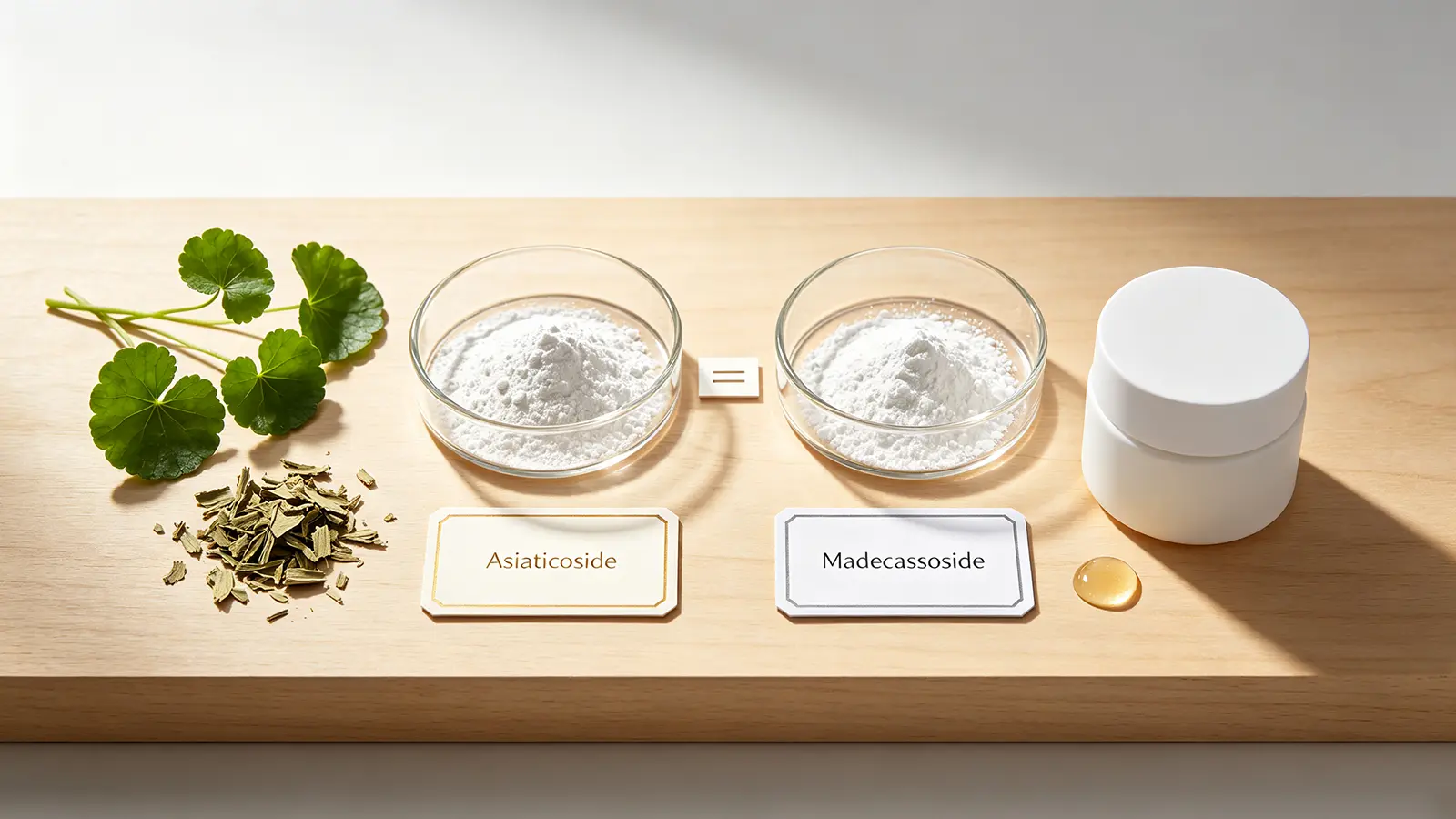

Side-by-Side: Asiaticoside vs Madecassoside
| Property | Asiaticoside | Madecassoside |
|---|---|---|
| Molecular formula | C₄₈H₇₈O₁₉ | C₄₈H₇₈O₂₀ |
| Molecular weight | 959.12 g/mol | 975.12 g/mol |
| Aglycone | Asiatic acid | Madecassic acid (6β-OH asiatic acid) |
| C-6 hydroxyl | Absent | Present |
| Relative polarity | Lower (amphiphilic) | Higher (~18% increase by LogP) |
| Natural abundance in plant | 0.04–2.41% DW (avg 0.44%) | 0.15–5.27% DW (avg 1.59%) |
| Primary research direction | Type I collagen synthesis, TβRI-independent Smad pathway | NF-κB / TLR4 anti-inflammatory cascade, barrier repair |
| Water solubility | Poor (~0.1 mg/mL) | Good (~1 mg/mL) |
| Ethanol solubility | Moderate (~5 mg/mL) — best handled with a co-solvent | Not the limiting solvent; water is sufficient |
| Typical downstream application | Anti-aging / firmness serums; requires ethanol or propylene glycol pre-dissolution for aqueous or hydro-alcoholic formats | Soothing / calming / barrier-repair serums, aqueous cica formats — disperses directly |
Both compounds are pentacyclic triterpenoid glycosides from Centella asiatica, sharing the same ursane skeleton and the same glucose–glucose–rhamnose trisaccharide chain. Their entire structural difference is a single hydroxyl group. But that one functional group divides them into distinct research profiles and, for formulators, into materially different solubility handling — Madecassoside dissolves directly in water, while Asiaticoside requires a co-solvent step. The choice between asiaticoside and madecassoside is not about quality — it is about matching the compound to the formulation’s target pathway and dissolution requirements.
One Hydroxyl, Two Research Profiles
Madecassoside carries a 6β-hydroxyl group on its aglycone ring (madecassic acid) that asiaticoside’s aglycone (asiatic acid) lacks. This increases madecassoside’s overall polarity by approximately 18% as measured by calculated LogP values.[1] The hydroxyl also changes the molecule’s hydrogen-bonding geometry at biological targets — which is why, despite near-identical molecular architecture, the two glycosides show measurably different activity profiles in comparative studies.In the most rigorous head-to-head study available, Wu et al. tested all four Centella triterpenes (both glycosides and both aglycones) on primary human skin fibroblasts and in a mouse burn-wound model.[2] The key findings were:
- Both glycosides promoted fibroblast proliferation and upregulated procollagen type I and type III expression via the TGF-β/Smad signaling pathway
- Madecassoside was statistically more potent than asiaticoside for procollagen type III synthesis (P = 0.0446) and wound-healing speed (P = 0.0057)
- Procollagen type I responded to both glycosides without a significant difference between them
- The glycosides themselves — not the aglycones produced by metabolic deglycosylation — were the active wound-healing constituents
This last point overturned the earlier assumption that Centella’s glycosides were merely pro-drugs for their aglycones. The intact sugar chain is part of the active pharmacophore, not just a solubility modifier.
Asiaticoside: The Collagen-Pathway Glycoside
Asiaticoside’s most distinctive mechanistic finding is its ability to induce type I collagen synthesis through a TβRI kinase-independent Smad pathway. In a study on human dermal fibroblasts, asiaticoside triggered phosphorylation of Smad 2 and Smad 3, followed by nuclear translocation of the Smad 3/Smad 4 complex — but this Smad activation was not blocked by SB431542, a specific inhibitor of the TGFβ receptor I kinase.[3] This means asiaticoside activates collagen synthesis through a signaling route that is partially independent of the canonical TGF-β receptor, suggesting a distinct binding target or receptor interaction that has not yet been fully characterized.Why this matters for formulators: the TβRI-independent pathway means that asiaticoside’s collagen-stimulating activity is not subject to the same regulatory feedback loops that modulate conventional TGF-β signaling. In practical terms, this may translate to a more consistent pro-collagen effect across different skin conditions and formulation contexts — though this remains a research observation, not a verified clinical outcome.In the Wu et al. head-to-head comparison, asiaticoside’s collagen-pathway activity was most pronounced for type I collagen — the dominant structural protein in mature dermis and the collagen subtype most associated with skin firmness and tensile strength.[2] Both glycosides also upregulated MMP-1 inhibitor TIMP-1, contributing to net collagen accumulation by slowing degradation alongside promoting synthesis. This type I bias positions asiaticoside as the more relevant glycoside for anti-aging and firmness-appearance formulations where the claims strategy centers on collagen support rather than soothing or calming.The other noteworthy property is solubility, and this is where formulators most often misjudge the compound. At high purity (≥90% by HPLC), asiaticoside is not oil-soluble — published solubility data places it at approximately 0.1 mg/mL in water, low enough that vendors and analytical sources commonly describe the crystalline compound as “insoluble in water.”[6] It is somewhat more soluble in ethanol (~5 mg/mL), which is why published transdermal delivery research on asiaticoside has used propylene glycol (15% w/w) and gelatin (4% w/w) as penetration-enhancing co-solvents rather than relying on water alone.[6] In practice, this means asiaticoside 90% needs a co-solvent pre-dissolution step — in ethanol or propylene glycol — before it can be incorporated into either an aqueous phase or a hydro-alcoholic system. It does not have a direct route into an anhydrous oil phase either, since it is not lipophilic; it is simply poorly soluble in water and moderately soluble in alcohol.
Madecassoside: The Anti-Inflammatory and Barrier Glycoside
Madecassoside’s research profile clusters around NF-κB pathway suppression and inflammatory-cascade modulation. In LPS-stimulated cell models, it concentration-dependently downregulated iNOS, COX-2, and NF-κB at both mRNA and protein levels, while upregulating the anti-inflammatory enzyme HO-1.[4] The mechanism involves TLR4/MyD88 inhibition upstream of NF-κB nuclear translocation — a broader point of intervention than downstream COX-2 blockade alone.In the Wu et al. comparison, madecassoside outperformed asiaticoside specifically on procollagen type III — the collagen subtype associated with early-phase wound remodeling and granulation tissue formation.[2] Combined with its NF-κB suppression profile, this positions madecassoside as the glycoside best matched to soothing, calming, barrier-repair, and post-procedure recovery formats.Madecassoside also inhibits UVB-induced melanin synthesis through an indirect mechanism — suppressing the PAR-2 signaling axis that drives post-inflammatory pigmentation rather than directly inhibiting tyrosinase.[1] This gives madecassoside-standardized formulations a secondary positioning angle in the brightening/calming crossover space, though it should not be marketed as a direct brightening active.At ≥90% purity, madecassoside is water-soluble (~1 mg/mL), incorporating directly into aqueous serums, toners, and the water phase of emulsions. Its higher polarity compared to asiaticoside also means higher transdermal penetration resistance, which may favor encapsulation or nanoemulsion delivery systems in low-concentration leave-on formats. For a deeper analysis of madecassoside’s full mechanism and stability profile, see What Is Madecassoside? Compound Guide.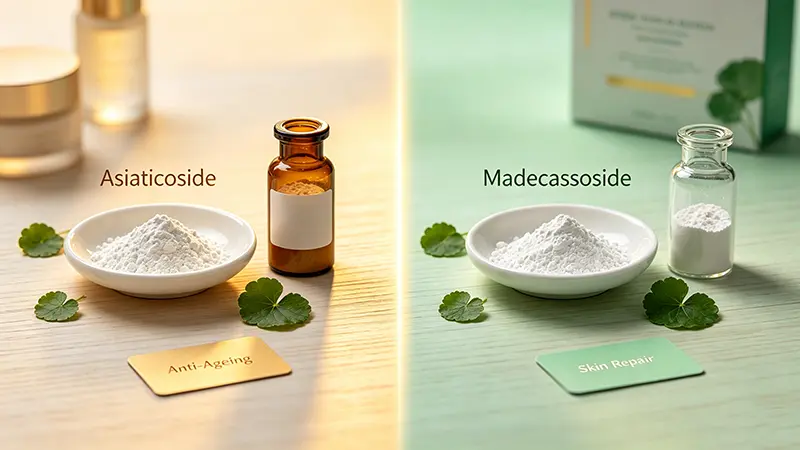
Grade Selection: Matching the Glycoside to the Formulation
The choice between asiaticoside and madecassoside ultimately reduces to two variables: the target research pathway the formulation references, and how much dissolution handling the formulation can accommodate.
| Formulation Goal | Recommended Grade | Rationale |
|---|---|---|
| Anti-aging / firmness-appearance serum (aqueous) | Total Centella Glycosides 80% or Asiaticoside 90% (pre-dissolved) | Collagen type I pathway bias; Asiaticoside 90% requires a 15–20% ethanol or propylene glycol pre-dissolution step before addition to the water phase, given its poor intrinsic water solubility (~0.1 mg/mL) |
| Anti-aging hydro-alcoholic toner or essence | Asiaticoside 90% | The ethanol content already present in this format assists dissolution directly, making it one of the more practical formats for this specific compound |
| Soothing / calming / cica toner or serum | Madecassoside 90% | NF-κB suppression profile directly supports soothing/calming claims framework; genuinely water-soluble (~1 mg/mL), disperses directly into the water phase |
| Post-procedure recovery moisturizer | Madecassoside 90% | Procollagen type III bias favors early-phase repair positioning; anti-inflammatory pathway supports recovery context; direct aqueous compatibility |
| Dual-pathway emulsion (both mechanisms) | Madecassoside 90% added directly to the water phase + Asiaticoside 90% pre-dissolved in the ethanol/propylene glycol portion before combining | Leverages both pathways within a single water-based or hydro-alcoholic system; requires two-grade sourcing and a co-solvent step for the asiaticoside component |
| General cica positioning (broad claims) | Total Centella Glycosides 80% (water-soluble) | Contains both glycosides; broadest research support without pathway-specific claims |
The natural ratio of madecassoside to asiaticoside in C. asiatica averages approximately 3.6:1 but varies from 1.2:1 to over 30:1 depending on plant genotype.[5] This means that a “standardized Centella extract” without individual compound verification is inherently unpredictable in its pathway balance. Formulators who need reproducible soothing performance should specify madecassoside content directly; those targeting firmness should verify the asiaticoside content is adequate for their positioning.Valeherb supplies all three formats: total Centella glycosides 80% (water-soluble), asiaticoside 90% (poorly water-soluble, ethanol-assisted), and madecassoside 90% (water-soluble), each with per-batch HPLC verification of the individual compound profile.For formulators working with published TECA (Titrated Extract of Centella Asiatica) literature, the classic TECA ratio (40% asiaticoside, 30% madecassic acid, 30% asiatic acid) uses a different compound-class mix than modern single-glycoside standardization. See What Is TECA? for a detailed explanation of how to read TECA-based research and translate it to current commercial grades.
Frequently Asked Questions
What is the main difference between asiaticoside and madecassoside?
Can I use both asiaticoside and madecassoside in the same formulation?
Is asiaticoside 90% oil-soluble?
Which glycoside is more abundant in Centella asiatica?
References
[1] Tan SC, Bhattamisra SK, Chellappan DK, Candasamy M. Actions and therapeutic potential of madecassoside and other major constituents of Centella asiatica: A review. Appl Sci. 2021;11(18):8475. doi:10.3390/app11188475
[2] Wu F, Bian D, Xia Y, et al. Identification of major active ingredients responsible for burn wound healing of Centella asiatica herbs. Evid Based Complement Alternat Med. 2012;2012:848093. doi:10.1155/2012/848093
[3] Lee J, Jung E, Kim Y, et al. Asiaticoside induces human collagen I synthesis through TGFβ receptor I kinase (TβRI kinase)-independent Smad signaling. Planta Med. 2006;72(4):324–328. doi:10.1055/s-2005-916227
[4] Sasmita AO, Ling APK, Voon KGL, Koh RY, Wong YP. Madecassoside activates anti-neuroinflammatory mechanisms by inhibiting lipopolysaccharide-induced microglial inflammation. Int J Mol Med. 2018;41(5):3033–3040. doi:10.3892/ijmm.2018.3479
[5] Kunjumon R, Johnson AJ, Remadevi RKS, Baby S. Assessment of major centelloside ratios in Centella asiatica accessions grown under identical ecological conditions, bioconversion clues and identification of elite lines. Sci Rep. 2022;12:8204. doi:10.1038/s41598-022-12077-9
[6] Solubility data (asiaticoside ~0.1 mg/mL in water, ~5 mg/mL in ethanol; madecassoside ~1 mg/mL in water) per vendor-reported analytical specifications (Cayman Chemical, ChemicalBook, Santa Cruz Biotechnology product documentation) and Fan L, et al. Measurement and correlation of solubilities of asiaticoside in water, methanol, ethanol, n-propanol, n-butanol, and a methanol + water mixture from (278.15 to 343.15) K. J Chem Eng Data. 2011;56(3):674–677. doi:10.1021/je101208p. Propylene glycol/gelatin co-solvent data from published transdermal asiaticoside gel research.