

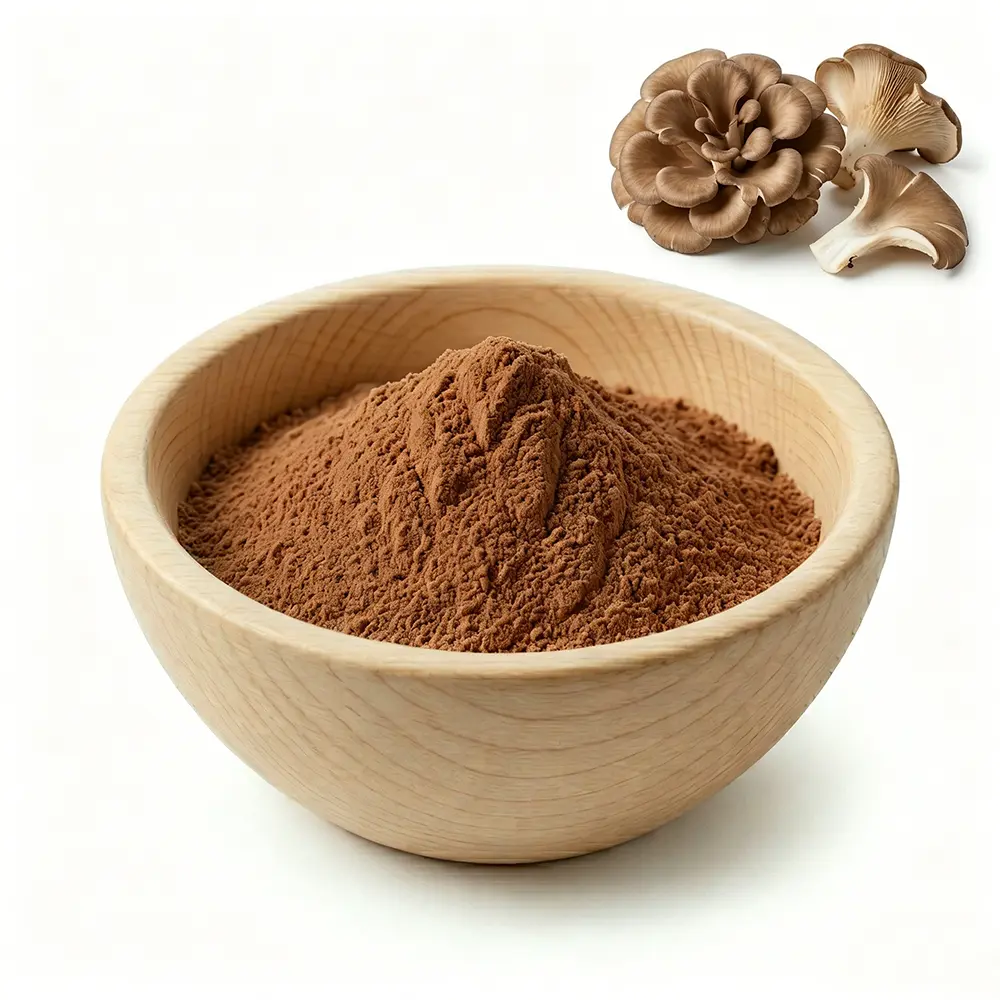
Bulk Maitake Extract Supplier — Polysaccharides 30/40/50% (UV), Grifola frondosa, B2B Wholesale
Valeherb supplies maitake extract bulk wholesale — Grifola frondosa fruiting body — standardized to total polysaccharides at 30%, 40%, and 50% by UV, with custom specifications available for immune-support supplement, functional mushroom blend, and functional food formulation. Maitake (the “dancing mushroom”) is among the most-researched functional mushrooms in the polysaccharide literature; that research — covering its beta-glucans and the named D- and SX-fractions — sits at the compound level and is summarised below as ingredient background, not as a claim for any finished product. For procurement, the decisions that matter are polysaccharide grade, source part, and assay basis.
Active Compounds: Beta-Glucans and the D-/SX-Fraction Research
Grifola frondosa is rich in branched β-1,6:β-1,3-glucan polysaccharides that have been the subject of concentrated research:
| Compound / Fraction | Structure | Activity Studied in Research |
|---|---|---|
| Beta-Glucan Polysaccharides (total) | Mixed β-1,3 and β-1,6 glucan linkages | Studied for immune-modulating activity via dectin-1 receptor signalling (macrophage, NK-cell, T-cell models)[1] |
| D-Fraction | Highly branched β-1,6:β-1,3-glucan proteoglycan complex | The most-studied maitake fraction, originally characterised by Nanba and colleagues; examined in research for NK-cell and macrophage activity[2] |
| SX-Fraction | Glycoprotein / proteoglycan fraction | Studied in research for glucose- and insulin-pathway activity (e.g., alpha-glucosidase and insulin-sensitivity research)[3] |
Available Grades and Specifications
We supply Grifola frondosa fruiting body extract standardized to total polysaccharides by UV. Custom ratios and formats (including water-dispersible) available on request:
| Grade | Polysaccharide Content | Source / Extraction | Typical Application Category |
|---|---|---|---|
| 30% Polysaccharides | 30% total polysaccharides by UV | Fruiting body; hot-water | Functional food fortification, mushroom blends, entry-level immune-support capsules |
| 40% Polysaccharides | 40% total polysaccharides by UV | Fruiting body; hot-water | Standardized immune-support capsules, mushroom-blend formulas |
| 50% Polysaccharides | 50% total polysaccharides by UV | Fruiting body; hot-water | High-standardization supplement formulations, premium mushroom SKUs |
Published Research
Immune-Pathway Research
Maitake beta-glucans bind dectin-1 and complement receptors on innate immune cells in laboratory models, a mechanism reviewed by Wu et al. (2021).[1] In humans, Deng et al. (2009) ran a phase I/II dose-escalation trial whose primary endpoints were safety and tolerability in 34 post-menopausal breast-cancer patients who were disease-free after treatment; oral maitake extract was well tolerated and produced measurable immune changes in both directions — the authors specifically cautioned that it may depress as well as enhance immune function.[2] A 2021 meta-analysis by Zhao et al. of preclinical (animal) studies summarised polysaccharide activity in tumour models.[4] This is compound- and model-level research, not evidence of a finished-product effect.
Glucose-Pathway Research
Maitake polysaccharides and the SX-fraction have been studied for glucose- and insulin-pathway activity, largely in cell and animal models. The most-cited human reference, Konno et al. (2001), is a brief two-patient case report describing lower fasting glucose in two type-2-diabetic individuals who were also taking a prescription antidiabetic drug.[3] The human glucose evidence for maitake is therefore preliminary and hypothesis-generating, not established.
Application Categories
- Immune-support supplements: 40% or 50% polysaccharide extract at formulation-reference amounts (commonly 300–500 mg per serving), often combined with reishi, turkey tail, and vitamin D3 in immune-complex formulations.
- Metabolic-support supplements: standardized polysaccharide extract used in multi-ingredient metabolic-support formulations. Glucose-related positioning, where used, must use the “supports healthy blood glucose already within the normal range” wording and marketer substantiation.
- Functional mushroom blends: 30–50% polysaccharide extract alongside lion’s mane, shiitake, and chaga for broad mushroom-complex products.
- Functional beverages: water-dispersible grade for RTD and mushroom-coffee formats; mild earthy flavour suits cacao and umami-forward drinks.
Sourcing Criteria: What to Require from Any Supplier
| Criterion | What to Require |
|---|---|
| Polysaccharide Assay Basis | Confirm whether the value is UV total polysaccharide or a beta-glucan-specific assay. UV total polysaccharide is the standard commercial spec; beta-glucan-specific assays read lower because they exclude non-glucan polysaccharides |
| Fruiting Body vs. Mycelium | Specify source part. Mycelium-on-grain products can carry residual substrate starch that inflates total-polysaccharide readings; fruiting body avoids this |
| Extraction Method | Hot-water extraction for polysaccharide-standardized extract. Dual extraction available for a broader compound profile |
| Third-Party COA | Polysaccharide content (UV), heavy metals (USP <232>), pesticide residues, microbial limits (USP <2021>), moisture — per production batch |
| Substrate Documentation | For mycelium products, request substrate composition documentation, as grain substrates raise apparent polysaccharide content |
| Certifications | Non-GMO, Kosher/Halal for relevant markets. FDA-registered facility for US supplement supply chains |
Regulatory Background
- US (DSHEA): immune-function and antioxidant structure/function claims are the more defensible categories, but must be substantiated by the marketer and carry the FDA disclaimer. Glucose wording is disease-adjacent — only “supports healthy blood glucose levels already within the normal range” is appropriate, with substantiation. Disease claims, including any cancer or diabetes treatment claim, are prohibited without drug approval.
- EU: Grifola frondosa fruiting body is used as a food ingredient. The authorized beta-glucan health claims (EC 1924/2006) apply to oat and barley beta-glucan; mushroom beta-glucan claims are not authorized and require separate substantiation.
- Canada (NHPs): maitake has a Health Canada NHP monograph; permitted claims are defined within that monograph.
- Japan: maitake is a long-established culinary mushroom — useful safety context for export documentation.
References
[1] Wu JY, Siu KC & Geng P. (2021). Bioactive ingredients and medicinal values of Grifola frondosa (Maitake). Foods, 10(1), 95. doi:10.3390/foods10010095
[2] Deng G, Lin H, Seidman A, et al. (2009). A phase I/II trial of a polysaccharide extract from Grifola frondosa (Maitake mushroom) in breast cancer patients: immunological effects. Journal of Cancer Research and Clinical Oncology, 135(9), 1215–1221. doi:10.1007/s00432-009-0562-z
[3] Konno S, Tortorelis DG, Fullerton SA, Samadi AA, Hettiarachchi J, Tazaki H. (2001). A possible hypoglycaemic effect of maitake mushroom on Type 2 diabetic patients [case report]. Diabetic Medicine, 18(12), 1010. doi:10.1046/j.1464-5491.2001.00532.x
[4] Zhao F, et al. (2021). Antitumor activities of Grifola frondosa (Maitake) polysaccharide: a meta-analysis based on preclinical evidence and quality assessment. Journal of Ethnopharmacology, 280, 114395. doi:10.1016/j.jep.2021.114395


