
Written by Jonathan · July 2026
Why “Hawthorn Extract” Isn’t One Ingredient
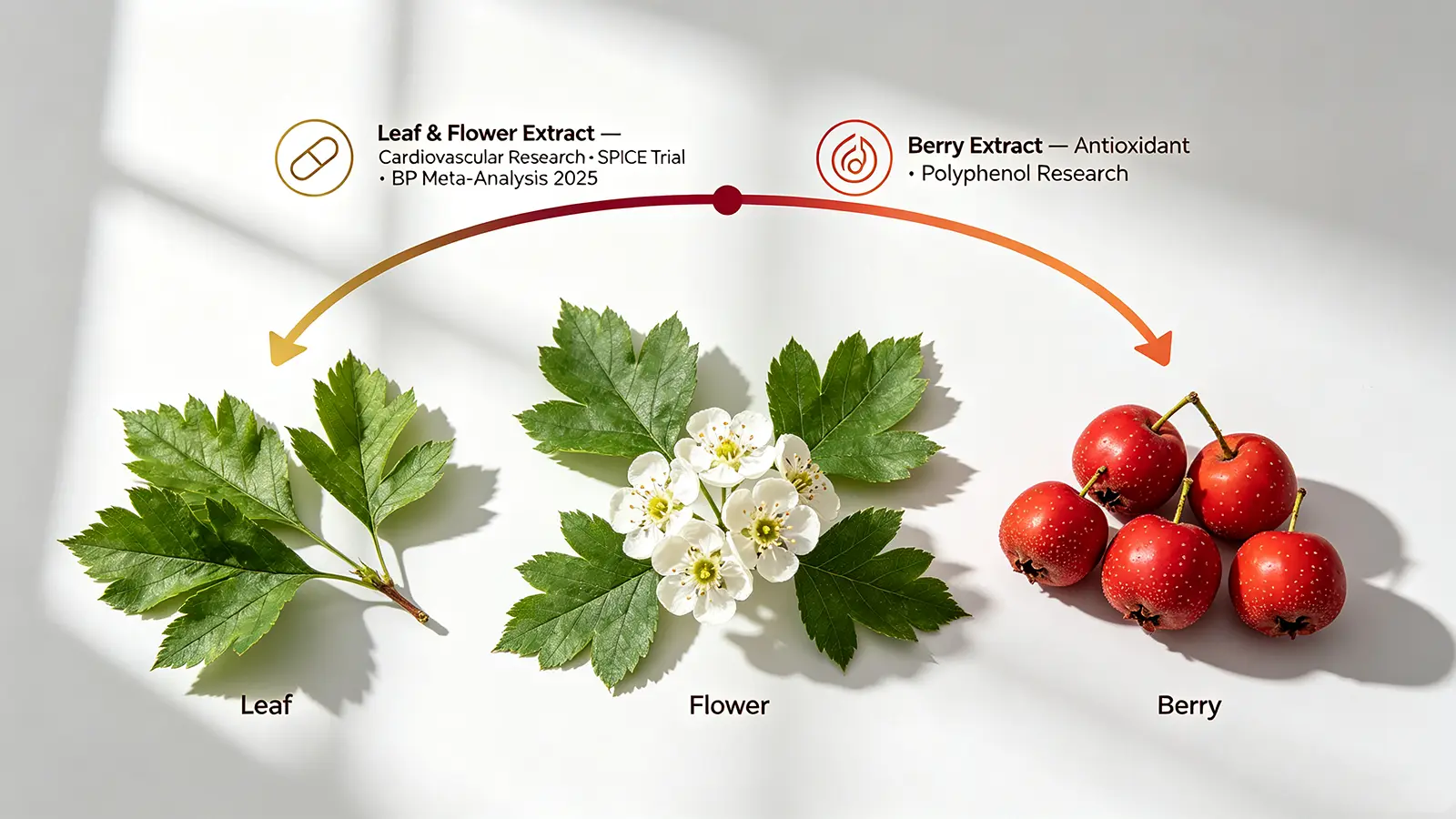
The short answer: the SPICE trial, the Cochrane review, and most of the clinical research behind hawthorn’s cardiovascular reputation were conducted on leaf and flower extract — not berry. If your formulation or label wants to reference that research base, berry-sourced flavonoids don’t carry the same evidence, even though both are legitimately called “hawthorn extract.” Here’s the distinction and why it matters for what you can claim.
The mismatch is common in practice because global commercial supply skews toward berry (fructus) material from Crataegus pinnatifida, Chinese hawthorn — it’s the more widely cultivated commercial source and the plant part most readily available at scale. The European clinical trials, by contrast, were built specifically on leaf/flower extract from different species. A buyer defaulting to whatever “hawthorn extract” is most readily available can end up, without intending to, sourcing exactly the plant part the cardiovascular research wasn’t conducted on.
The Plant Part Behind the Clinical Research
The landmark SPICE trial — 2,681 chronic heart failure patients across European centers, given 900 mg/day of extract over 24 months — used WS 1442, a standardized leaf/flower extract of Crataegus monogyna and Crataegus laevigata.[1] The trial did not meet its primary endpoint (time to first cardiac event), though a pre-specified subgroup with higher ejection fraction showed a reduction in sudden cardiac death — a nuanced result, but one built entirely on leaf/flower material. The Cochrane systematic review pooling multiple randomized trials of standardized hawthorn extract reported improvements in exercise tolerance and in breathlessness and fatigue symptoms versus placebo, again primarily using leaf/flower-standardized extracts.[2] A more recent 2025 meta-analysis of six placebo-controlled trials (428 participants) reported a mean systolic blood pressure reduction of −6.65 mmHg over 10 weeks to 6 months, drawing on the same class of standardized material.[3] This is a European Pharmacopoeia-recognized material — “Crataegi folium cum flore” — with its own EMA/HMPC monograph, distinct from berry (fructus) material.
Berry Extract: A Different Flavonoid Chemistry, Not a Weaker Version
Berry extract isn’t an inferior substitute for leaf/flower — it’s chemically different. Comparative phytochemical analysis across Crataegus species shows leaves and flowers are dominated by flavonol glycosides and C-glycosyl flavones, chiefly vitexin and vitexin derivatives, while fruit is comparatively richer in oligomeric procyanidins.[4] A 2023 comparative screening across multiple Crataegus species using HPTLC and HPLC identified chlorogenic acid, neochlorogenic acid, quercetin and vitexin derivatives, epicatechin, and procyanidins across different plant parts, with the relative proportions of each compound class shifting depending on whether flower-bearing branches, leaves, or fruit were analyzed.[4] Berry extract has its own legitimate research base — largely antioxidant and polyphenol-content studies — it simply isn’t the material the cardiovascular trials above were built on.
| Parameter | Leaf & Flower | Berry (Fructus) |
|---|---|---|
| Dominant compound class | Flavonol glycosides, C-glycosyl flavones (vitexin) | Oligomeric procyanidins |
| Pharmacopoeia name | Crataegi folium cum flore | Crataegi fructus |
| Clinical trial material | SPICE, Cochrane-reviewed trials, 2025 BP meta-analysis | Not the material used in these trials |
| EMA/HMPC status | Well-established and traditional-use monograph | Covered separately; different evidentiary basis |
| Typical research focus | Cardiovascular, blood pressure | Antioxidant, polyphenol content |
Why This Matters for Label Claims
This isn’t a technicality. A structure/function claim that leans on “clinically studied” cardiovascular research, built with berry-sourced flavonoids, is a substantiation gap — the underlying trials didn’t use that material. This distinction is formalized in Europe: the EMA/HMPC assessment of Crataegus leaf and flower gives that specific material a “well-established use” and “traditional use” regulatory background that berry material doesn’t automatically inherit, since it was assessed as a separate monograph. Marketers are responsible for their own claim substantiation in every market, but sourcing the correct plant part is the first step toward a defensible claim rather than an assumed one — no amount of careful label wording fixes a formulation built on the wrong starting material.
Specifying What You Actually Need
State the plant part (leaf, flower, leaf/flower combined, or berry) on every enquiry, alongside the flavonoid grade (20/50/80%) and species. Crataegus monogyna and Crataegus laevigata are the European species behind the clinical research literature; Crataegus pinnatifida, Chinese hawthorn, is the dominant commercial source globally and carries its own long traditional-use history in Chinese medicine, but it is not the species the SPICE trial, Cochrane review, or 2025 meta-analysis were built on. Neither species is “better” in absolute terms — they simply carry different evidentiary bases, and which one belongs in a formulation depends on what the finished product needs to be able to say. Full grade specifications and sourcing criteria are on the hawthorn extract product page. If your enquiry is actually about maslinic acid rather than flavonoids, that’s a separate compound entirely — see Hawthorn Flavonoids vs Maslinic Acid.
Frequently Asked Questions
Is hawthorn berry extract as effective as leaf and flower extract?
They’re not directly comparable because they’re chemically different — berry is richer in procyanidins, while leaf and flower are richer in vitexin-type flavonoids. The cardiovascular clinical trials, including SPICE, were conducted specifically on leaf/flower extract, so that research doesn’t transfer automatically to berry-sourced material.
Which hawthorn part should I specify for a heart-health supplement?
If the positioning references the published clinical research (SPICE, Cochrane review, or the 2025 blood-pressure meta-analysis), specify leaf/flower extract, since that’s the material those studies used. Berry extract is a legitimate ingredient in its own right but carries a different, mostly antioxidant-focused research base.
What’s the difference between European and Chinese hawthorn?
Crataegus monogyna and Crataegus laevigata are the European species used in the clinical research literature. Crataegus pinnatifida, Chinese hawthorn, is the dominant commercial source globally and has its own traditional use history, but isn’t the species behind the SPICE trial or Cochrane review. Specify species on your enquiry.
Does “hawthorn extract” on a label tell you which plant part was used?
Not reliably. “Hawthorn extract” is often used generically for berry, leaf, flower, or combined leaf/flower material. If plant part matters for your formulation or claims, request it explicitly on the certificate of analysis rather than assuming it from the label alone.
References
[1] Holubarsch CJF, Colucci WS, Meinertz T, Gaus W, Tendera M. The efficacy and safety of Crataegus extract WS 1442 in patients with heart failure: the SPICE trial. European Journal of Heart Failure, 10(12), 1255–1263 (2008). https://doi.org/10.1016/j.ejheart.2008.10.004
[2] Guo R, Pittler MH, Ernst E. Hawthorn extract for treating chronic heart failure. Cochrane Database of Systematic Reviews, Issue 1, CD005312 (2008). https://doi.org/10.1002/14651858.CD005312.pub2
[3] Szikora Z, Mátyus RO, Vargáné Szabó B, Csupor D, Tóth B. Hawthorn (Crataegus spp.) Clinically Significantly Reduces Blood Pressure in Hypertension: A Meta-Analysis of Randomized Placebo-Controlled Clinical Trials. Pharmaceuticals, 18(7), 1027 (2025). https://doi.org/10.3390/ph18071027
[4] Turnalar Ülger T, Oçkun MA, Guzelmeric E, et al. Comprehensive Analysis of the Chemical and Bioactivity Profiles of Endemic Crataegus turcicus Dönmez in Comparison with Other Crataegus Species. Molecules, 28(18), 6520 (2023). https://doi.org/10.3390/molecules28186520
[5] Wu M, Liu L, Xing Y, Yang S, Li H, Cao Y. Roles and Mechanisms of Hawthorn and Its Extracts on Atherosclerosis: A Review. Frontiers in Pharmacology, 11, 118 (2020). https://doi.org/10.3389/fphar.2020.00118
Jonathan
Content Editor, Valeherb. Specializing in botanical ingredient science communication for B2B nutraceutical and functional food markets.
This article is for informational purposes only and has not been evaluated by the Food and Drug Administration. It is not intended to diagnose, treat, cure, or prevent any disease. © 2026 Valeherb.