
Written and reviewed by Dr. Xiaoyan Qiu · Botanical Extract R&D Engineer, Valeherb · June 2026
Ginkgo biloba and ginseng are two of the most widely used botanical ingredients in cognitive and energy supplements, and they are frequently compared — or combined — in finished formulas. The comparison makes sense on the surface: both have extensive research backing, both appear in nootropic blends, and buyers often ask which one to choose. The honest answer is that they are not alternatives to each other. They have different active compounds, different mechanisms studied in research, different standardization systems, and different application fits. This guide sets them side by side from a formulator’s perspective — active compounds, COA requirements, stability, and where each ingredient actually belongs in a product.
Different Plants, Different Active Compounds
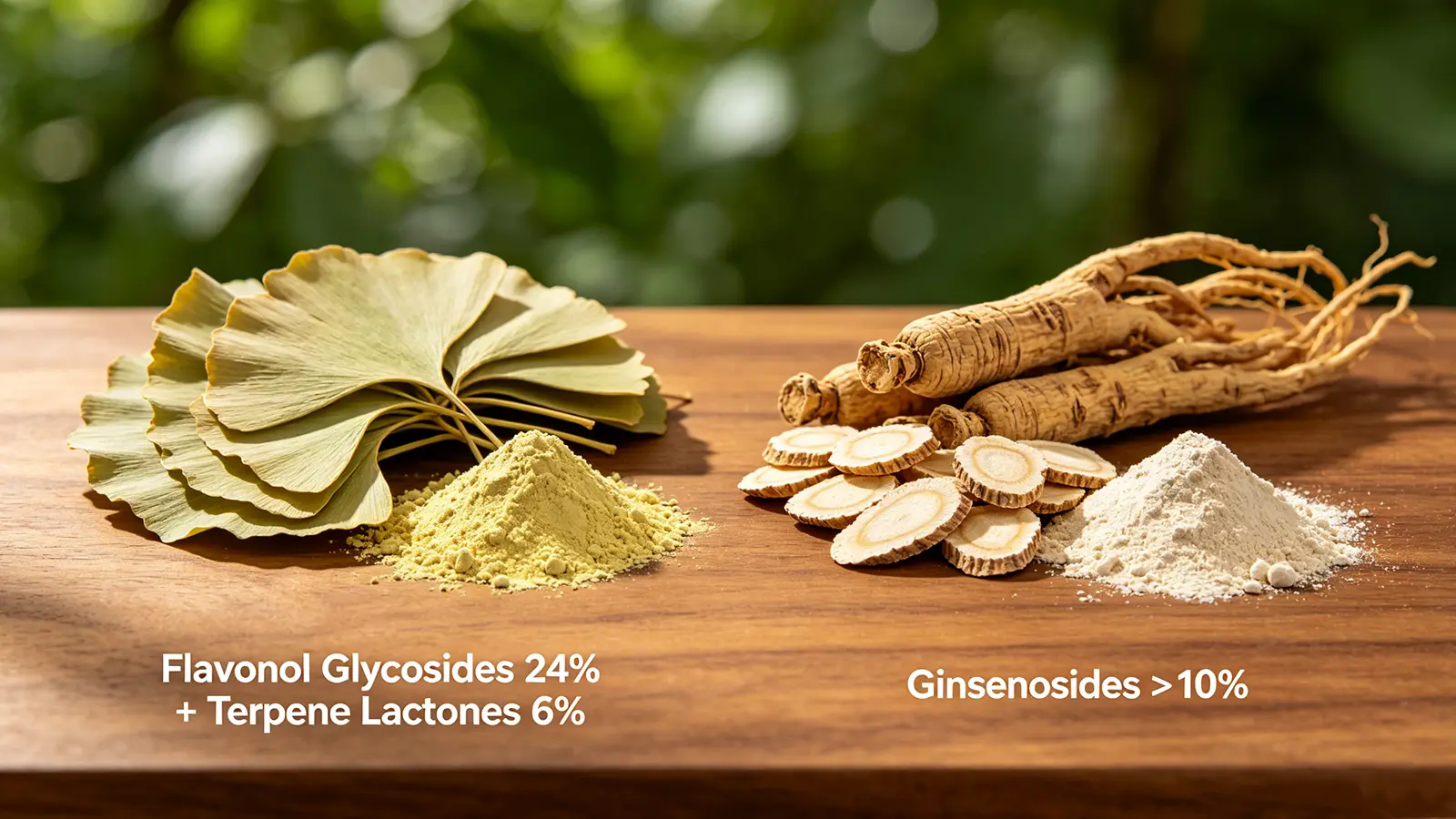
The two ingredients come from unrelated plant families and have nothing in common chemically. Ginkgo biloba is a leaf extract; the active fraction is two compound classes found only in this species — flavonol glycosides and terpene lactones (ginkgolides and bilobalide). Panax ginseng is a root extract; its actives are ginsenosides, a family of triterpenoid saponins that occur across the Panax genus but not in ginkgo.
| Property | Ginkgo Biloba Extract | Ginseng Extract (Panax) |
|---|---|---|
| Plant source | Ginkgo biloba leaf | Panax ginseng or P. quinquefolius root |
| Primary active compounds | Flavonol glycosides; terpene lactones (ginkgolides, bilobalide) | Ginsenosides (Rb1, Rg1, Re, and others) |
| Compound class | Flavonoids + diterpene/sesquiterpene trilactones | Triterpenoid saponins |
| Standard marker | 24% flavonol glycosides + 6% terpene lactones | Ginsenosides 4–10% (supplement grade); 20–80% (concentrated B2B extract) |
| Measurement method | UV (flavonol glycosides) + HPLC (terpene lactones) | HPLC (ginsenoside profile) |
| Safety limit | Ginkgolic acid <5 ppm | Pesticide residues; heavy metals per batch |
Different Mechanisms in the Research Literature
The distinction in active compounds leads directly to a distinction in what each ingredient is studied for. They are not competing for the same mechanism — they are studied for different ones, which is the underlying reason they appear together in combination formulas rather than as substitutes.
Ginkgo biloba extract is studied primarily through two mechanisms. The flavonol glycosides are antioxidants, studied for free-radical scavenging activity in neuronal tissue.[1] The terpene lactones — particularly ginkgolide B — are studied as platelet-activating factor antagonists, with research connecting this to effects on microcirculation.[2] Most of the published human trial data is based on the EGb 761 composition at 120–240 mg daily.[3]
Ginseng extract is studied as an adaptogen — a compound that modulates the body’s response to stress via the hypothalamic-pituitary-adrenal axis. Its ginsenosides are also studied for effects on energy metabolism, physical endurance, and cognitive function through pathways including cholinergic system modulation and neurotrophin support.[4] The cognitive mechanisms studied for ginseng are largely distinct from those studied for ginkgo, which is why formulators targeting both circulation/antioxidant support and adaptogenic/energy pathways often include both ingredients rather than choosing between them.
Standardization and COA Requirements
The two ingredients use different standardization systems, and the COA requirements reflect that difference. For ginkgo, the standard is composition-based: both marker classes must be verified per batch, along with a safety limit. For ginseng, the standard is ginsenoside percentage — but because individual ginsenosides have different activities, a total ginsenoside figure tells only part of the story for premium applications.
| COA Requirement | Ginkgo Biloba Extract | Ginseng Extract |
|---|---|---|
| Primary marker | Flavonol glycosides ≥24% by UV, per batch | Total ginsenosides by HPLC, per batch — target depends on formulation grade (supplement-grade typically 4–10%; concentrated B2B extract 20–80%) |
| Secondary marker | Terpene lactones ≥6% by HPLC, per batch | Individual ginsenoside profile (Rb1, Rg1, Re) for premium grades |
| Safety limit | Ginkgolic acid <5 ppm by HPLC — non-negotiable | Heavy metals, pesticide screen per batch |
| Pharmacopeial reference | Ph. Eur. 01/2016:1827 or USP | USP Panax ginseng monograph or Ph. Eur. |
One practical difference is that ginkgo has a well-defined single-composition standard (the 24/6 specification) that most serious suppliers work to, while ginseng standardization varies more widely — supplement-grade extracts typically run 4–10% ginsenosides for finished-product use, while concentrated B2B extracts go up to 20–80% for precise formulation control, and the ratio of individual ginsenosides differs by species (P. ginseng vs P. quinquefolius) and processing (white ginseng vs red ginseng). For ginseng, specifying total ginsenoside percentage alone without naming the species, the processing method, and the individual ginsenoside profile is a less complete specification than the equivalent for ginkgo.
For full sourcing specifications on each ingredient, see the Valeherb ginkgo biloba extract product page and the white ginseng extract product page.
Stability and Formulation Considerations
Both ingredients are available as dry standardized powders and are reasonably stable under normal supplement manufacturing conditions, but there are differences worth knowing before finalizing a formula.
Ginkgo extract’s flavonol glycosides are sensitive to prolonged light exposure and high humidity, though they are heat-stable enough for standard encapsulation and tableting. The more critical stability issue is ginkgolic acid — not degradation of the markers, but the need to confirm that a supplier’s process reliably keeps ginkgolic acid below 5 ppm across batches, not just in a type-test sample. Batch-to-batch variation in ginkgolic acid is the most common quality failure in commodity ginkgo, and it is invisible without per-batch testing.
Ginseng extract’s ginsenosides are generally stable in dry form but can degrade under prolonged heat or high-moisture processing conditions. Red ginseng differs from white ginseng in ginsenoside profile because the steaming step converts some ginsenosides to heat-transformed variants — this affects both the analytical profile and the research base that applies to the material, so the processing method belongs on the specification alongside the ginsenoside percentage.
Can Ginkgo and Ginseng Be Combined?
Yes, and this is common in cognitive and nootropic formulations. The combination addresses two different mechanism pathways — ginkgo’s circulation and antioxidant fractions alongside ginseng’s adaptogenic and energy-metabolism activity — without functional overlap or known adverse interaction between the two extracts themselves at typical supplement doses.[5]
The main consideration for combination formulas is not ingredient interaction but drug interaction awareness on the ginkgo side: ginkgo’s antiplatelet activity means that labels for products containing it should address potential interactions with anticoagulants and antiplatelet drugs. This is a finished-product labeling issue the brand is responsible for; it does not change the formulation logic of combining the two ingredients.
When specifying a combination, both sets of COA requirements apply independently — the ginkgo COA needs its ginkgolic acid result and terpene lactone breakdown, and the ginseng COA needs its ginsenoside profile. Sourcing them from the same supplier simplifies documentation but does not change what each COA must show.
Frequently Asked Questions
What is the main difference between ginkgo biloba and ginseng?
They are unrelated plants with different active compounds and different mechanisms studied in research. Ginkgo biloba is a leaf extract standardized to flavonol glycosides and terpene lactones, studied primarily for cerebral circulation support and antioxidant activity. Ginseng is a root extract standardized to ginsenosides, studied as an adaptogen affecting stress response, energy metabolism, and cognitive function through HPA-axis modulation. They address different pathways, which is why they are frequently combined in nootropic formulas rather than substituted for each other.
Which is better for cognitive support, ginkgo or ginseng?
Neither is categorically better — they support cognition through different mechanisms. Ginkgo’s research base centers on cerebral circulation and antioxidant activity via its flavonol glycoside and terpene lactone fractions. Ginseng’s centers on adaptogenic and neuroprotective activity via ginsenosides, with research on energy and stress resilience. A formula targeting both pathways would typically include both. Any finished-product claim is the brand’s responsibility to substantiate against the specific ingredient and dose.
Can ginkgo and ginseng be used together in one formula?
Yes. The combination is common in nootropic and cognitive formulas because the two ingredients address different mechanism pathways without functional overlap. The main labeling consideration on the ginkgo side is its antiplatelet activity — products containing ginkgo should address potential interactions with anticoagulants on the label. This is a finished-product responsibility for the brand and does not prevent the combination. Both sets of COA requirements apply independently: ginkgo needs its ginkgolic acid result and terpene lactone breakdown; ginseng needs its ginsenoside profile.
How is ginkgo extract standardized compared to ginseng?
Ginkgo uses a two-marker system: 24% flavonol glycosides (UV) and 6% terpene lactones (HPLC), with ginkgolic acid below 5 ppm as a safety limit. This composition — the EGb 761 standard — is well-defined and consistent across quality suppliers. Ginseng standardization varies more widely: supplement-grade extracts typically contain 4–10% total ginsenosides for finished-product use, while concentrated B2B extracts reach 20–80% for formulation precision, and the individual ginsenoside profile differs by species and processing method. For ginseng, specifying total ginsenoside percentage alone is a less complete specification than the equivalent two-marker system for ginkgo.
What should a COA show for ginkgo vs ginseng?
For ginkgo: flavonol glycosides ≥24% by UV per batch, terpene lactones ≥6% by HPLC per batch with individual ginkgolide and bilobalide breakdown for premium applications, and ginkgolic acid below 5 ppm per batch. For ginseng: total ginsenosides by HPLC per batch, species and processing method stated, individual ginsenoside profile for premium grades, and standard heavy metals and pesticide screen. Both require third-party verification rather than supplier self-reporting alone.
References
[1] Birks JS, Grimley Evans J. (2009). Ginkgo biloba for cognitive impairment and dementia. Cochrane Database of Systematic Reviews, Issue 1. doi:10.1002/14651858.CD003120.pub3
[2] Pittler MH, Ernst E. (2000). Ginkgo biloba extract for the treatment of intermittent claudication: a meta-analysis of randomized trials. American Journal of Medicine, 108(4), 276–281. PMID: 11014719
[3] Tan MS et al. (2015). Efficacy and adverse effects of ginkgo biloba for cognitive impairment and dementia: a systematic review and meta-analysis. Journal of Alzheimer’s Disease, 43(2), 589–603. doi:10.3233/JAD-140837
[4] Arring NM, Millstine D, Marks LA, Nail LM. (2018). Ginseng as a treatment for fatigue: a systematic review. Journal of Alternative and Complementary Medicine, 24(7), 624–633. doi:10.1089/acm.2017.0361
[5] Kennedy DO, Scholey AB, Wesnes KA. (2000). The dose-dependent cognitive effects of acute administration of Ginkgo biloba to healthy young volunteers. Psychopharmacology, 151(4), 416–423. doi:10.1007/s002130000501
FDA Notice: These statements have not been evaluated by the Food and Drug Administration. This article is for informational purposes only; all references describe published peer-reviewed research at the compound and ingredient level and are not health claims for any product or medical advice. Products must comply with applicable regulations in the buyer’s jurisdiction, and all finished-product claims are the brand’s responsibility. © 2026 Valeherb. All rights reserved.