Why Formulators Are Asking This Question
The question of whether monk fruit is good for diabetics comes up consistently in B2B formulation contexts — not because the answer is uncertain, but because the implications for product development are significant. Diabetic-friendly positioning is one of the fastest-growing claims categories in functional food, beverage, and supplement markets globally. Ingredient selection for these products requires a higher standard of evidence than standard clean-label claims: glycemic impact must be zero, metabolic predictability must be documented, and purity must be verifiable per batch.
Monk fruit extract — standardized to 50% Mogroside V by HPLC — meets all three criteria. This article explains why, with specific reference to the mechanisms that matter for formulation teams and procurement specialists sourcing at scale.
Does Monk Fruit Raise Blood Sugar? The Metabolic Mechanism
The direct answer is no — and the biochemical basis for that answer is well-characterized in peer-reviewed literature. Mogrosides, the cucurbitane triterpenoid glycosides responsible for monk fruit extract’s sweetness, are not metabolized as carbohydrates. They are not absorbed in the upper gastrointestinal tract, produce no measurable blood glucose response, and do not trigger an insulin release in healthy or insulin-resistant subjects.[1]
The metabolic pathway is as follows: after ingestion, mogrosides pass through the stomach and small intestine essentially intact. In the colon, gut microbiota hydrolyze the glycoside bonds, releasing aglycone metabolites that are either excreted or absorbed in trace quantities with no glycemic consequence. This colonic metabolism pathway is the structural reason why monk fruit extract carries an effective glycemic index of zero — not as a regulatory approximation, but as a biochemically accurate characterization.
Beyond Zero Glycemic: The Active Bioactivity Case for Mogroside V
Zero glycemic index is the baseline requirement for diabetic-friendly sweetener positioning. What distinguishes mogroside V from other zero-GI sweeteners is documented bioactivity that goes beyond passive non-interference with blood glucose.
Published research has identified two mechanisms of particular relevance to diabetic formulation positioning. First, mogroside V activates the AMPK (AMP-activated protein kinase) pathway — a cellular energy sensor that plays a central role in glucose uptake, fatty acid oxidation, and insulin sensitivity. AMPK activation by mogroside V has been demonstrated in preclinical models of hepatic steatosis, where treatment significantly ameliorated lipid accumulation in liver tissue through an AMPK-dependent pathway, suggesting a potential supporting role in metabolic health beyond simple sweetness substitution.[2]
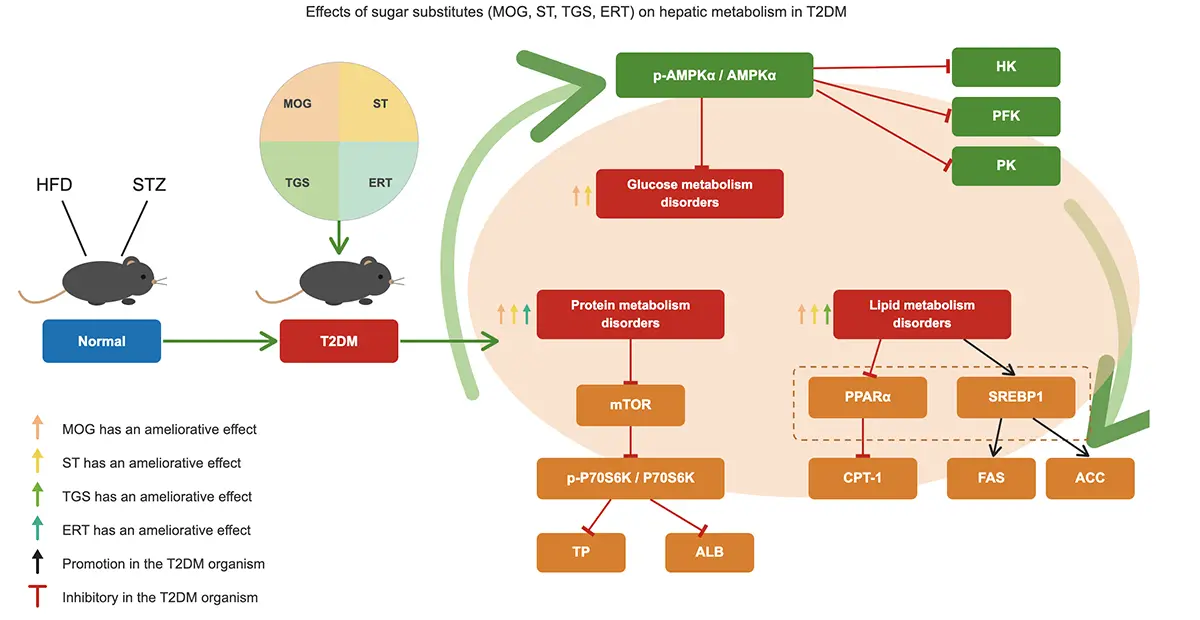
For diabetic-targeted positioning, the AMPK rationale is further supported in a T2DM model rather than a generic high-fat one: mogroside V concurrently modulated glucose, lipid, and protein metabolism through AMPK-dependent pathways, giving R&D teams a more directly applicable mechanistic reference for metabolic-health claims evaluation.[6]
Second, a 2025 study in Food & Function demonstrated that mogroside V supplementation improved intestinal barrier function via PI3K/AKT pathway activation and reduced pro-inflammatory cytokine levels in type 2 diabetic mouse models, alongside measurable improvements in gut microbiota composition and glucose homeostasis markers.[3] The gut microbiota modulation finding is particularly relevant given that mogrosides are themselves colonic metabolites — the same pathway that ensures zero glycemic impact may also contribute to the observed microbiome benefits.
Is Monk Fruit Safe for Diabetics? Regulatory and Toxicological Basis
Monk fruit extract received FDA GRAS status in 2010 (GRN 000301), based on a comprehensive safety dossier including acute, subchronic, and chronic toxicology studies across multiple animal models. No adverse effects were identified at doses far exceeding those achievable through normal dietary or supplement exposure. No genotoxicity, reproductive toxicity, or carcinogenicity was identified.[4]
The safety profile is additionally supported by over 800 years of traditional consumption of Siraitia grosvenorii fruit in southern China — a historical use record that informed the GRAS review. Monk fruit extract is further approved in the EU, Canada, China, and Australia/New Zealand, providing a broad regulatory foundation for multi-market diabetic-friendly product development.
For diabetic populations specifically, the absence of any insulin response or blood glucose perturbation is the primary safety consideration — and on this point the evidence is unambiguous. Clinical studies directly comparing postprandial glucose responses to monk fruit-sweetened versus sucrose-sweetened beverages confirm no measurable difference from water in glucose or insulin area under the curve.[1]
Monk Fruit Sweetener and Diabetes: What the Purity Grade Determines
Not all monk fruit products perform identically in diabetic formulation contexts. The purity grade — expressed as Mogroside V percentage by HPLC — determines use rate, metabolic predictability, and formulation cleanliness in ways that matter specifically for regulated and sensitive-population applications.
Standard-grade extracts (20–25% Mogroside V) require higher inclusion rates to achieve target sweetness, which increases the mass contribution of non-mogroside components — including lower-order mogrosides that may contribute off-notes and whose metabolic characterization is less complete than mogroside V’s. High-purity grades (50% MogV, Valeherb supply specification) achieve target sweetness at approximately half the inclusion rate, minimizing non-target compound contribution and enabling tighter formulation control. For a full breakdown of grade specifications and their formulation implications, see our reference guide: Mogroside V: Chemistry, Grades, and Industrial Applications.
| Grade | Mogroside V (%) | Typical Beverage Use Rate | Diabetic Formulation Suitability |
|---|---|---|---|
| Standard | 20–25% | 0.04–0.08% w/v | Adequate — higher inclusion rate; less precise |
| High-Purity | 40–45% | 0.02–0.05% w/v | Good — reduced inclusion; cleaner profile |
| Ultra-High-Purity (Valeherb) | 50–55% | 0.01–0.04% w/v | Optimal — lowest use rate; maximum purity control |
| Mogroside V Isolate | ≥80% | 0.005–0.02% w/v | Pharmaceutical-grade; significant cost premium |
Trilobatin: A Complementary Botanical for Diabetic Formulation
Formulators developing diabetic-targeted products have access to a second botanically derived compound with well-documented antidiabetic mechanism: trilobatin, a dihydrochalcone glycoside extracted from Lithocarpus litseifolius (Yao sweet tea). While monk fruit extract addresses diabetic formulation needs primarily through zero glycemic sweetening and AMPK-mediated metabolic support, trilobatin acts through a distinct and complementary pathway — making the two ingredients genuinely synergistic in antidiabetic nutraceutical design.

Trilobatin is a potent inhibitor of α-glucosidase, the intestinal enzyme responsible for breaking down complex carbohydrates into absorbable glucose. By inhibiting this enzyme, trilobatin slows the rate of postprandial glucose absorption — a mechanism analogous to pharmaceutical α-glucosidase inhibitors used in type 2 diabetes management, but derived from a natural botanical source with a long traditional use history in southern Chinese herbal medicine.[5]
In formulation terms, the combination of monk fruit extract and trilobatin offers a dual-mechanism positioning that neither ingredient provides alone: monk fruit delivers zero-glycemic sweetness with AMPK pathway support; trilobatin contributes active postprandial glucose modulation via α-glucosidase inhibition. For functional beverages, dietary supplements, and nutraceutical products targeting metabolic health and diabetic-friendly claims, this combination represents a technically defensible and commercially differentiated ingredient platform.
Trilobatin also delivers sweetness at approximately 300× sucrose — meaning it contributes to the overall sweetness profile of a formulation rather than functioning purely as a functional additive. Its flavor character is fresh and clean, with a pleasant sweetness return and mild tea character that pairs naturally with monk fruit’s rapid, clean onset. For a detailed technical overview of trilobatin’s antidiabetic mechanism and formulation applications, see our dedicated guide:Trilobatin and Blood Sugar: The Phlorizin Connection Explained. In the meantime, supply specifications and COA documentation for trilobatin are available on the Sweet Tea Extract product page.
Formulation Applications: Monk Fruit in Diabetic-Targeted Products
The zero-glycemic and bioactive profile of high-purity monk fruit extract translates into specific formulation advantages across several product categories relevant to diabetic and metabolic health positioning.
- Functional beverages and RTDs: At 0.01–0.04% w/v, 50% MogV monk fruit extract delivers target sweetness in clear, acidic, and citrus-forward matrices with no glycemic contribution. Stable through pasteurization and hot-fill. FDA GRAS as both sweetener and flavor enhancer supports dual regulatory functionality on the label.
- Dietary supplements and powder sticks: High-purity extract enables precise sweetness delivery in small-dose formats — capsules, sachets, powder sticks — without introducing carbohydrate mass. Bitterness-masking activity of mogrosides is valuable for improving palatability of bitter botanical actives common in diabetic supplement formulas (berberine, bitter melon extract).
- Protein and meal replacement formats: Monk fruit extract performs cleanly in high-protein matrices where stevia’s aftertaste is often amplified. For diabetic meal replacement products where protein content is elevated and total carbohydrate must be minimized, 50% MogV provides sweetness without label complications.
- Antidiabetic nutraceuticals with trilobatin co-formulation: As described above, monk fruit + trilobatin combination products offer a dual-mechanism antidiabetic ingredient platform suitable for functional food and supplement positioning in the metabolic health category.
For bulk inquiry and full COA documentation for monk fruit extract at 50% Mogroside V, visit the Valeherb Monk Fruit Extract product page.
B2B Sourcing Checklist for Diabetic Formulation Applications
- Mogroside V % by HPLC per production batch — not per specification sheet, not by spectrophotometric estimation. Require the analytical method to be disclosed alongside the result.
- Absence of glycemic carriers — confirm no maltodextrin, dextrose, or other carbohydrate-based carriers in the extract. Request ingredient declaration and manufacturing process documentation.
- Heavy metal panel — ICP-MS (lead, arsenic, cadmium, mercury) per batch.
- Pesticide residue screen — multi-residue per batch for EU and US market compliance.
- Microbial limits — total plate count, yeast and mold, E. coli, Salmonella per batch.
- Non-GMO documentation — required for the majority of diabetic-friendly and metabolic health retail positioning.
Frequently Asked Questions
Is monk fruit good for diabetics?
Yes — high-purity monk fruit extract is well-suited for diabetic formulations. Mogrosides are not metabolized as carbohydrates, produce no blood glucose response, and trigger no insulin release. FDA GRAS status (GRN 000301) is supported by extensive toxicological and metabolic safety data. Preclinical research additionally documents AMPK pathway activation and gut microbiota benefits, though these require further human clinical evidence before supporting label claims.
Does monk fruit raise blood sugar?
No. Mogrosides pass through the upper GI tract without absorption, are metabolized by colonic microbiota, and produce no measurable postprandial glucose or insulin response. Clinical studies comparing monk fruit-sweetened beverages to water confirm no difference in glycemic area under the curve. This applies to pure monk fruit extract — blended products containing maltodextrin or dextrose as carriers do not share this profile.
Is monk fruit sweetener safe for diabetics?
Pure monk fruit extract is safe for diabetics based on both regulatory review and clinical evidence. FDA GRAS status reflects comprehensive safety assessment including chronic toxicology data. The key distinction is between pure extract (safe, zero glycemic) and blended retail sweeteners containing glycemic carriers such as maltodextrin or dextrose — the latter can raise blood sugar despite the “monk fruit” label. For diabetic formulations, always specify pure extract with HPLC-verified Mogroside V content.
Is monk fruit ok for diabetics compared to stevia?
Both monk fruit extract and stevia are zero-glycemic and appropriate for diabetic formulations. Monk fruit’s practical advantages in this context are: cleaner flavor profile (no licorice aftertaste), broader pH stability for acidic beverage applications, and documented AMPK pathway bioactivity. Stevia has broader global regulatory coverage and lower cost-in-use at standard grades. For precision diabetic supplement and pharmaceutical applications, monk fruit at 50% MogV is generally preferred for its metabolic predictability and formulation cleanliness.
What is trilobatin and how does it complement monk fruit in diabetic formulations?
Trilobatin is a dihydrochalcone glycoside from Lithocarpus litseifolius (Yao sweet tea) with documented α-glucosidase inhibitory activity — meaning it slows intestinal absorption of glucose from complex carbohydrates. Combined with monk fruit extract’s zero-glycemic sweetening and AMPK support, the two ingredients provide complementary antidiabetic mechanisms: monk fruit addresses sweetness substitution and metabolic pathway activation; trilobatin addresses postprandial glucose modulation. Together they represent a differentiated botanical ingredient platform for metabolic health formulations.
References
[1] Tey S.L., Salleh N.B., Henry J., Forde C.G. (2017). Effects of aspartame-, monk fruit-, stevia- and sucrose-sweetened beverages on postprandial glucose, insulin and energy intake. International Journal of Obesity, 41(3), 450–457. https://doi.org/10.1038/ijo.2016.225
[2] Li L., Zheng W., Wang C., Qi J., Li H. (2020). Mogroside V protects against hepatic steatosis in mice on a high-fat diet and LO2 cells treated with free fatty acids via AMPK activation. Evidence-Based Complementary and Alternative Medicine, 2020, 7826874. https://doi.org/10.1155/2020/7826874
[3] Huang H., Liu S., Peng Z., Wang B., Zhan S., Huang S., Li W., Liu D., Yang X., Zhu Y., Xiao W. (2025). Comparative effects of different sugar substitutes: Mogroside V, stevioside, sucralose, and erythritol on intestinal health in a type 2 diabetes mellitus mouse. Food & Function, 16(5), 2108–2123. https://doi.org/10.1039/d4fo04446k
[4] Duan J., Zhu D., Zheng X., Ju Y., Wang F., Sun Y., Fan B. (2023). Siraitia grosvenorii (Swingle) C. Jeffrey: research progress of its active components, pharmacological effects, and extraction methods. Foods, 12(7), 1373. https://doi.org/10.3390/foods12071373
[5] Ćorković I., Gašo-Sokač D., Pichler A., Šimunović J., Kopjar M. (2022). Dietary polyphenols as natural inhibitors of α-amylase and α-glucosidase. Life, 12(11), 1692. https://doi.org/10.3390/life12111692
[6] Huang H, Wang B, Peng Z, et al. Research on the effects of different sugar substitutes—Mogroside V, Stevioside, Sucralose, and Erythritol—on glucose, lipid, and protein metabolism in type 2 diabetic mice[J]. Food Research International, 2025, 209: 116262.https://doi.org/10.1016/j.foodres.2025.116262