
Written by Jonathan, Valeherb · June 2026
Both come from rosemary. Both are antioxidants. But carnosic acid and rosmarinic acid serve very different purposes in formulation — and specifying the wrong one is a common and costly mistake. This guide explains what each compound is, how they differ structurally and mechanistically, and which to specify for food preservation, supplement, or cosmetic applications.
The Short Answer
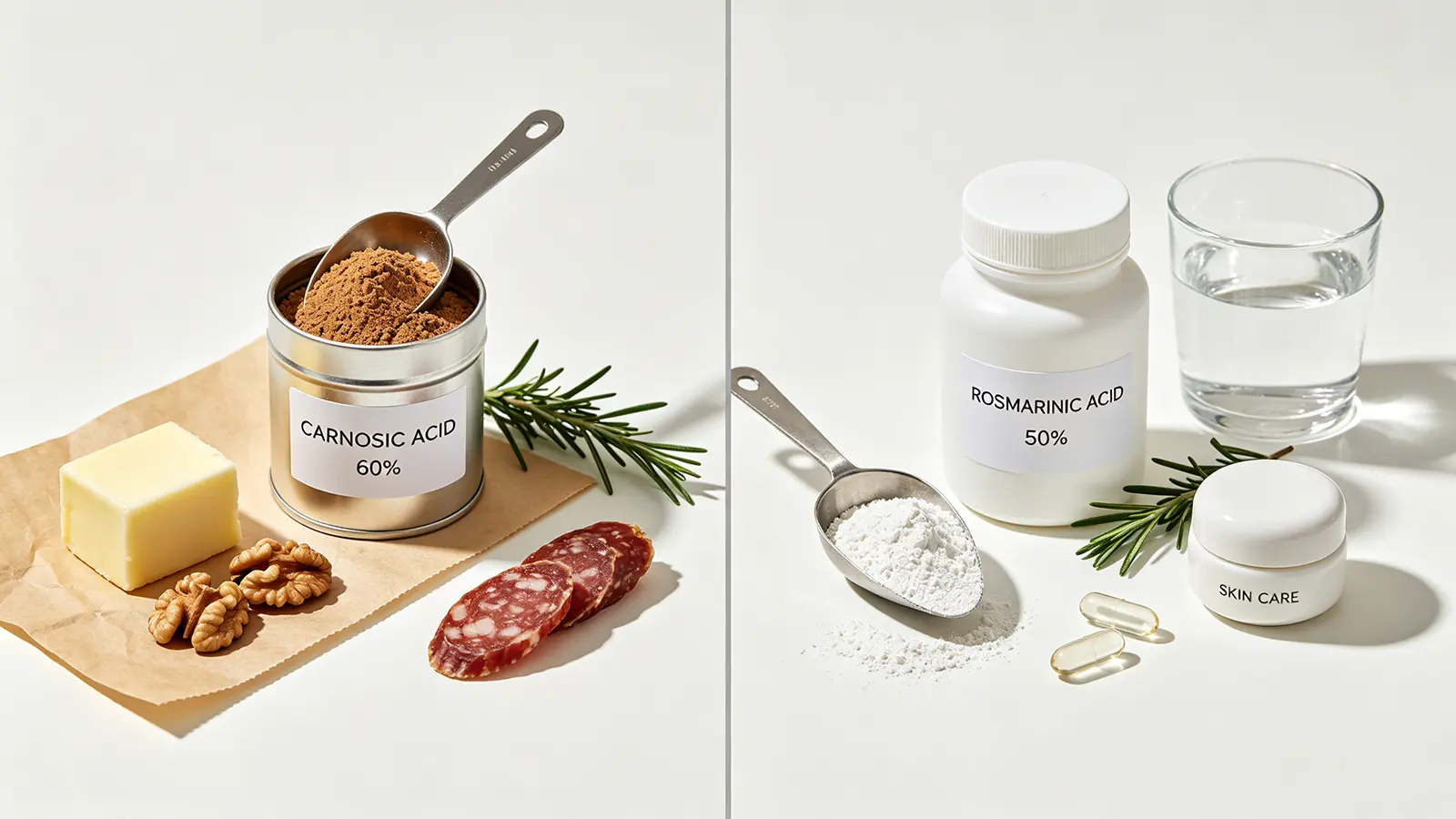
Carnosic acid is lipid-soluble, thermally stable, and the active compound behind rosemary extract’s function as a food antioxidant (E392). It works by intercepting free radicals in the fat phase — which is where oxidative spoilage actually happens. It’s what food manufacturers use to extend shelf life in oils, meat products, and snack foods.
Rosmarinic acid is water-soluble, more bioavailable orally, and the compound most studied for supplement applications — anti-inflammatory activity via NF-κB inhibition, antioxidant activity via Nrf2 activation, and immune-modulating effects in published preclinical research. It’s what goes into aqueous supplement capsules, functional beverages, and water-phase cosmetic formulas.
They are both present in rosemary, but they partition into different phases and serve different functions. A “rosemary extract” COA that doesn’t specify which compound is standardised tells you almost nothing about what you’re actually buying.
Structure and Chemical Properties
| Property | Carnosic Acid | Rosmarinic Acid |
|---|---|---|
| Chemical class | Phenolic diterpene | Hydroxycinnamic acid ester (caffeic acid + DHPL) |
| CAS number | 3650-09-7 | 20283-92-5 |
| Molecular weight | 332.4 g/mol | 360.3 g/mol |
| Solubility | Lipid-soluble; poorly water-soluble | Water-soluble; low oil solubility |
| Stability to heat | Good below 180°C; converts to carnosol above this | Moderate; degrades faster at high temperature[3] |
| Stability to light | Sensitive; store away from direct light | Sensitive; similar precautions required[3] |
| pH stability | Stable pH 3–7; degrades above pH 8 | Stable across wider pH range |
| Oral bioavailability | Moderate; improved with lipid co-administration | Good; absorbed in small intestine, rapid plasma appearance |
Different Mechanisms, Different Applications
Carnosic Acid: The Redox-Activated Antioxidant
Carnosic acid operates as what researchers call a “pro-electrophilic” compound — it exists in a relatively inactive form under normal conditions and becomes activated precisely when and where oxidative stress is occurring. When free radicals are generated in a lipid matrix (as happens during fat oxidation or during cellular oxidative stress), carnosic acid converts to an electrophilic form that activates the Nrf2/Keap1 transcriptional pathway, triggering upregulation of the body’s own antioxidant enzymes — glutathione S-transferase, NQO1, and HO-1.[1]
This on-demand activation mechanism has two practical consequences. In food applications, carnosic acid’s conversion to carnosol as it scavenges radicals actually generates additional antioxidant capacity — the degradation product is itself an active antioxidant, giving rosemary extract a sustained protective effect over storage time. In supplement applications, the same mechanism is the basis for carnosic acid’s studied neuroprotective properties: it activates cytoprotective pathways selectively in cells under oxidative stress.
Rosmarinic Acid: The Water-Phase Anti-Inflammatory
Rosmarinic acid works through direct radical scavenging and through inhibition of NF-κB signaling — the key transcriptional pathway that drives production of pro-inflammatory cytokines including TNF-α, IL-1β, and IL-6. It also activates Nrf2, but via a different upstream mechanism than carnosic acid. Its water solubility means it distributes into aqueous biological compartments effectively, which is why published research on rosmarinic acid covers a broader range of inflammatory conditions than carnosic acid research — from respiratory allergy models to skin inflammation to joint inflammation.[2]
For supplement applications, rosmarinic acid’s oral bioavailability is better than carnosic acid’s in simple formulations. It appears in plasma within 30 minutes of oral dosing in published pharmacokinetic studies. Carnosic acid benefits significantly from lipid-based delivery — phospholipid complexes or oil-based capsule formats improve its absorption substantially.
Which to Specify: Application Decision Guide
| Application | Specify | Grade | Reason |
|---|---|---|---|
| Food antioxidant / preservation (oils, fats, meat) | Carnosic acid | 10% or 60% HPLC | Lipid-soluble; E392-designated active; sustained protection via carnosol conversion |
| Anti-inflammatory supplement capsules | Rosmarinic acid | 50% HPLC | Better oral bioavailability in aqueous formula; NF-κB inhibition research base |
| Neuroprotective / antioxidant supplement | Carnosic acid | 60% HPLC | Nrf2/HO-1 pathway activation; lipid-based capsule enhances absorption |
| Functional beverages (water-based) | Rosmarinic acid | 10% or 50% HPLC | Water-soluble; distributes evenly in aqueous matrix |
| Cosmetic — oil phase serums | Carnosic acid | 60% HPLC | Lipid-soluble; antioxidant protection in oil-phase formulation |
| Cosmetic — water phase / aqueous serums | Rosmarinic acid | 50% or 98% HPLC | Water-soluble; tyrosinase inhibitory activity studied in published research |
| Research or pharmaceutical-adjacent (precision dose) | Rosmarinic acid | 98% HPLC | Highest purity; well-characterised pharmacokinetics |
Stability: What Both Compounds Have in Common
Both carnosic acid and rosmarinic acid degrade faster with increasing temperature and light exposure — this is documented in published degradation studies comparing the two.[3] Standard precautions apply to both: store away from direct light, in sealed containers, in cool dry conditions. For finished formulations, accelerated stability testing under your specific processing and storage conditions is always recommended.
One practical difference: carnosic acid’s conversion to carnosol during storage is not simply degradation — carnosol is itself an active antioxidant. This means that a carnosic acid extract showing some carnosol on the COA is not necessarily of lower quality; it reflects normal oxidative conversion. Rosmarinic acid’s degradation products do not carry the same secondary antioxidant activity.
Sourcing Both Compounds from Valeherb
Valeherb supplies carnosic acid at 10% and 60% HPLC, and rosmarinic acid at 10%, 50%, and 98% HPLC — all from Salvia rosmarinus leaf extract with HPLC-verified content and full third-party COA per batch. For food antioxidant applications requiring E392 documentation, carnosic acid-standardised grades are available with EU compliance documentation. See the full specifications and available grades on the Valeherb rosemary extract product page.
If your application involves food preservation specifically — selection between grades, EU maximum levels by category, and formulation tips — see Rosemary extract as a food preservative: E392 guide.
If you have any questions about Skin care, please refer to Rosemary Extract for Skin and Hair: A Cosmetic Formulator’s Guide
Frequently Asked Questions
Is carnosic acid the same as carnosol?
No — they are related but distinct compounds. Carnosic acid is the primary diterpene in fresh rosemary extract and acts as a precursor: under oxidative conditions it converts to carnosol, which is itself an active antioxidant. Both are lipid-soluble and both contribute to the antioxidant activity of rosemary extract. EU Regulation 1333/2008 defines E392 activity as the sum of carnosic acid and carnosol, recognising that both compounds are functionally active. A batch COA for carnosic acid extract may show both compounds; their combined content is what matters for E392 compliance.
Can I use rosmarinic acid extract for food preservation instead of carnosic acid?
Not effectively for fat-phase preservation. Rosmarinic acid is water-soluble — it doesn’t partition into the fat phase where lipid oxidation is occurring. For oil and fat preservation, you need a lipid-soluble antioxidant, which means carnosic acid-standardised extract. Rosmarinic acid can contribute antioxidant activity in the aqueous phase of emulsified products (dressings, sauces, marinades), but it is not a substitute for carnosic acid in fat-phase applications.
Why does a rosemary extract supplement specify rosmarinic acid but a food preservation extract specify carnosic acid?
Because the two applications need different things. Food preservation requires a lipid-soluble antioxidant that protects the fat phase — carnosic acid. Supplement applications generally target systemic anti-inflammatory and antioxidant effects via oral absorption — rosmarinic acid’s water solubility gives it better oral bioavailability in standard capsule formulations and its NF-κB inhibitory activity is well-characterised in published preclinical research. The two compounds come from the same plant but are optimised for different formulation environments.
What grades of carnosic acid and rosmarinic acid does Valeherb supply?
Valeherb supplies carnosic acid at 10% and 60% HPLC, and rosmarinic acid at 10%, 50%, and 98% HPLC. The 10% grades retain the full-spectrum rosemary extract profile including carnosol and other polyphenols. The higher-purity grades (60% carnosic acid, 50%–98% rosmarinic acid) are progressively purified toward the individual compound — suitable where precise dosing or a cleaner active profile is required. All grades are supplied with third-party COA and are available in B2B bulk quantities.
References
[1] Rashedinia M, Lari P, Abnous K, Shafiei SA. (2023). Neuroprotective effects of carnosic acid: insight into its mechanisms of action. Molecular Neurobiology. 2023;60(4):2011-2027. doi: 10.1007/s12035-022-03175-y
[2] Luo C, Zou L, Sun H, Peng J, Gao C, Bao L, Ji R, Jin Y, Sun S. (2020). A review of the anti-inflammatory effects of rosmarinic acid on inflammatory diseases. Frontiers in Pharmacology. 2020;11:153. doi: 10.3389/fphar.2020.00153
[3] del Baño MJ, Lorente J, Castillo J, Benavente-García O, del Río JA, Ortuño A, Quirin KW, Gerard D. (2003). Phenolic diterpenes, flavones, and rosmarinic acid distribution during the development of leaves, flowers, stems, and roots of Rosmarinus officinalis. Antioxidant activity. Journal of Agricultural and Food Chemistry. 2003;51(15):4247-4253. doi: 10.1021/jf0300745
Jonathan
Content Editor, Valeherb. Specializing in botanical ingredient science communication for B2B nutraceutical and functional food markets.
This content is for informational and educational purposes only. Valeherb supplies raw botanical ingredients to B2B customers; it does not sell finished consumer products. © 2026 Valeherb